
The Australian Press Council upheld a complaint against The Sydney Morning Herald and The Age yesterday regarding a Cathy Wilcox cartoon published shortly after the Bondi Beach terrorist attack.
The ruling determined that the image incorporated an antisemitic stereotype.
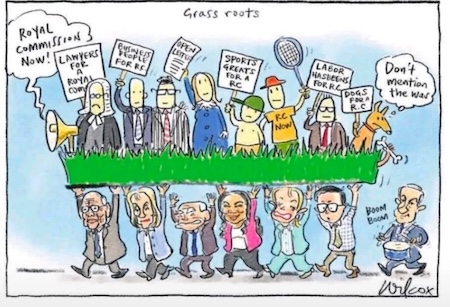
The cartoon, titled “Grass roots”, was published on 7 January 2026, less than a month after the 14 December 2025 stabbing and shooting attack at Bondi Beach during a Hanukkah celebration, which killed 15 people and injured dozens more.
It depicted a group demanding a royal commission, with placards from various sectors such as “Business People for RC”, “Lawyers for a Royal Com”, “Sports Greats for a RC” and “Labor Has Beens for RC”. Prominent figures, including Sussan Ley, Jacinta Price, John Howard, Jillian Segal and Rupert Murdoch, were shown in the foreground carrying a strip of grass overhead. On the side, a figure resembling Israeli Prime Minister Benjamin Netanyahu was depicted beating a drum labelled “Boom Boom”.
The complaint contended that the illustration drew on familiar antisemitic motifs by implying that Jewish individuals were secretly directing what was portrayed as a grassroots campaign for an inquiry. It also suggested the cartoon undermined the legitimate concerns of those affected by the attack, by framing the push for a royal commission as driven by external manipulation rather than the tragedy itself.
Nine Entertainment defended the work as commentary on the swift politicisation of calls for a royal commission, which it viewed as an attack on Prime Minister Anthony Albanese. The company explained that the title “Grass roots” was meant ironically, highlighting “astroturfing” where organised political efforts are disguised as spontaneous public action. It noted that Netanyahu was included due to his public criticism of Albanese’s recognition of Palestine, in which he claimed it had added fuel to antisemitic tensions.
Nine acknowledged the distress caused, especially to Jewish readers, and responded by publishing apologies, reader letters and arranging meetings between senior editors and Jewish community representatives.
Jewish organisations criticised the cartoon soon after its release. The Jewish Community Council of Victoria contacted editors on the day of publication, urging its removal and a public apology. The group argued that the image evoked notions of a coordinated “Zionist lobby” controlled by Israeli leaders.
Jewish leaders strongly condemned the cartoon at the time. Jeremy Leibler, president of the Zionist Federation of Australia, said it “could have been published in Der Stürmer”, referring to the pro-Nazi newspaper.
Arsen Ostrovsky, a human rights lawyer and survivor of the Bondi attack who was shot in the head, described it as “hard to see this as anything but an unadulterated form of Jew-hatred”.
Alex Ryvchin, CEO of the Executive Council of Australian Jewry, wrote that the cartoon portrayed “Olympic athletes, the captains of industry, our top jurists, the families of the dead and the majority of ordinary Australians who favour a royal commission” as “mindless drones” doing the bidding of others, adding that the victims “were slaughtered because of Israel and any deviation from this belief makes you a stooge of the Zionists”.
On 11 January, Nine issued an apology, stating that Wilcox had aimed to highlight the rapid politicisation of the Bondi attack but recognised the deep offence it caused.
The cartoon also sparked a debate on free speech. The Media, Entertainment and Arts Alliance supported Wilcox, describing the piece as legitimate political satire on the royal commission push and emphasising that cartoons should retain the right to provoke.
In its decision, the Press Council noted that cartoons generally receive a broad scope as expressions of opinion, often relying on exaggeration and provocation. However, this freedom has limits, especially when content risks reinforcing racial, ethnic or religious stereotypes.
The council determined that the image portrayed public figures bearing a supposed grassroots effort, while Netanyahu, identified as Jewish and Israel’s leader, directed proceedings from the side by beating the drum. It concluded that the cartoon “encodes the antisemitic trope that Jewish people secretly control or manipulate global events, governments, financial systems, or the media”.
The ruling found the publication was likely to cause significant offence, distress and prejudice, particularly among Jewish communities. Although it recognised the public interest in scrutinising political motivations behind the royal commission calls, this did not outweigh the harm of depicting the campaign as orchestrated by Netanyahu.
The Press Council ruled that The Sydney Morning Herald and The Age breached General Principle 6 by not taking adequate steps to prevent material contributions to substantial offence, distress or prejudice.
It welcomed Nine’s apologies and plans to engage with Jewish leaders, while stressing the importance of stronger editorial processes for handling sensitive topics and their effects on communities.
The Press Council did not identify the complainant in its published adjudication, which refers only to “Complainant” in accordance with its usual practice in some cases.
Michele Goldman, CEO of the New South Wales Jewish Board of Deputies, commented: “The cartoon not only relied on imagery echoing long-standing antisemitic tropes, it also diminished the broad and genuine support for a Royal Commission – across the board from sportspeople, political leaders and the legal and medical professions – by implying that Australians calling for an inquiry were being manipulated.
The Council has rightly recognised that the cartoon crossed a line and reinforced harmful stereotypes that have fuelled hatred against Jewish people.
We welcome the ruling that the publication failed to take reasonable steps to avoid causing substantial offence, distress or prejudice.”
The ruling was also welcomed by the Australia/Israel & Jewish Affairs Council.
AIJAC executive director Dr Colin Rubenstein said the decision recognised the distinction between legitimate criticism of Israel and antisemitic imagery.
“The Press Council’s ruling is an important acknowledgement that there is a clear distinction between legitimate criticism of Israel’s policies or Prime Minister Benjamin Netanyahu, and imagery that draws upon longstanding antisemitic tropes, such as portraying Jewish figures as manipulative actors exerting hidden influence,” he said.
“At a time when antisemitism is at record levels in Australia, especially after the Bondi attack, media organisations have a particular responsibility to ensure they do not perpetuate harmful stereotypes that have historically fuelled both prejudice and violence against Jews.”
Dr Rubenstein noted that Nine had apologised following the controversy and accepted that the cartoon had caused offence.
“We acknowledge that The Age and Sydney Morning Herald showed they take these responsibilities seriously in the aftermath of the Wilcox cartoon controversy, accepting it was divisive and offering an apology for the hurt and offence it caused in an editorial,” he said.
He said the ruling carried broader implications for Australian media as the Royal Commission into Antisemitism and Social Cohesion prepares to examine the role of the media.
“With the media set to be a focus of the Royal Commission into Antisemitism and Social Cohesion, this Press Council decision serves as a timely reminder of how critical it is for all Australian media outlets to continue to maintain proper editorial standards, and how failures in this regard can have real-world consequences for social cohesion, public trust and safety.”
Cathy Wilcox herself should suffer consequences.
It’s quite extraordinary that so soon after the Bondi massacre she felt free to depict what she has in this obscene cartoon and that 9 Entertainment was okay with it.
I agree.What now?…….
OK, so what happens NOW?
What is their PUNISHMENT?
If saying SORRY is ALL that it takes, what guarantees do we have that they will not continue to Publish this sort of Antisemitic material ??
And then say SORRY AGAIN!