
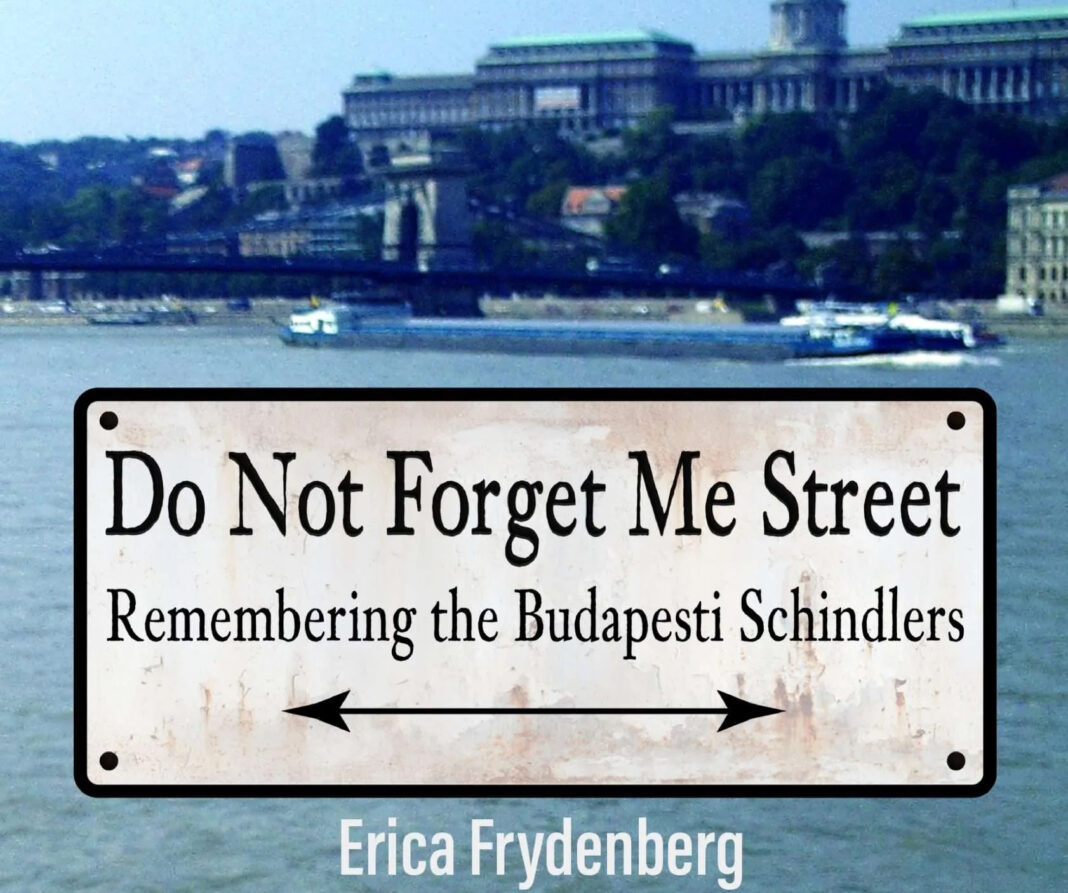
Good men in bad times. Book review by Dr Anne Sarzin
 Psychologist and author Erica Frydenberg has invented an original and historical collective noun—’Budapesti Schindlers’. This aptly describes a band of brave men who risked their own lives in Budapest and further afield to save Jews during the Second World War, the subject of her investigative book Do Not Forget Me Street.
‘Budapesti Schindlers’ is an accurate, profound and evocative descriptor that conjures up a group of courageous humanitarians, all cast in the mould of Oskar Schindler, whom most of us got to know through Spielberg’s 1993 epic film drama, Schindler’s List, an historic saga based on Thomas Keneally’s book Schindler’s Ark. Wielding her book’s title in this way, Frydenberg taps into the zeitgeist that the very name of Schindler evokes so powerfully. She endows these wartime heroes with Schindler’s traits of gambling, risk-taking, courage, determination and perseverance. These men put their own lives on the line again and again, and did the best they could for others trapped, tortured and threatened with death during the genocidal Nazi and fascist Arrow Cross regimes throughout Hungary and, in particular, during their deadly incursions among the Jews in Budapest.
Frydenberg’s probing research into the lives, motivations and deeds of the Budapesti Schindlers is intimately intertwined with her personal quest to learn more about her own family, in particular her mother’s brother, Uncle Nandor Eichel. She felt driven to decode the enigmas prompted by the lacunae in his life story, the tantalising gaps in his wartime activities in Budapest, which were blanketed with a consensual family silence throughout the post-war decades.
Frydenberg suspected, but had never confirmed definitively, that Nandor Eichel worked closely with the humanitarian giants dominating the Budapest landscape at that time—especially two diplomats, Swiss Vice-Consul Carl Lutz and Swedish Attaché Raoul Wallenberg. There was also Schindler himself, credited with saving the lives of his 1200 Jewish workers, who visited Budapest frequently. He had ongoing contact with the Jewish Relief Organisation in the city, who enlisted his support to rescue known activists and also trusted him with funds for those incarcerated in Polish labour camps. A charismatic figure among these giants was Rezso Kasztner, of whom Schindler said, ‘His actions remain unsurpassed’. In an attempt to save Hungary’s Jews, Kasztner negotiated over a prolonged period with Eichmann, a testing and turbulent interaction that demanded an outwardly calm and controlled demeanour in the face of Eichmann’s bullying. Dedicated to saving Jews, Kasztner clashed with Miklos Moshe Krausz, the Jewish Agency’s man in Budapest, who was heroic in his own bureaucratic way, whom Frydenberg describes as a man who stuck to the rules, so as not to offend or alienate the British Mandatory Authority.
There were also several other peripheral, shadowy but extremely significant humanitarian figures, some with subsequent family histories in post-war Sydney—such as, Frydenberg’s uncle Nandor Eichel, who later qualified as a medical doctor and practised in Bondi Junction; and Janos Farkas (aka Pentek), a member of the Hungarian resistance, who memorably rescued 50 people from Gestapo headquarters known as the House of Terror in Budapest. Farkas was acknowledged as Wallenberg’s right-hand man and was the last to see and speak with him before he disappeared into the Soviet headquarters of the occupying Russian forces. Swedish Embassy Secretary Per Anger, working in a close partnership with Raoul Wallenberg, issued protective Swedish documents that gave the recipients protection as citizens of a neutral country. Frydenberg tirelessly establishes the complex linkages between all these men in an engrossing blend of hard facts and intuitive speculation.
Frydenberg is judicious and measured in her delineation of her protagonists’ heroism, careful to avoid overt hagiography. As a psychologist, she understands better than most what huge challenges can do to human beings—the flawed complexity of human nature revealed in disparate responses by men from very different backgrounds, who nevertheless were able to unite in their mission to free fellow human beings from subjugation and death in the direst of circumstances. All this undertaken while relentless Nazi transports from Hungary reduced the Hungarian Jewish population from 825,000 in 1941 to a shattered remnant of 230,000-255,000, the majority of whom owed their lives to the Budapesti Schindlers, that gallant band who disregarded their own safety and survival to secure the liberation of others.
Frydenberg brings the full strength of her professional knowledge and experience to bear on her analysis of historic events and the discoveries she makes in her multiple efforts and journeys, from the unknown to the known, encapsulating her own family story and the wider national tragedy of Hungarian Jewry. Her chapter on ‘Philosophy, psychology and silence’ explores perceptively how history is recorded and accepted; and she recommends the pursuit of ‘forensic research’ that shines a light on the past, increasingly important in an age of Holocaust denial. She explores with compassion the role of silence among survivors of those times and especially across the generations in her own family. She acknowledges empathically, ‘The trauma of those postwar years and the earlier relentless, omnipresent fear of Nazi occupation and the acute trauma of facing the Arrow Cross death squad, believing that one’s last moments would be on the banks of the Danube, would have taken its toll on my father’.
A feature of this book is Frydenberg’s ability to ask questions, all of which are relevant to her exploration of a nation in thrall to evil. She asks pertinently why some men seek recognition while others seek the shadows of anonymity; who the complex people were with whom her family were linked so intimately; who gets credit for what in the historic overview; and, importantly, what factors help us to survive and thrive and achieve the best outcomes for a good life despite past traumas.
While, unfortunately, an index has been omitted, the author includes an excellent chronology adapted from Randolph Braham’s book, as well as a glossary and useful endnotes. Although there is a measure of repetition of facts in this story, it would seem an inevitable consequence of the need for explanatory links between the family’s contemporary journey to Budapest and the historic narrative that serves as a poignant backdrop. There are references to children and grandchildren that highlight the ongoing significance of this book for today’s descendants of these Budapesti Schindlers; further highlighting the exemplary way in which understanding of the heroism of the past can be passed down as a precious entity to be cherished and nurtured by successive generations, as Erica Frydenberg herself has demonstrated so conclusively.
Do not forget me street: Remembering the Budapesti Schindlers
By Erica Frydenberg
Ginninderra Press, Bentleigh, Melbourne
2026