
Jews have two annual holidays that centre around introspection.

Obviously, one is Yom Kippur, the Day of Atonement, when members of the community are supposed to atone for their sins for a 10-day period beginning with Rosh Hashanah, when they perform a cheshbon nefesh or spiritual “accounting of their souls.” The other is Tisha B’Av.
The traditional day of mourning for the destruction of the two holy Temples, as well as so many other tragedies inflicted on the Jewish people up until and including the Holocaust perpetrated by the German Nazis, is observed not only in sorrow for those woes. Rather, the focus has traditionally been on how disunity and sinat chinam, or “baseless hatred,” hastened the destruction of the Second Temple in Jerusalem during the Roman siege that destroyed the city and the religious centre of Jewish life in 70 C.E.
Mindless hatred
For good reason, that lack of unity and murderous hatred has been held up as a fatal flaw in Jewish life—one that should be avoided at all costs. Some 1,956 years later, in 2026, that more or less still holds. As important as it is to avoid that sort of mindless internal strife in our own discourse and politics, we have another related, though distinct, problem to deal with. And that is a refusal on the part of many Jews to recognise that while we may have big differences within our community, both inside Israel and in the Diaspora, our situation has something in common with our forebears of two millennia ago: We are under siege.
It may not be entirely in keeping with the way Tisha B’Av has been discussed for most of the past 2,000 years. Still, it is necessary to remind contemporary Jewry that a focus on introspection is significant, but not in and of itself entirely adequate to the current situation.
The reflexive impulse to assign blame to ourselves for some of the greatest catastrophes of Jewish history served a religious and pedagogical purpose during the many centuries of exile and powerlessness. What happened inside Jerusalem as Roman legions laid siege to the city validated that thesis.
The history as we know it lines up with the traditional spiritual interpretation of the event.
The defenders of Jerusalem were split into factions that waged war on each other inside the city, even as the Romans were steadily working to conquer them and lay waste to all they held sacred. The Jewish group known to us as the Zealots was particularly reprehensible. Their single-minded belief in their own rectitude led them to act as if fighting their fellow Jews was as important as the struggle against the foreign enemy. They apparently thought that it was imperative to force the population to fight to the death, rather than hang on and hope for some sort of peaceful settlement. That led them to burn the city’s food supply. That insane act hastened the city’s fall and paved the way for mass slaughter, the burning of the Temple and the loss of Jewish sovereignty (notwithstanding the brief respite during the Bar Kochba revolt 62 years later) for 20 centuries.
A survival strategy
Unlike other peoples who succumbed to despair and ultimately disintegrated under the impact of foreign conquest, the Jews survived. They did so not just because of their stubborn tenacity, but by constructing an identity that focused on faith, the Torah and scriptures, peoplehood and longing for return to the land of Israel. And they interpreted their sacred writings and history in such a way as to see their fate as a result of violations of their covenant with God.
It was a brilliant survival strategy and faithful to longstanding understandings of Jewish religious law. It also promoted a belief that their redemption and hold on their land was conditional on their observance and good behaviour.
A strictly geostrategic analysis of what happened in the Great Jewish Revolt that ended in the cataclysm of 70 C.E. might focus more on the madness of a small, largely powerless people picking a fight they couldn’t win against the greatest superpower on the planet. Yet the Jewish frame of reference about this chapter of history has instead looked inward. On Tisha B’Av, we think more about the fatal consequences of disunity than about how we might have dealt better with hostile outside forces bent on dominating and then destroying Jewish sovereignty.
With the third year of the war that followed the Oct. 7, 2023 Palestinian Arab assault on Israel drawing to a close, there are important benefits to focusing on our internal conflicts. It’s a reminder that the greatest mass slaughter of Jews since the Holocaust was enabled by internal strife over judicial reform that threatened to paralyse Israel in the 10 months before the Hamas-led attacks in southern Israel.
Sadly, it’s far from clear that everyone who helped create and then escalate that situation is willing to draw the proper conclusions from what happened during that period of intense political strife. One can assign some of the blame to Prime Minister Benjamin Netanyahu and his allies because of their decision to try and reform the country’s broken and politicised judicial system, and restore balance between it and the democratically elected Knesset. But fingers can also be pointed at the forces that lost the election in November 2022—that brought Netanyahu back into the prime minister’s office—and that were ready to bring down the state and undermine its defences as a result. Their stand in favour of maintaining the Israeli Supreme Court’s out-of-control power was not a defence of democracy. If anything, it was the opposite. It was a last-ditch effort to maintain a grip on the last institution of government that remained in their control.
One can have a legitimate debate about the virtues of those two positions. But what both sides of the judicial-reform debate seemed to forget was that for all of Israel’s economic growth, military power and diplomatic successes, such as the 2020 Abraham Accords, it remained under siege. The Islamist terror regime in Iran—and its Hamas, Hezbollah and Houthi terror proxies—were ready to strike.
And strike they did.
A post-Oct. 7 crisis
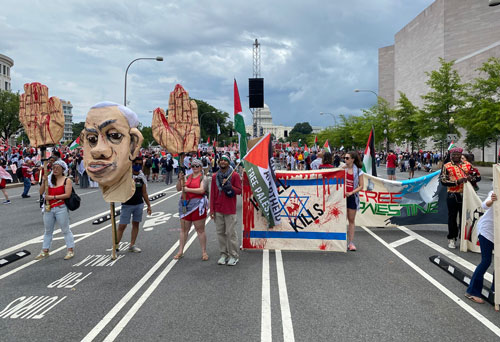
The same lesson applies to post-Oct. 7 Diaspora Jewry. Most American Jews were unprepared not just for the task of rising to the defence of an Israel under attack. More than that, they were shocked to find themselves in the cross-hairs of an unprecedented surge of visceral hatred in the United States. That was set off by the delegitimisation of the State of Israel, embraced by both the left and far right.
Jews in the United States and elsewhere were confounded by the fact that they and their children were now being targeted for intimidation and even violence at institutions, especially colleges and universities, where they once felt most at home. What they were experiencing was something that had been enabled by the rise of toxic left-wing doctrines like critical race theory, intersectionality and settler-colonialism. Many Jews had either cheered or merely tolerated these ideas as the price of staying in sync with liberal political fashion, or thought they were concepts that only conservatives or supporters of President Donald Trump opposed. Nevertheless, opposing Trump and conservatives on other issues, as most of them did, granted them no exemption from the label of “white” oppressor that the left now mendaciously applied to Jews and Israel.
They were equally appalled by the way the same forces that had seemingly conquered not merely academia, but mainstream media and culture, mimicked propaganda that validated blood libels about Israel committing “genocide” in Gaza. And they were even more upset when they realised that they, too, would be judged as guilty of “genocide” if they didn’t abandon even minimal support for the Jewish state.
Nor were they unaware that a rise in incidents of violence, including murder, against Jews was being enabled by a society and political leaders willing to tolerate chants calling for Jewish genocide (“From the river to the sea”) and terrorism against Jews everywhere (“Globalize the intifada”). There was no escaping the fact, at least for those who were willing to acknowledge reality, that the anti-Zionism being normalised by the left and the far-right was indistinguishable from antisemitism.
Opposition to Israel—and the repetition of heinous and false charges against its people—is now not merely normative American discourse. Fealty to this stand is the organising principle of left-wing and even liberal American politics, as the Democratic Party primaries across the nation this year have shown.
With New York City Mayor Zohran Mamdani—the man in charge of the largest Jewish city outside of Israel—not merely calling for the arrest of Netanyahu on false war-crimes charges but making speeches elaborating on the “genocide” blood libel, the stakes in this debate aren’t limited to Israelis. New York’s Jews, as well as many in cities throughout the country, are now on notice that their claim to equal status in the public square is in danger if they keep faith with their religion and traditions, of which a powerful connection to the land of Israel is an integral part of their identity.
In other words, like Israelis, who remain in peril from terrorist states and their allies, Jews elsewhere are also under siege.
In keeping with the traditional understanding of Tisha B’Av, this should serve as a reminder to avoid speech and actions that create unnecessary and harmful divisions within their communities that aid and abet those seeking to demonise and harm them.
The imperative to fight back
It also requires them to understand that they cannot go on pretending as if the events of the last three years never happened. Joining the mobs chanting antisemitic slogans might grant them at least temporary immunity from attacks and inclusion in circles where Jew-hatred is now the price of admission. But it does so only at the cost of their Judaism and Jewish peoplehood.
The crime of the Zealots was in undermining and harming those who, though holding different beliefs, were fighting alongside them, in effect ignoring or downplaying the genocidal threat coming from outside Jerusalem.
So, on this Tisha B’Av, the focus must not only be on refraining from baseless hatred, but also on the necessity of recognising that Jews are under attack and must fight back with every tool that democracy offers them. Without engaging in dehumanisation, they should engage in spirited debate against those who are enabling this state of affairs by echoing the lies of the antisemites.
The lessons from the siege of Jerusalem remain valid: not undermining the defence of the community with efforts that make everyone less safe. Still, it doesn’t oblige us to be silent about those who are aiding and abetting hate and violence directed at Jews and Israelis.
We can debate how best to defend ourselves. But denial about the war being waged against the Jewish people by those who are following in the footsteps of the Romans and Nazis is as unacceptable and potentially destructive as the worst kind of harmful speech.
Jonathan S. Tobin is editor-in-chief of JNS. Follow him: @jonathans_tobin.