
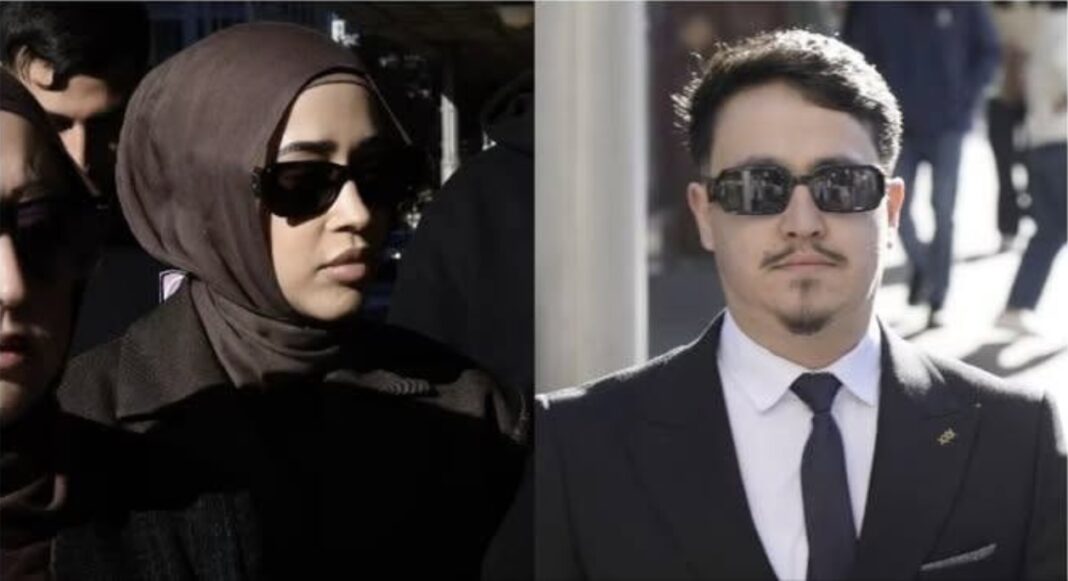
The decision to exclude the viral Bankstown nurses video is a serious setback for the prosecution.
However, it is not a vindication of the accused nurses, and it does not erase the seriousness of the alleged conduct.
Ahmad Rashad Nadir and Sarah Abu Lebdeh, who were working as nurses at Bankstown-Lidcombe Hospital when the exchange occurred, have pleaded not guilty to charges arising from an online conversation with Israeli content creator Max Veifer (whose legal name is Max Ilinski). The video, which spread widely online, allegedly showed the pair making menacing and offensive comments about Israeli patients.
Nadir faces a charge of using a carriage service to menace, harass or offend. Abu Lebdeh faces two charges: threatening violence against a group, and using a carriage service to menace, harass or offend. A third charge against her — using a carriage service to threaten to kill — was dropped by prosecutors in September 2025. Both deny the remaining charges.
Judge Michael McHugh has ruled that the video and other recordings of the conversation cannot be used as evidence in their trials.

The ruling has angered many people, particularly in the Jewish community. That reaction is understandable. The video was not only evidence in a criminal case. It became a public record of an exchange that appeared to strike at one of the most basic expectations in any civil society: that patients can trust health workers to treat them safely and without prejudice.
But the legal issue before the court was narrower.
The court was not asked to decide whether the alleged comments were moral, acceptable or antisemitic. It was asked to decide whether the recording was lawfully obtained and, if not, whether it should still be admitted as evidence.
That distinction matters.
Under NSW law, private conversations generally cannot be recorded without the consent of all parties, except in limited circumstances. The Surveillance Devices Act 2007 is based on the principle that people are entitled to privacy in private conversations, even when those conversations are offensive, ugly or disturbing.
That is not a special protection for people accused of wrongdoing. It is a general rule that applies to everyone.
The defence argued the online exchange – which took place on Chatruletka, a video-chat platform also known internationally as ChatRoulette, which randomly connects strangers – was a private conversation and that the recording was made without consent. The Crown argued the material should still be admitted, including because of the platform used and the cross-border nature of the exchange.
The judge accepted the defence argument and excluded the video. According to reporting on the ruling, most of Judge McHugh’s reasons were suppressed, so the full legal reasoning is not publicly available.
What is clear is that the judge found the video evidence should be excluded from the trials of both accused. He said improperly obtained evidence should only be admitted if the desirability of admitting it outweighed the undesirability of allowing evidence obtained in that way.
That does not mean the court found nothing happened. It means the court found this particular evidence could not be used.
One issue in the case was that the conversation was recorded by a person outside Australia, while the accused were in Australia. Because the prosecution is in NSW, the court still had to apply the relevant Australian law.
Another issue was what happened after the recording was made. The footage was not provided only to authorities. It was also posted online, where it spread quickly across social media. Whether a different course of action would have changed the legal result is uncertain, but it is relevant to how courts assess purpose, necessity and fairness.
This is why comparisons with dashcam or CCTV footage are limited.
Dashcams usually record public roads. CCTV usually records public or semi-public areas — shops, workplaces and public buildings — where people have a lower expectation of privacy.
A private online conversation raises different legal issues because the question is whether those involved could reasonably expect the exchange to remain private.
Police body-worn cameras are different again. Police use those cameras under specific statutory powers and procedures. If those procedures are not followed, footage can also face legal challenge.
The law does not turn on whether the content is hateful, whether the public is outraged or whether the accused are sympathetic. It turns on whether the evidence was obtained in a way the law permits and whether admitting it would be fair.
There is an important exception under NSW law. A recording may sometimes be admitted if it was reasonably necessary to protect a person’s lawful interests.
Courts have considered that exception in cases involving abuse, coercion, threats or situations where covert recording was the only practical way to preserve evidence. One example often cited is DW v R, a 2014 NSW Court of Criminal Appeal decision in which a 14-year-old girl secretly recorded a conversation with her father, who was later convicted of indecent assault. The court found the recording was lawful because it was made to protect her lawful interests — a narrow category tied to genuine personal danger, not a general right to record and publish private conversations.
But the exception is narrow. It is not a general licence to secretly record and publish private conversations whenever a person believes the material may later be useful to police, the media or the public.
The court must decide whether the facts justify the exception. In the Bankstown case, based on reporting of the ruling, the judge found the threshold was not met.
That outcome may feel like form defeating substance. But in law, process matters. Rules about evidence exist to prevent arbitrary decision-making. The same rules that can frustrate a prosecution in one case may protect a victim or an accused person in another.
It is important to say this clearly: the ruling is not judicial antisemitism. It is not a moral endorsement of what was allegedly said. It is not the court absolving the accused.
It is a ruling about whether a specific piece of evidence met the statutory and evidentiary threshold for trial.
The judge’s role is not to punish people because the public is disgusted. It is to decide whether evidence can properly go before the court.
That may sound cold, but it is the structure of the criminal justice system. Judges are meant to be insulated from public anger so they can apply the law consistently, even when the allegations are vile.
In a case involving alleged antisemitic comments by hospital staff, the temptation to read every adverse ruling as institutional failure is real. But the legal system was not asked to approve the conduct. It was asked to apply rules that exist so decisions are not made on outrage alone.
The video was powerful, but it was never the whole case.
The prosecution may still rely on the witness who was on the call, any admissible statements, admissions, surrounding evidence, contemporaneous records and explanations given by the accused.
A criminal case can be proved without a video if the remaining evidence is strong enough.
That is why the public should not confuse a procedural setback with the collapse of the prosecution.
The core allegation remains serious: that two people employed as nurses at a public hospital spoke in a way that was menacing, offensive and threatening to Jewish people and Israeli patients.
Excluding the clip does not erase what was allegedly said. It changes the evidentiary path by which the court will assess the case.
The public and employer response also remain part of the story. The pair’s conduct was not treated as a harmless misunderstanding by the institutions responsible for them. Both were stood down from their NSW Health positions after the footage emerged and their nursing registrations were suspended. Those consequences do not decide the criminal case, but they show the seriousness with which the matter was treated outside the courtroom.
Jewish Australians are not overreacting when they say this case hit a nerve.
It is not only that the alleged comments were antisemitic. It is that they were allegedly made by health workers, in a hospital context, about the treatment of Israeli patients.
That cuts directly to trust.
Trust in medical settings is not abstract. For Jews, especially after the rise in antisemitism since October 7, the case confirmed a fear many have been carrying quietly: that they may not always be safe or treated with dignity in institutions that are meant to protect them.
That is what makes the matter larger than its legal mechanics.
It is not simply about two people allegedly making vile remarks. It is about whether Jews can walk into hospitals and feel safe, respected and protected.
That social wound will not be closed by one ruling, whatever the final result.
The danger now is not only the exclusion of the video. It is the temptation to treat the ruling as if it changes the substance of what occurred.
It does not.
The law has not said the comments were acceptable. It has not said the accused are innocent. It has said this specific recording cannot be used in the trial.
The prosecution can still proceed if the remaining evidence supports the charges. The court can still reach a serious outcome if the admissible evidence proves the case.
That is why calm matters. Not passive calm. Not silence, surrender or forgetting. Disciplined calm.
The community can remain outraged about the alleged conduct while being precise about the legal process.
The focus now should be on the remaining evidence, the witness, any admissions, the broader context and the trial ahead.
The video may be out, but the case is not over.
The horror of what was allegedly said has already done its damage. No evidentiary ruling can undo that.
What remains is for the legal process to run its course. If the facts are proved, the absence of one video clip will not necessarily save the accused.
Elliot Vesely is a Sydney-based journalist who covers topics from sport, geopolitics, and diaspora affairs.