
Labor has adopted a more critical policy platform on Israel without change, even after Australian Jewish leaders and Israel’s ambassador warned that it drops key conditions for Palestinian statehood and puts too much blame for the conflict on Israel.
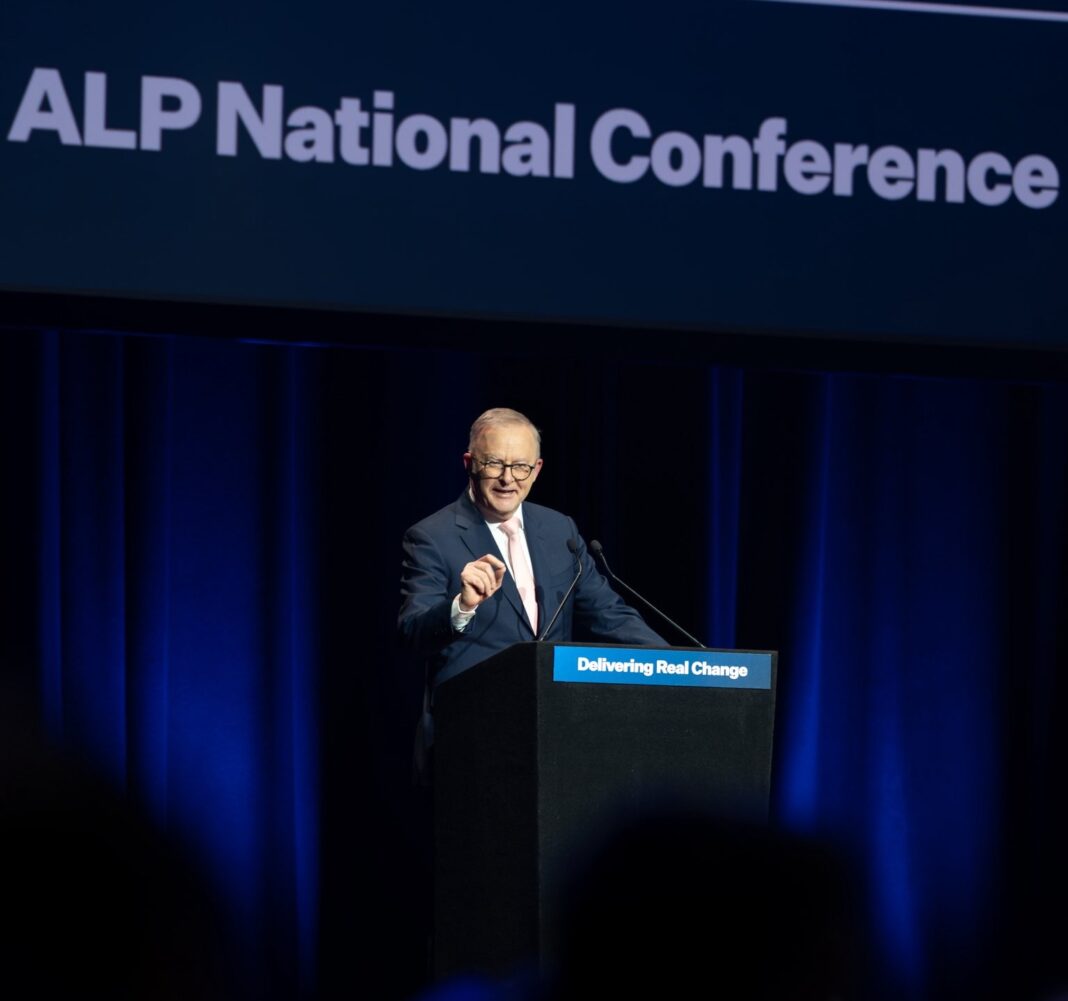
Prime Minister Anthony Albanese closed the three-day national conference in Adelaide on Saturday by describing it as the most united Labor gathering he had attended since joining the party in 1979.
“This is the most purposeful and united national conference I have attended since I joined the Labor Party back in 1979,” Albanese told delegates.
“At a time when the media landscape is fragmented, the political conversation is more polarising … we have demonstrated that it is still possible to disagree respectfully, to resolve differences.”
The platform was endorsed without a floor debate on competing proposals concerning Israel, Hamas and the Palestinian Authority.
Labor MPs Josh Burns, who is Jewish, and Basem Abdo, who is of Palestinian background, addressed delegates in support of the negotiated wording.
Abdo said the platform reflected Labor’s belief in international law and social justice.
“For generations of Palestinians living under occupation, so many of those things we take for granted remain out of reach,” he said.
“Every one of us in this movement believes in social justice. It is the foundation of Labor. It shapes our platform and it guides our movement.”
Ed Husic’s resolution accusing Israel of genocide and apartheid was not debated after it failed to secure a seconder. Husic called the outcome a “big disappointment” and said too much effort had been devoted to stopping debate rather than allowing it.
The adopted platform says Israel must comply with its obligations as an occupying power and increases Labor’s criticism of settlements, settler violence and proposed annexation in the West Bank.
“Labor opposes the annexation of Palestinian territory and wants Israel to bring its illegal settlement activity and the occupation to an end, to see security for Palestine, for Israel and for the region,” the policy states.
It also urges the federal government to prevent support for settlement activity or extremist settler violence and to implement further action and sanctions as necessary.
The platform condemns terrorism and violent extremism, including acts committed by Hamas, and supports the release of hostages. However, it does not repeat the conditions Albanese previously attached to Australia’s recognition of a Palestinian state.
Those conditions included Hamas having no role in Palestinian government, reform of the Palestinian Authority, an end to prisoner payments, changes to education, democratic elections and demilitarisation.
Before the conference, Executive Council of Australian Jewry co-CEO Peter Wertheim said that Labor’s draft did not reflect the government’s stated position on Hamas or the commitments it had received from the Palestinian Authority.
“Australia’s Prime Minister and Foreign Minister have repeatedly acknowledged that Hamas can have no role to play in any Palestinian government,” Wertheim said.
“But apparently the ALP National Conference cannot quite bring itself to acknowledge it. The best it can do is refer to Hamas, in passing, as a terrorist group.”
Wertheim said the platform ignored the lack of progress by the Palestinian Authority towards meeting its commitments to reform governance, end prisoner payments, change school curricula, demilitarise and hold elections.
“Instead of providing an honest assessment of the leadership on both sides of the conflict, the draft platform regurgitates the same old one-eyed obsession with blaming Israel,” he said.
He said failing to hold the Palestinian Authority accountable for its conduct and governance failures would hold back Palestinians rather than assist them.
The Zionist Federation of Australia said Labor risked singling out Israel while lowering the standards expected of Palestinian leaders.
The ZFA said criticism of Israel was legitimate but warned that double standards arose when the Israeli-Palestinian conflict was treated as uniquely important while Palestinian obligations were softened or omitted.
It said the government had justified recognition of a Palestinian state by referring to commitments from the Palestinian Authority to reform governance, end prisoner payments, change education, hold elections, demilitarise and recognise Israel’s right to exist.
“For the ALP to now omit or dilute the very commitments the Government relied upon to justify recognition would compound that mistake,” the ZFA said.
“It would send the wrong message to Hamas, to the Palestinian Authority and to all those who understand that a genuine two-state outcome requires reform, demilitarisation, recognition of Israel and an end to terror.”
AIJAC executive director Dr Colin Rubenstein said Hamas disarmament and Palestinian Authority reform were central requirements for any credible peace process, not secondary issues.
He said Labor’s wording imposed detailed demands on Israel while containing no equivalent demands on Palestinian leaders.
“There can be no credible pathway to peace while Hamas remains armed and committed to Israel’s destruction, and without a reformed Palestinian Authority,” Rubenstein said.
He warned that removing those requirements undermined Australia’s traditional support for a negotiated two-state outcome and damaged efforts towards regional stability.

Israel’s Embassy in Canberra also took the unusual step of issuing a four-page statement before the conference.
It warned that the platform risked placing responsibility for the conflict on Israel while giving “insufficient attention” to the decisions and continuing obligations of Hamas and Palestinian leaders.
The embassy said Israel remained committed to Israelis and Palestinians living alongside one another in peace and security, but argued that this would not result from unilateral declarations or international pressure directed at only one side.
It also said settler violence was reprehensible but received disproportionate attention in the platform and did not represent Israel’s identity or values.
Israeli Ambassador Dr Hillel Newman rejected claims that the embassy was interfering in Labor’s internal affairs.
“When we see issues that are relating to Israel … and they’re based perhaps on misinformation, we’ll put our information forward for people to read it if they want to,” Newman said.
“We are not forcing ourselves on anyone.”
Newman said the embassy was presenting information to those making policy decisions rather than trying to dictate Labor’s position.
A separate amendment backed by the Shop, Distributive and Allied Employees Association sought stronger wording on Hamas disarmament and Palestinian Authority reform, but it also did not reach the conference floor.
The decision allowed the policy forum’s draft to pass unchanged and enabled Labor leaders to avoid a public dispute over Israel and Palestine.
While Albanese presented the outcome as evidence of unity and respectful disagreement, Jewish community organisations said the final platform retained the same imbalance they had warned about before delegates gathered in Adelaide.