
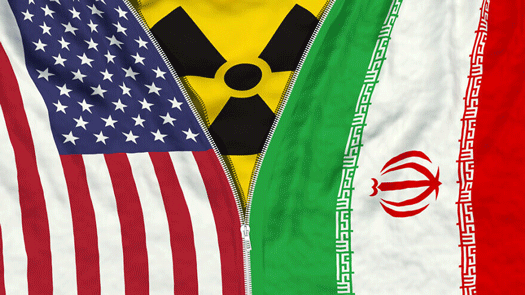
The New Zealand Government has significantly expanded its travel warnings for the Middle East, urging New Zealanders to avoid travel to much of the region as fighting between the United States and Iran continues to intensify.
Updated advice issued through the Ministry of Foreign Affairs and Trade’s (MFAT) SafeTravel service places Iran, Iraq, Israel, the Occupied Palestinian Territories, Lebanon, Syria and Yemen under Level 4 – Do Not Travel advisories.
New Zealanders already in those countries are advised to leave if it is safe to do so. Those unable to depart are urged to follow the advice of local authorities, monitor developments closely, and contact New Zealand’s consular emergency service if assistance is required.
SafeTravel has also raised Bahrain, Jordan, Kuwait, Oman, Qatar, Saudi Arabia and the United Arab Emirates to Level 3 – Avoid Non-Essential Travel, reflecting concerns that the conflict is increasingly affecting the wider region.
“The situation in the Middle East is highly volatile, with military strikes and reprisal attacks occurring in a number of locations,” SafeTravel said.
The advisory notes that US military strikes have been reported across Iran and warns that the security situation “could deteriorate at any moment”.
It also highlights Iranian attacks or threats against US military and other interests throughout the region, including warnings directed at civilian infrastructure such as airports and water desalination facilities.
The updated advisory comes amid one of the most dangerous periods of regional instability in recent years. The United States has continued strikes against Iranian military targets, while Iran has responded with missile and drone attacks directed at American and allied interests across the Middle East. Commercial aviation has faced repeated disruption as airlines reroute or suspend flights through affected airspace, while concerns have grown over the security of shipping transiting the Strait of Hormuz, one of the world’s most strategically important maritime chokepoints.
US President Donald Trump this week warned that any Iranian attack on shipping in the Strait of Hormuz would trigger direct retaliation against Iranian infrastructure, stating that the United States would destroy “one bridge or power plant” for every attack on commercial vessels. The statement followed further exchanges of fire between US and Iranian forces and heightened concerns that the conflict could expand beyond its current scope.
Against that backdrop, MFAT’s updated travel advice reflects an assessment that the security risks now extend well beyond the immediate combat zones. While Israel and Iran remain at the centre of the conflict, neighbouring states — including Jordan, Qatar, Bahrain, Saudi Arabia, Oman, Kuwait and the United Arab Emirates — have all seen their threat environment deteriorate through missile activity, military operations, airspace restrictions or the risk of wider regional escalation.
The broadened advisory underscores the interconnected nature of Middle Eastern security. Countries that are not direct participants in the fighting nevertheless face potential disruption to aviation, maritime transport and critical infrastructure, increasing the risks for international travellers.
MFAT has advised New Zealanders travelling in the region to remain alert, monitor official updates closely, ensure family members know their whereabouts, and be prepared for rapidly changing security conditions. Those requiring assistance are urged to contact the Ministry’s 24-hour consular emergency line.