
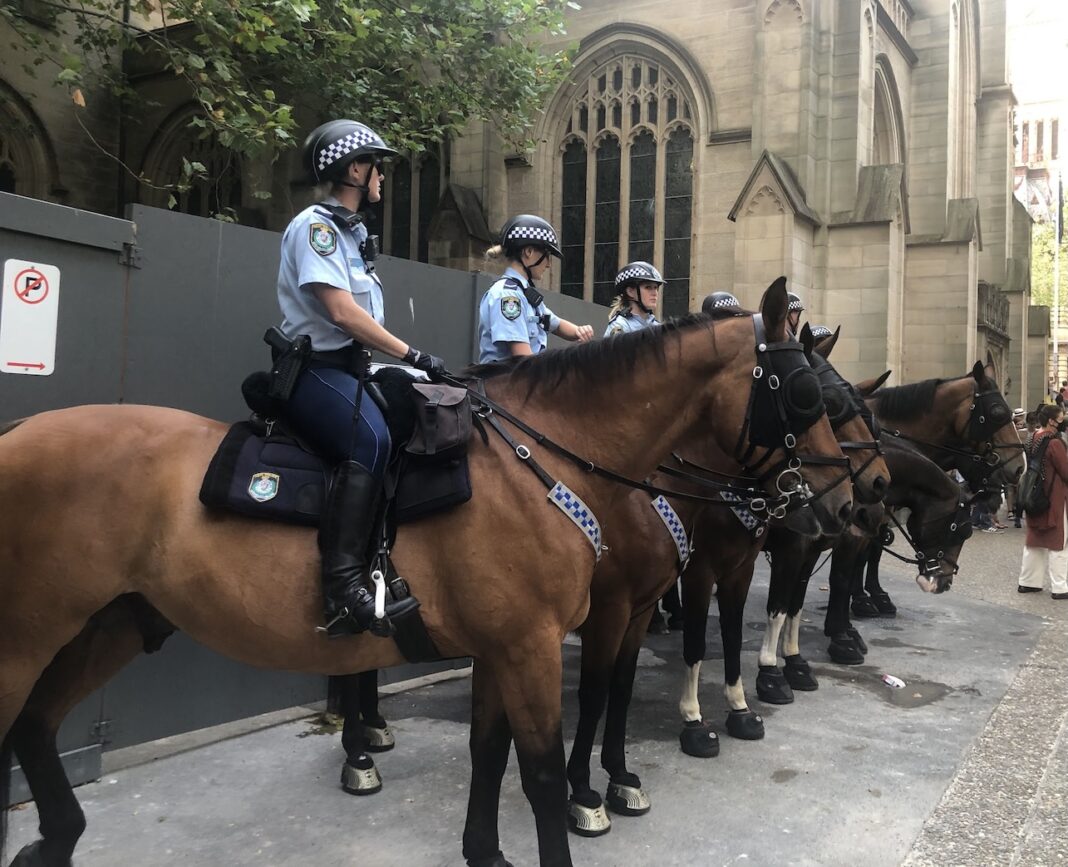
Prominent Jewish businessman Steven Lowy has urged every state and territory to establish a dedicated policing capability to protect Jewish Australians, warning that current arrangements are fragmented, under-resourced and failing to keep pace with the threat.
The former co-chief executive of Westfield Corporation told the Royal Commission on Antisemitism and Social Cohesion today that permanently assigned officers should be supported by specialist intelligence cells and protective units maintaining a visible presence at Jewish schools, synagogues, community centres, sporting facilities and major events.
The intelligence cells should operate within state and territory police services and the Australian Federal Police, with formal information-sharing links involving the AFP and ASIO, he said.
Lowy also called for structured partnerships between law enforcement agencies and Jewish communal and private security organisations, which often held information that could help authorities identify patterns of threatening conduct.
View this post on Instagram
He said antisemitic threats could originate overseas, interstate or locally and fall within the responsibilities of several agencies, leaving important information scattered across organisations without any one body seeing the full pattern.
Lowy acknowledged that individual police officers and specialist units had often acted professionally and with commitment.
However, he said the wider system was limited by inadequate resources, inconsistent priorities, training gaps and a poor understanding of the particular nature of antisemitic threats.
“The problem has been less one of bad faith than of inadequate resourcing, inconsistent prioritisation and, at times, a failure to understand the specific character of antisemitic violence and the community context in which it occurs,” he said.
Police should receive specialist training in Jewish history and communal life, the development of antisemitism and the significance of institutions that could become targets, he said.
Lowy also argued that laws against harassment and intimidation had not always been properly enforced and that only a small proportion of hostile conduct resulted in police engagement.
His call came as he revealed that his family’s security team assessed more than 15,000 hostile or threatening items in the year to February 2026.
More than 200 people of interest were identified during that period because of the nature or persistence of their conduct, with several cases referred to NSW Police, the AFP and counter-terrorism authorities.
In one recent month alone, Lowy’s family security team reviewed more than 1,500 items of hostile or threatening online content directed at the family and its institutions.
“The threats against my family have never stopped,” Lowy said.
Lowy’s wife, Judy, was also targeted online with the hashtag #genocidejudy after launching a fundraising campaign for the foundation of a prominent Sydney Jewish school where she serves as a board member.
“It was published by somebody with over 230,000 followers. It’s had enormous airplay,” Mr Lowy said about the now-removed hashtag.
Appearing before Commissioner Virginia Bell AC SC on Monday, Lowy described antisemitism as a constant feature of his life, extending from schoolyard remarks and abuse on the soccer field to terrorism, death threats, surveillance, doxxing and online incitement.
He called on governments to cover the cost of protecting Jewish institutions, estimated at about $100 million a year and largely borne by Jewish families, schools, synagogues and communal organisations.
Lowy said the expense diverted money from education, welfare, religious life, sport and culture.
Guards, fences and security procedures had become part of ordinary Jewish life, shaping decisions about attending schools, services and community events. Protecting citizens and lawful community life was a government responsibility and should not be treated as a private problem for Jewish Australians to fund and manage, he said.
Lowy’s father, Sir Frank Lowy, survived the Holocaust before coming to Australia and co-founding Westfield.
Sir Frank’s father disappeared after being taken from a railway station in Budapest. The family learnt 50 years later that a Nazi guard had bludgeoned him to death beside a railway wagon at Auschwitz-Birkenau after he repeatedly refused to surrender his Jewish prayer items.
Lowy said his family’s history gave it a direct understanding of what could happen when antisemitism was allowed to spread without an effective response.
He recalled antisemitic comments at school about Jewish money, influence and physical appearance, followed by frequent abuse while playing competitive soccer for Hakoah and Maccabi.
Lowy later served for three years as chairman of Football Federation Australia after his father’s 12 years in the role.
He said their work in one of Australia’s most multicultural sports became a continuing source of antisemitic vilification, with abuse directed at the family continuing more than seven years after he left the organisation.
Lowy also recounted the bombings of the building housing Westfield’s William Street offices and the Israeli consulate and the Hakoah Club in Bondi on 23 December 1982.
He said he personally received a telephone call at the family home that day threatening their lives.
The two attacks showed how violence directed at an Israeli target could quickly extend to an Australian Jewish institution with no role in government or foreign policy, he said.
Lowy argued that antizionism often operated as a vehicle for antisemitism, while stressing that criticism of Israel or its government was not inherently antisemitic.
The line was crossed when Jews and Jewish institutions were collectively blamed, excluded, intimidated or attacked, he said.
He warned that organised antisemitism was no longer confined to the far right but had spread through parts of the far left, extremist religious networks, conspiracy movements and online campaigns.
Lowy told The Australian that hatred of Jews appeared to be the one subject on which the far right and far left agreed.
Threats against his family had included abusive calls and letters, suspicious packages requiring X-ray examination, attempted approaches at homes and events, surveillance, doxxing and online incitement.
Lowy said an Iranian national was detected filming his home in 2023. He also cited conspiracy theories falsely alleging that Sir Frank was responsible for, or benefited from, the September 11, 2001 terrorist attacks.
He said social media had allowed abuse, conspiracy theories and incitement to spread at a scale and speed not previously possible and called for legally enforceable requirements compelling platforms to remove antisemitic content.
Lowy also proposed a national framework to help businesses, universities, cultural bodies, sporting organisations and other institutions prevent and respond to antisemitism.
He supported use of the International Holocaust Remembrance Alliance working definition of antisemitism and called for model policies, guidance for boards and training for senior leaders.
Institutions should apply the same standards regardless of whether antisemitism came from the political right, political left, religious extremism or another source, he said.
Lowy called for a national school curriculum covering the history and modern forms of antisemitism, including Holocaust denial, conspiracy theories, terrorism and the use of antizionism to hold Jews collectively responsible for events in Israel.
He also proposed a civil or military national service program bringing young Australians from different backgrounds into sustained contact. Citing Singapore’s national service system, Lowy said diverse societies required shared experiences and obligations that encouraged people to see one another as fellow citizens.
He said the Hamas-led attacks in Israel on 7 October 2023 and the reaction in parts of Australia had changed his sense of security.
Lowy recalled feeling safer during a later visit to Israel than in Sydney and said scenes at the Sydney Opera House protest two days after the massacre led his family to ask whether they might eventually have to leave Australia.
He told The Australian that if the commission’s recommendations fell short, or were not properly implemented, Jewish Australians could reconsider whether the country remained the right place for them and their children.
Although encouraged by support from many non-Jewish Australians after 7 October and the Bondi Beach terrorist attack of 14 December 2025, Lowy questioned whether the same national response would have followed had the massacre occurred inside a synagogue.
He urged the commission to recognise the cumulative harm caused by antisemitism across generations and every part of Jewish communal life, including the effects of constant security, fear, exclusion and intimidation.
Lowy said he had given evidence despite the risk of further abuse because the commission could bring significant change if governments acted on clear recommendations.
His submission was “not a counsel of despair”, he said.
Lowy remained confident in Australia’s fairness and common humanity, but warned that those values required political leadership, education, properly funded policing, institutional accountability and consistent enforcement of the law.
The antisemitism royal commission resumed in public view today after a behind-closed-doors stretch focused on security issues.
For the next fortnight, commissioners will be trained on the role of media – particularly the ABC and SBS – and the nature, prevalence and drivers of antisemitism and other hate speech on social media.
Among the witnesses was an anonymous Sydney woman who detailed threats her young daughter had received online from fellow school students, which had been reported to police.