
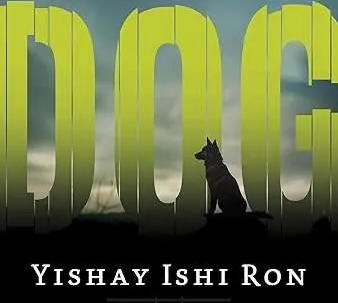
Book review by Anne Sarzin
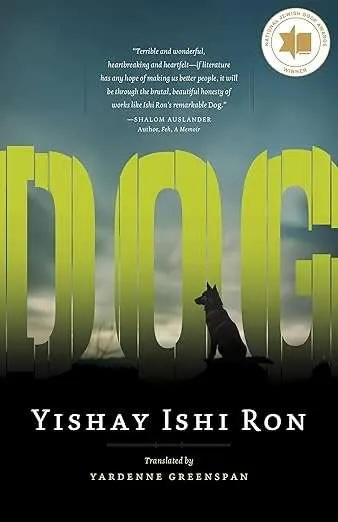 Post-traumatic stress disorder (PTSD) and narcotics and alcohol addictions are at the core of Yishay Ishi Ron’s extraordinarily powerful and moving novel titled Dog, a gripping psychological story of an Israeli commando, from an elite unit, whose experiences in Gaza are embedded in his memory with disastrous consequences.
He is especially haunted by two seminal events there—the death of a dog shot so needlessly by his comrade, and his own heroic deed, rescuing under fire one of his fellow soldiers, who dies in his arms. These two deaths, canine and human, merge into memories that sear his soul, fracturing his sense of stability and reality. His anger, sorrow, panic and pain are so debilitating that only alcohol and drugs can alleviate his suffering, and then only momentarily. Inevitably, he moves along the narcotics spectrum to heroin addiction, which alienates him further from his former compatriots, family and lifestyle; and it is only his subjugation to the drugs that offers him momentary relief from the hallucinatory memories that torment him ceaselessly. But this temporary relief and amnesia, desirable as they seem, come at an unconscionable price, his total submission to the demands of heroin addiction. It is hauntingly similar to a Faustian bargain with the devil, and the author traces this descent into drug dependency graphically and dramatically. We see the erasure of a man who once had agency and control over his world, someone respected and even revered by his Golani comrades, a leader who made considered life-and-death decisions for himself and for others. Tragically, we see him transform into a junkie sinking into dirt, depression and degradation, squatting in a hell-hole known as ‘the dump’.
Israeli author Ishay Ishi Ron has based the core of his narrative on his own personal history of PTSD following his service in the army, although he never served in Gaza. In Ron’s personal life, he faced the escalating consequences of his own anger that triggered violent episodes disruptive for his family’s safety and wellbeing, and he sank to new depths of despair that led inevitably to drugs and alcohol. His intimate knowledge and understanding of this condition enables him to convey most powerfully his anti-hero’s tortured emotions, as well as the constant pressure of addiction, unable to withstand the urgent compulsion to insert a needle that relieves pain and obliterates memories. As he withdraws from society, he recedes even further from those accepted norms of civility, cleanliness and self-respect to which he formerly subscribed. He rejects the pleas of his distraught brother Amir to come home, to accept family support for rehabilitation and healing of body and mind. Instead, his human connections eroded, he spirals downward into a morass solely ruled by his drug dependency.
Importantly, he even rejects his name, Barak, and reconfigures his identity by calling himself Geller, thereby claiming for himself the powers of the renowned mentalist about whom he obsesses, attempting to reshape inanimate objects by means of his will and concentrated energy, thus revealing his subconscious need to tap into those inner resources that will help him reassert dominion over his fragmented life.
Two dogs, one dead the other living, are central to the novel, both depicted as significant characters weighted with meaning, especially the one so brutally and unnecessarily killed in Gaza that haunts Geller and triggers profound sadness and regret. The living Dog, on the other hand, shares much of Geller’s suffering. He, too, is abandoned, scrounges a living and is subject to casual abuse by others. Nonetheless, Dog initiates a relationship with Geller in Tel Aviv, and their connection proves both reassuring and redemptive.
And then there is Doris, a maternal figure who has also suffered devastating loss of loved ones, yet somehow retains her humanity, dignity and compassion for others. Her bond with Dog creates a significant partnership that supports Geller with affection and signals the hope of redemption. There are ancillary characters—the murderous and muscular Georgian, and a vulnerable outcast known as Crutchy Zvi—who are denizens of a dark and degraded realm, where Geller also finds a place amid the stench and detritus of those who are seemingly damned and despised. Is there any hope of salvation and rebirth into an accepting world? Geller ponders these crucial psychological quandaries from time to time, as if the mere thought of returning to sobriety and society and engaging with these issues can sustain the flame of hope that flares very occasionally in him. What ultimately proves most helpful and a turning point in Geller’s life is his innate understanding that Doris and Dog, both in their own ways, also suffer from PTSD; and it is this recognition that their lives are as damaged as his own but that somehow they function in the wider world that enables him to see their shared humanity and to accept their company and unconditional support.
This profoundly moving novel has been expertly translated from Hebrew by Yardenne Greenspan, who manipulates language to convey essential traits of Ron’s characters. Zvi, who shares the dump with Geller, speaks eloquently, clearly a man with an education. On the other hand, the Georgian’s monosyllabic speech reinforces the violence and cruelty that characterise his actions and nature. The linguistic shifts that differentiate the characters are testimony to Greenspan’s abilities as a skilled and sensitive translator.
Every reader will decide whether this is an anti-war novel or whether it is a plea for understanding of the consequences of war, especially on young people leaving school for the battlefield, and the consequent impact of traumatic experiences they endure and somehow must survive. Ron dedicates his book ‘to the combatants whose eyes have seen things that their minds refuse to forget’, so he establishes at the very beginning of his story the powerful role memory will play, a process interwoven with forays into ethics and fear of the judgemental attitudes of others. Perhaps Ron sums up most succinctly the major role of memory and its trajectory in his novel in the biblical quotation from the Book of Samuel with which he prefaces the story: ‘Who are you pursuing? A dead dog?’
For those readers who belong to book clubs, the book also includes a useful study guide that poses relevant questions for further discussion
Dog
By Ishay Ishi Ron
Translated from Hebrew by Yardenne Greenspan
Ginninderra Press, Bentleigh, Melbourne, Victoria
2026