
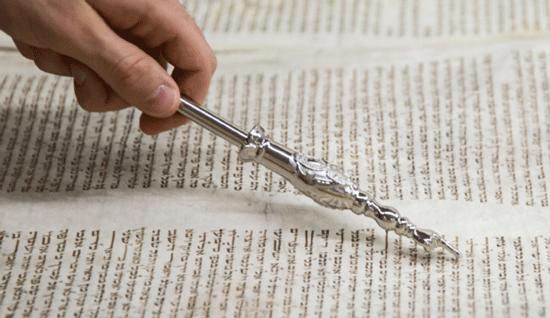
The Book of Devarim includes a complete re-statement and reformulation of the laws issued on Sinai, and also restates the struggles Moshe had. He is not sparing in his criticism of the Israelites’ repeated complaints and rebellions. He says that he knows that many of them will abandon the Covenant with God even though it is always going to remain in force regardless of how badly they will behave. Despite Moshe’s realisation that human nature is fragile, he remains remarkably optimistic. But he reiterates the fundamental core of Torah. Two core words Mishpat, justice, the rule of law and Tsedek, righteousness. The letter of the law and the spirit of the law. The need for both is a theme reiterated throughout this book.
“I commanded the judges of the people, listen to your brothers when there is disagreement. Judge justly between them and the stranger. Do not be biased in judgment or favor of the little person or the big one. Do not be frightened of other people, because justice is God’s” (Deuteronomy Chapter 1:16 & 17).
What does that mean, that Justice is God’s? Isn’t Justice our responsibility? But as humans, we more often than not get it wrong, even if we think we are right.
This is probably the most important civil ethical principle in all of the Torah. Having a fair system of Justice requires giving both sides a fair hearing, imperfect as it may be. This includes the stranger, the outsider, too, and all members of society. The judges have to follow the law, but the law cannot always deal with exceptional situations or circumstances. The ideal is to combine justice with sympathy and to include other standards, such as the Torah’s emphasis on ethics. This is the one principle that Moshe’s emphasises more than any other civil legal principle, and it is the one most often ignored.
Torah keeps repeating, when talking about law, our obligations to the poor, the widow, and the orphan. But the Law is the Law regardless of one’s bank balance. If a poor person steals to feed his family, he has still stolen and must be found guilty. But when it comes to punishment, the Judge has leeway to consider his difficult circumstances. And what is more, he will have a religious obligation to help that poor person and the family.
This is why the Torah uses these two words together, Mishpat and Tsedek. Mishpat is the law. It should be blind, like the Statues of Justice in front of the American Supreme Court with a blindfold over her face. But in addition, there is the moral and religious aspect, Tsedek, doing the right thing on a personal level, where you should be biased in favour of helping. Doing the right thing.
The trouble is, wherever we look, we see abuses of the law, whether for personal gain or political dogma. Look how differently the judges of the American Supreme Court all decree. And they are divided on political and ethical policies and judgments. As are all supreme courts. Let alone political parties.
We see too many examples of people doing what they claim is the right thing and legal, yet murdering, oppressing others, using the law as a political tool, and betraying moral values. Religious hooligans, nationalist bullies, doctrinal fascists and Marxists, and leaders who fail to stand up and give a lead or condemn evil. It is so depressing.
Yet from Moshe we learn not to give up, regardless of the mess around us. Despite all his criticism of the Israelites, he does not lose hope, and neither should we. This imagery of Moshe as the trustful shepherd, the Ra’ayh MeHemnah is why we regard him primarily as our teacher rather than as a messiah.
And that should be the role of the Rabbi or any other leader. The Law of Torah is the foundation. But one can still consider personal circumstances when applying it to individuals and individual cases. A rabbi of a community should treat everyone equally, regardless of wealth or power. No one should feel like a lesser person. Otherwise, the rabbi fails on both the grounds of Tzedek and of Mishpat. The same goes for politicians. At this moment, we are being failed by both.
Rabbi Jeremy Rosen lives in New York. He was born in Manchester. His writings are concerned with religion, culture, history and current affairs – anything he finds interesting or relevant. They are designed to entertain and to stimulate. Disagreement is always welcome.