
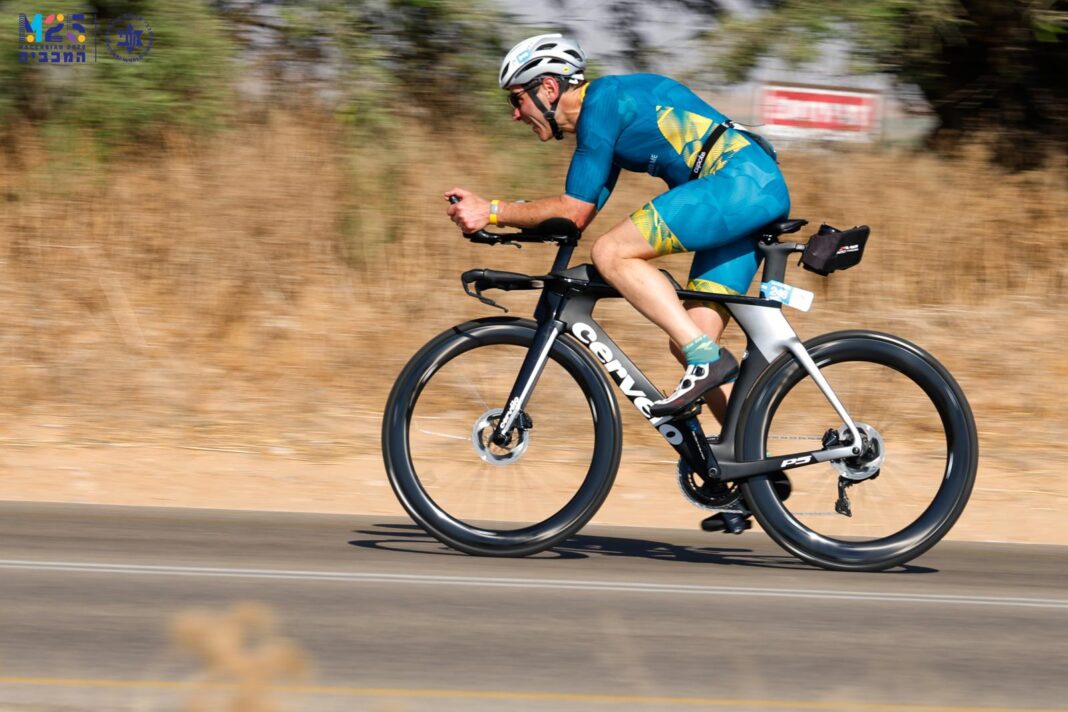
Melbourne triathlete Barry Lipp has completed a remarkable Maccabiah Games campaign, winning four gold medals and a silver only weeks after believing he would not compete.
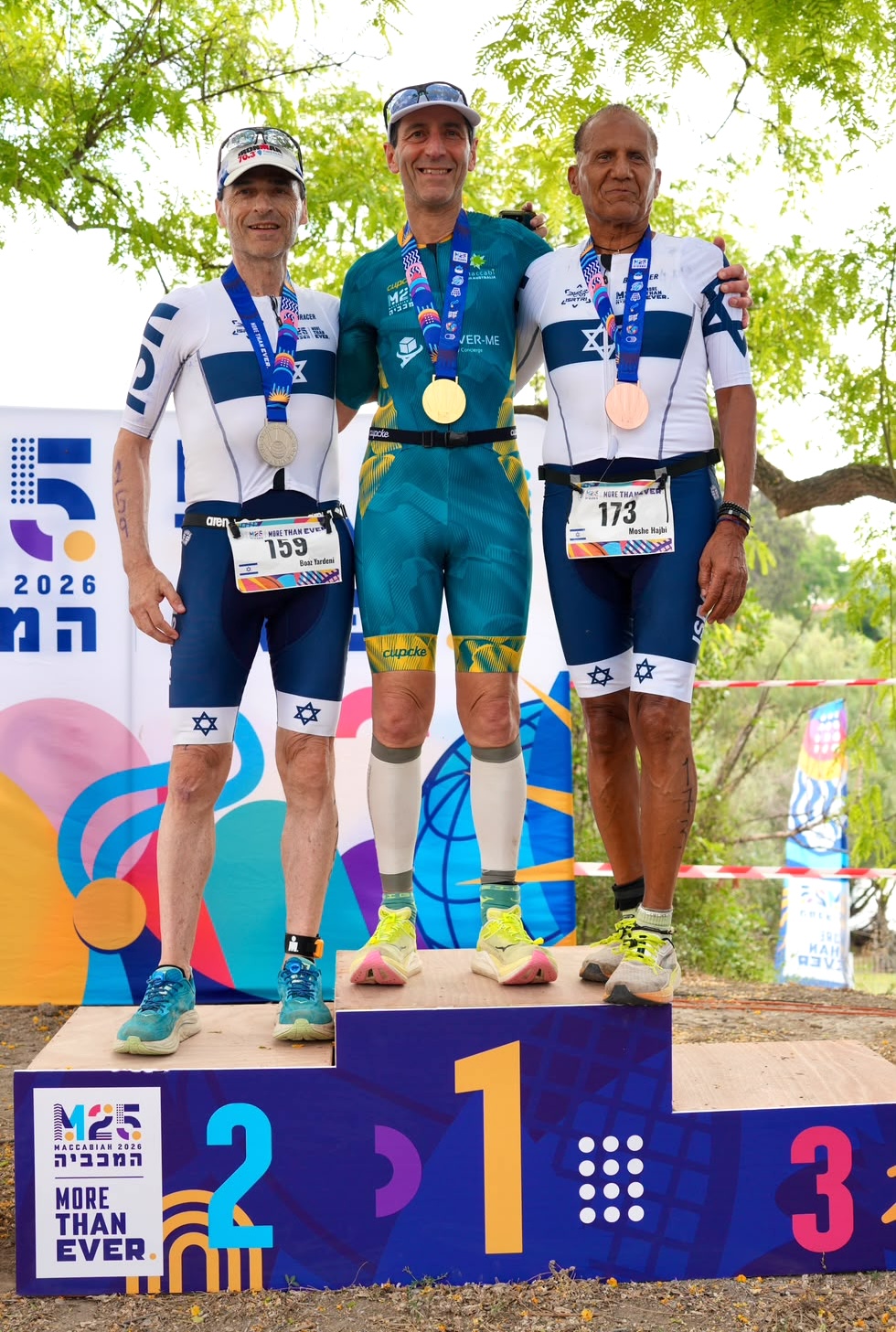
The 68-year-old won the men’s 65-plus Maccabi Man title after taking gold in the duathlon, half-marathon and cycling time trial, as well as silver in the three-kilometre open-water swim.
His combined performance across the four events secured a fourth gold medal as the overall Maccabi Man champion in his age group.
Lipp said the Maccabi Man competition was established about 15 years ago as a major event for triathletes at the Games.
“It comprises a triathlon, a three-kilometre open-water swim, a half-marathon and a cycling time trial,” he told JWire.
“There are medals awarded for each of those events, plus a medal awarded for the overall, for people who complete all four events.
“I was fortunate to receive three gold medals and a silver in the individual events and a gold medal for the Maccabi Man overall.”
About 17 athletes began in Lipp’s age division, with Israeli competitors finishing second and third in the overall standings.
The triathlon was converted into a run-bike-run duathlon after contamination was found in the stream where the swimming leg had been due to take place. The three-kilometre open-water swim was moved to Lake Kinneret, where Lipp had competed at previous Maccabiah Games.
“The water in the Kinneret is generally quite warm,” he said.
“The visibility is limited because it has a muddy bottom, which tends to get stirred up. It’s a freshwater lake rather than where Australian triathletes are used to swimming in the sea in salt water, so there’s less buoyancy.
Lipp’s participation was confirmed only shortly before the Games after the Australian Government changed its travel advice for Israel.
Maccabi Australia had been unable to send a delegation while the advice remained at “do not travel”. About 10 days before the Games began, it was lowered to “reconsider your need to travel”, allowing a small Australian team to attend.
By then, most members of the planned delegation had withdrawn.
Lipp, the vice-president of Maccabi Australia and Australia’s designated head of delegation, said he would not have travelled had there been no official Australian team.
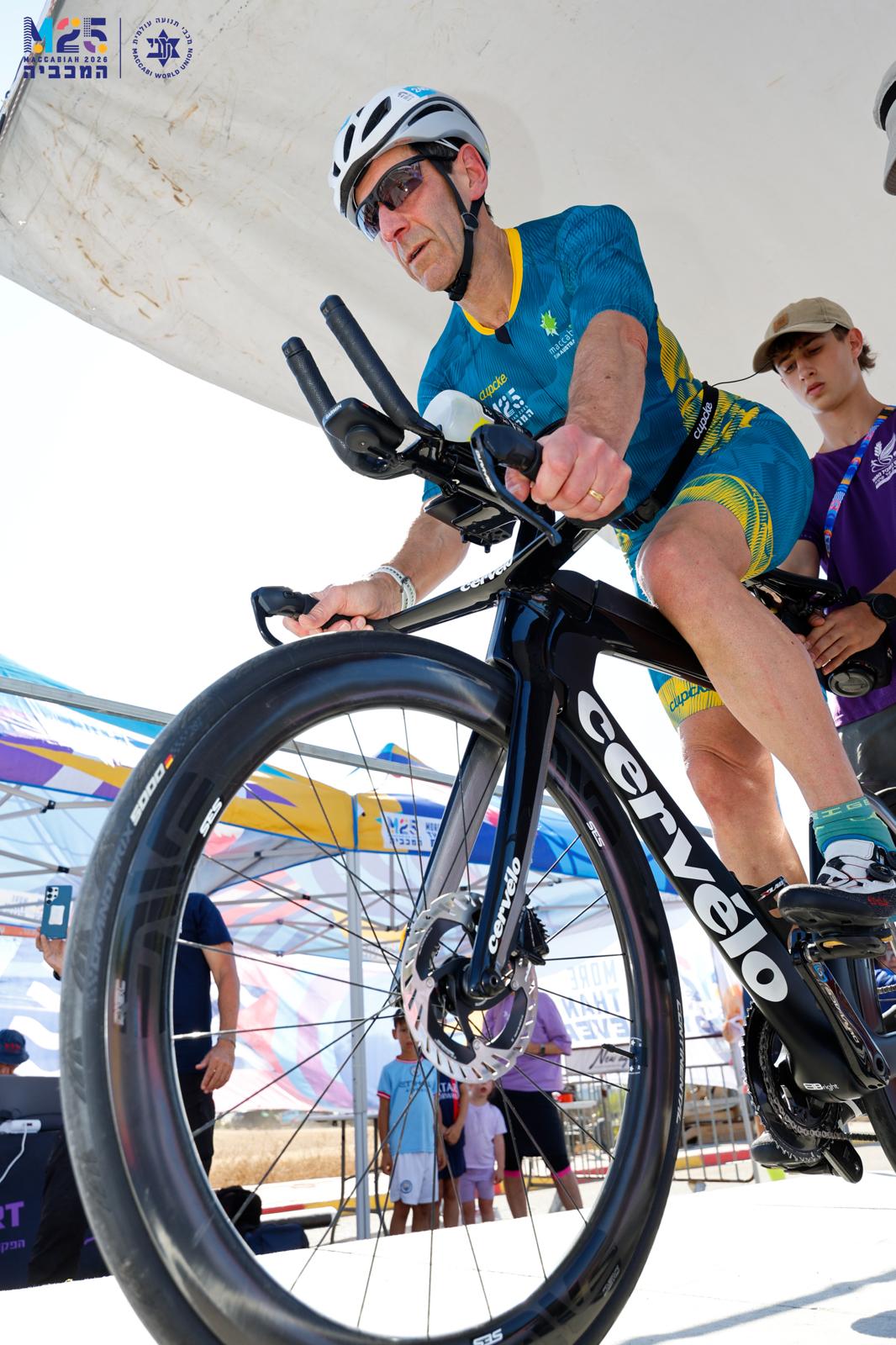
“I probably had changed my training focus about a month before Maccabiah because I felt that I wasn’t going to go,” he said.
“My training over the last month wasn’t ideal for Maccabiah, but nonetheless, as a triathlete training all year round, I still had the capacity to do it.”
The small size of the Australian delegation also meant Lipp’s role differed from what had originally been planned.
“Given that we weren’t sending a large Australian team, there really wasn’t a need for a head of delegation,” he said.
“But I was very fortunate that the board of Maccabi Australia still wanted me to go. So it gave me the opportunity to go and to focus on my participation.”
Only 14 Australian athletes ultimately competed, with Lipp the country’s sole Maccabi Man entrant.
Ordinarily, Australia would hold a pre-Games camp to bring the team together before competitors separated into their individual sports.
This time, Lipp joined Maccabi Man competitors from several countries who formed an informal international team.
“It was a very beautiful experience in that we, as internationals, really did bond like a team and supported each other, and cheered for each other and competed alongside each other,” he said.
Lipp said Israeli competitors and senior Maccabi World Union officials were deeply appreciative that Australia had managed to send a delegation.
“I have a strong relationship with those people who are at the top of Maccabi World Union, including the chairman of Maccabi World Union, the chairman of the Maccabiah Games and the CEO of the Games,” he said.
“They all expressed to me that they were extremely pleased that Australia was able to send a delegation and very, very happy that we were there.”
Lipp said the circumstances surrounding Israel, the postponement of the Games and the uncertainty over international participation made the 2026 Maccabiah unlike any of his previous appearances.
“For me, participating in Maccabiah is the most meaningful form of competition I can participate in,” he said.
“I’ve represented Australia 10 times at World Triathlon Championships, but for me, nothing is more meaningful than Maccabiah.
“Each one is special, but I actually think that this one was the most meaningful of all, in all the circumstances, of all that’s happened over the last two years, with the postponement of the Maccabiah Games last year and with ongoing issues in Israel.”
He said athletes understood the wider purpose of their presence from the opening ceremony.
“Right from the opening ceremony, I think every athlete understood why we were there,” he said.
“We were there to show our support.”
Lipp said the Games’ motto, “More than ever”, carried several meanings.
“The slogan or the motto for these Games was ‘More than ever’, and I think that has a number of different meanings and contexts,” he said.
“First, more than ever, it was very important that these Games go ahead.
“That Israel demonstrates that, with all that’s happening, it will continue. Life will continue in Israel, and it will continue to hold its head up and conduct sporting activities and social activities to show that its society continues, notwithstanding all the challenges it faces.”
Lipp began competing in triathlons in the late 1980s. After taking a break of almost 15 years, he returned to the sport and has trained consistently for almost two decades.
His weekly program covers swimming, cycling, running and strength work across seven days.
Saturday is usually devoted to a long bike ride, sometimes followed by a run, while Sunday is his long-running day. Weekdays include a mix of pool sessions, strength training, cycling and running.
“I train seven days a week,” he said.
Despite spending much of that time alone, Lipp said he did not find training isolating.
“It’s a great time to actually think,” he said.
“I do a lot of my thinking and work as a lawyer whilst I’m out training.
“When you train, you’re actually focusing on your technique in each sport, constantly trying to refine technique as well as improve strength and endurance.”
A former class-action litigator with Maurice Blackburn, Lipp now works as a sole practitioner, helps manage his family’s property business and holds several voluntary sporting positions.
“To be honest, I think I’m working as much as I was when I was working flat out as a legal practitioner,” he said.
Lipp is now preparing for his next international event, a World Triathlon Championship in Spain in September.
However, after four Maccabiah appearances and a Pan American Maccabi Games campaign in Buenos Aires, he said no other competition carried the same meaning.
“Nothing is more meaningful than Maccabiah,” he said.