
Book review by Dr Anne Sarzin
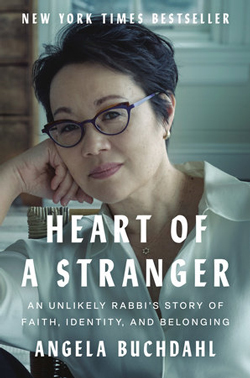 Everything about Rabbi Angela Buchdahl’s compelling memoir is unusual. This is the only autobiography I’ve ever read that includes a dedicated Devar Torah in every chapter, an exploration of Jewish teachings that provide spiritual guidance for her readers.
Buchdahl’s memoir focuses mainly on her own very unique story, her Jewish journey from her birthplace in Korea to one of the highest positions in the American rabbinate. Generally recognised as the Jewish world’s most influential rabbi, she is the daughter of a Buddhist Korean mother descended from Korean royalty, and a third-generation Jewish American father, who is also a Stanford graduate. A Reform Rabbi and Yale University alumna, today Buchdahl leads North America’s biggest Jewish congregation, Central Synagogue in New York City. Her global outreach services over the high holidays regularly draw one million viewers from more than 100 countries, and New Yorkers flock in large numbers to her Friday night Sabbath services in midtown Manhattan, supplemented by a sizeable community of online viewers, both constituencies totalling around 50,000 attendees most Friday nights. She is the world’s first Asian American Rabbi and the first Asian American Cantor, affectionately known as the ‘Judean Korean’.
Rabbi Angela Buchdahl has now told her fascinating story in a recently published book, Heart of a Stranger: An unlikely Rabbi’s story of faith, identity, and belonging. In November 2025, her book debuted on the New York Times’ hardcover non-fiction bestseller list, in itself a notable achievement considering the Times had never reviewed the book. Buchdahl’s rabbinical and cantorial careers comprise an impressive number of significant ‘firsts’, stellar milestones that testify to her pre-eminent position in the Jewish world. Arguably, she is the best-known Rabbi in the Western world with an international following. Presidents Barack Obama and Joe Biden invited her to the White House in 2014 and 2023, respectively, to recite the Chanukah blessings; and in 2024, she was the keynote speaker at the opening of Seoul National University’s Israel Education Research Centre, the only Korean university to offer academic studies in Hebrew, Jewish history and Israeli culture. ‘I had compartmentalized my Korean and Jewish identities, and depending on the context, one would crowd out the other,’ Buchdahl writes. ‘But here I was, returning to Korea because I was a rabbi. I came representing the wider Jewish community, but also as a hangguk saram, a Korean native.’
Born in Korea, where Buchdahl spent her first five years, she cherishes memories of her mother’s warm, extended Korean family. Despite her mother’s heartbreak at leaving family and friends, her parents decided to return to the United States, mainly to avoid the discrimination and bullying biracial children suffered in Korea. In 1977, they relocated to her father’s small hometown of Tacoma, Washington State, where Jewish life centred around Temple Beth El, a Reform congregation, where Buchdahl and her little sister, Gina, attended the nursery school. Her father’s Warnick family was renowned among the small Jewish community for their support and contributions to Jewish and civic life, so the little sisters were welcomed as fourth-generation Jews and, consequently, Angela experienced a profound sense of belonging that strengthened with the passing years. An especially spiritual child, she immersed herself in Jewish prayer and, from the age of eight, devised a bedtime prayer ritual for herself and her sister that they maintained rigorously over the years.
Early on, at 16, as the excited recipient of a Bronfman Youth Fellowship, Buchdahl visited Israel for the first time. There she encountered cutting observations and antagonistic criticism that openly challenged her status as a Jew. Others pointedly asked whether she had converted, whether she knew the meaning of the ‘chai’ necklace she wore. They told her she was not a halachic Jew because her mother had not converted to Judaism. As a young, sensitive person, she suffered intensely from this onslaught, which momentarily destabilised her. Remarkably, however, she used setbacks as stepping stones; and her resilience, recovery and response propelled her forward along her chosen path.
The title of this book, Heart of a Stranger, is especially relevant to Jewish readers now. For the past two-and-a-half years, since 7 October 2023, many have found themselves strangers in their different worlds, cruelly detached and isolated from the political, professional, creative, social and educational circles to which they contributed in so many fulfilling ways. Interestingly, Buchdahl traces the stranger syndrome back to the first Jew, Abraham, who was told ‘Lech Lecha’, and commanded to leave his family and friends and town and to travel with Sarah to another place. Being a stranger is seemingly encoded in our Jewish DNA.
There are guiding precepts embedded in every chapter, accessible words that touch the head and heart of the reader. These include references to and interpretations of Jewish lore and biblical texts on a range of subjects, such as Bridge (gesher), Love (v’ahavta), Trust (emunah), Resurrection (m’chayei metim), Patience (savlanut), Identity (zehut), Brokenness (shevarim), Kindness (chesed) and Awe (yirah), This reflects Buchdahl’s drive to explain Judaism to a wider world and to extend compassionate pastoral care to others in need beyond the boundaries of Central Synagogue. Committed to embracing the heart of the stranger, through this book, she is most certainly creating another powerful community comprising readers from diverse backgrounds and with different beliefs. She is always warmly welcoming of those gravitating towards Judaism in larger numbers at this time in contemporary history, for a host of reasons, including loneliness, marginalisation, fear and uncertainty, as well as the very real need to feel part of a collective, as evidenced in Judaic sources. She recalls that when the children of Israel left Egypt, the Torah describes them as ‘a mixed multitude’ (erev rav). Rashi interpreted that to mean the multitude included converts from other nations. The Spanish commentator Ibn Ezra believed the phrase alluded to the presence of Egyptians fleeing from Pharaoh’s tyrannical rule alongside Hebrew slaves.
There is much in this book that chimes with contemporary needs. The human story of an Asian American cantor and rabbi underpins a lucid and essentially loving exploration of Judaism’s wisdom tradition. For Jews and also for people of other faiths, this book serves as an excellent introduction to Jewish ethics and religious beliefs, but also delivers so much more for those seeking new answers to old questions.
Heart of a Stranger: An unlikely Rabbi’s story of faith, identity and belonging
Angela Buchdahl
Pamela Dorman Books / Viking
2025
Anne- I am so touched by this generous review and how the book resonated for you. Thank you for introducing this book to the Australian and New Zealand communities.
-Rabbi Angela Buchdahl
A lovely review, Anne Sarzin. I shall buy a copy of this book, for my heart goes out to this woman, who all of us should be willing to embrace as a Jew. Her treatment in Israel does not surprise – it is the same treatment she could expect in ultra-orthodox communities anywhere, and it comes from a self-righteous, narrow place that goes against what it is to be a Jew.