
Mark Dreyfus was standing on a Melbourne street corner, waiting to join a march against violence against women, when a stranger crossed the road towards him.
The then attorney-general greeted the man.
The response was immediate: “You’re a genocidal Zionist. You should be ashamed of yourself.”
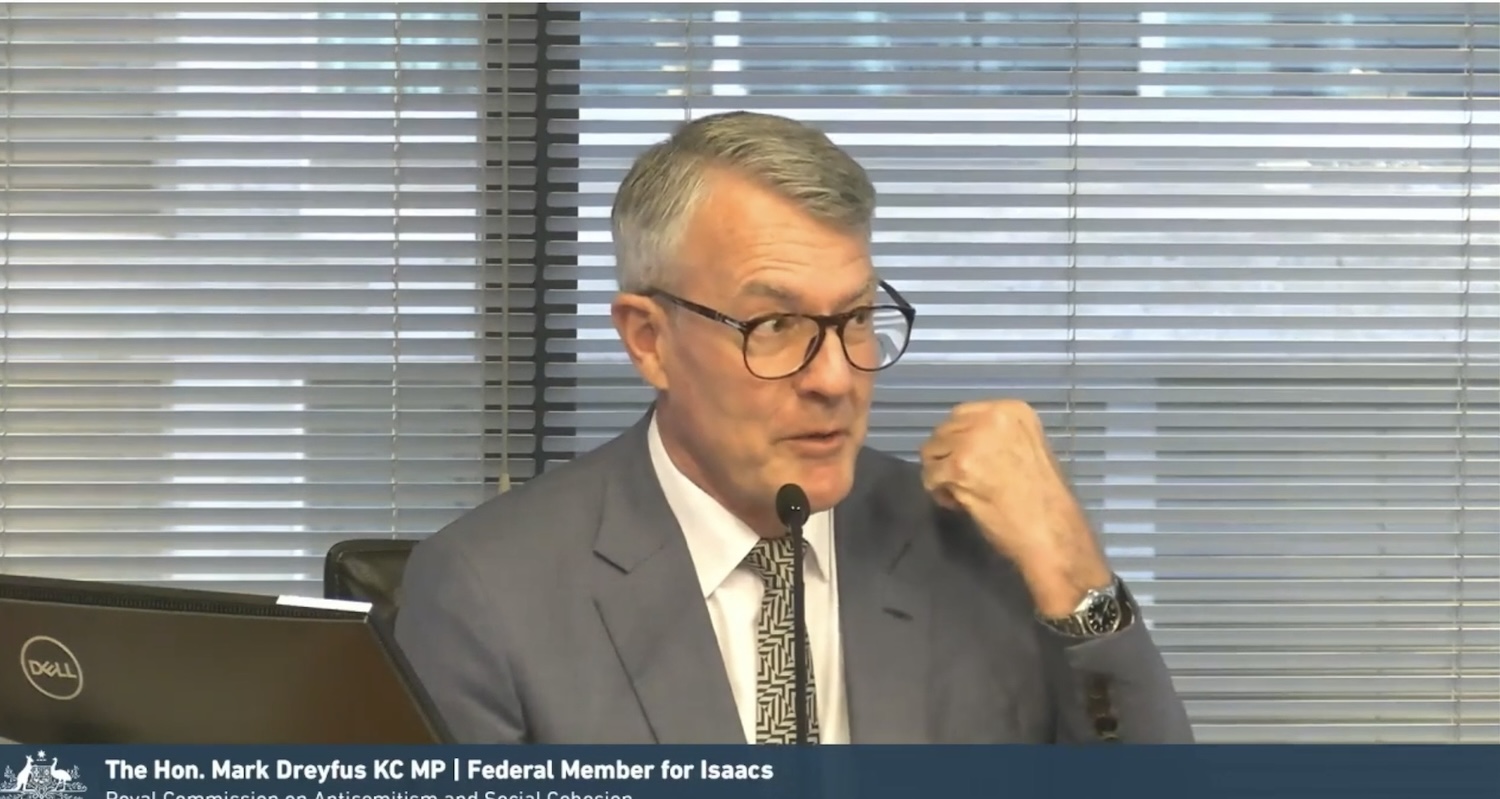
Dreyfus told the Royal Commission on Antisemitism and Social Cohesion the April 2024 encounter near the State Library marked a disturbing first in his long parliamentary career.
“No one had ever hurled abuse at me because I am Jewish,” he said.
“This was a new development in my engagement in Australian politics, and I know I’m not alone.”
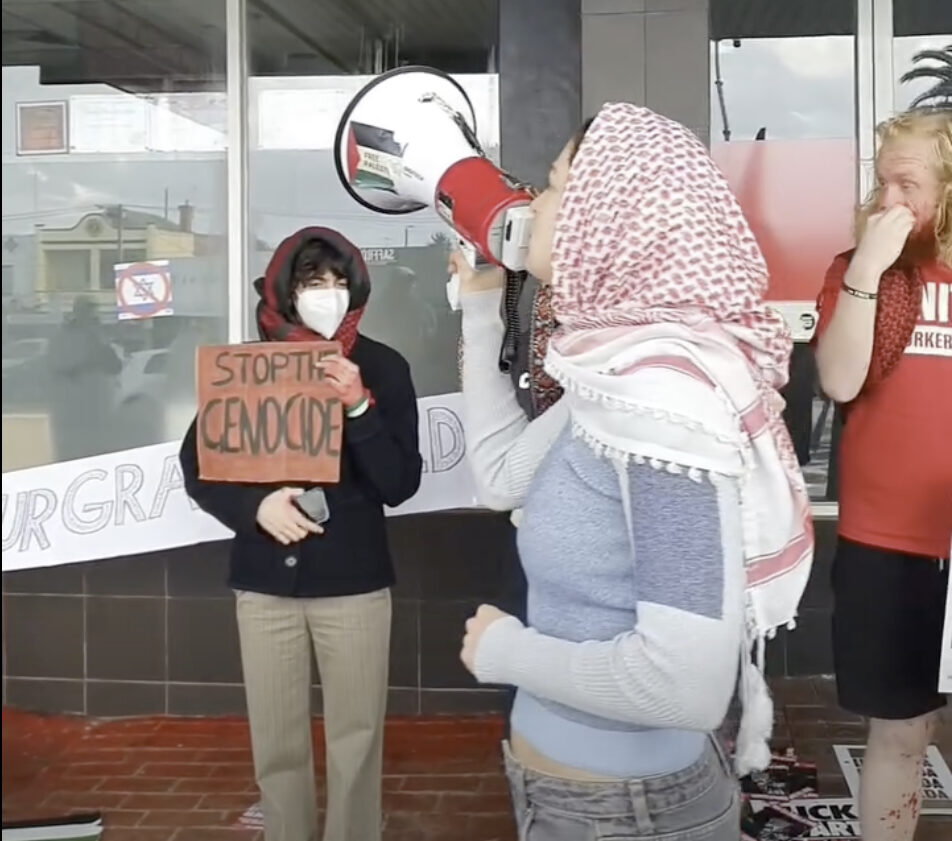
Several weeks later, his electorate office at Mordialloc was smeared with red paint, and words questioning whom he served were written on the pavement outside.
Dreyfus said the message invoked longstanding antisemitic accusations of dual loyalty.
“No one ever should make that suggestion about a member of the Australian Parliament, let alone someone who had been sworn to administer a portfolio as the Attorney-General of the Commonwealth,” he said.
“It’s a deeply wounding attack.”
Dreyfus was the opening witness in the Royal Commission’s fifth hearing block today, which is examining security arrangements for Australia’s Jewish community.
Dreyfus used his appearance before the commission to call for restrictions on protests outside synagogues, Jewish schools and community venues, broader federal hate-speech offences and a low-cost legal process allowing individuals to seek the removal of antisemitic material from social media.
Dreyfus said the model should be similar to laws restricting protest activity near abortion clinics.
“Not to ban political protest, not to say that people cannot express their views in our community, but rather to protect Jews, Jewish Australians from going about their worship, from gathering, from going to school, which should be free of protests occurring.”
He said demonstrations near Jewish institutions also created a direct security risk.
“That protest activity often presents a direct risk to the community in a security sense because it might be cover for some worse activity, for violence, for some actual physical threat to those places or people,” he said.
Dreyfus said any such laws would primarily be a matter for state and territory governments.
He also urged the Commonwealth to consider broader criminal offences covering serious vilification.
Dreyfus said the federal hate-speech offence introduced while he was attorney-general required incitement to force or violence, while more recent laws in Victoria and NSW went further.
“The states, at least Victoria and New South Wales, have landed in a place which I think is actually a more appropriate place,” he said.
He argued that legislation had value even without frequent prosecutions because it established acceptable standards.
“It’s the community speaking through its parliament to set a standard of behaviour.”
Dreyfus also expanded on his proposal for a private right of action against social media platforms under the federal government’s planned digital duty of care.
He said individuals should be able to seek swift takedown orders without being overwhelmed by the resources of technology companies.
“Big tech are the original deep pockets,” he said.
“They have incomes and revenues that exceed small countries, or even big countries.”
Dreyfus said the process should focus on removing harmful material rather than awarding damages.
“It’d be a plea for a takedown. That would be the process. I’m not thinking damages. I’m thinking takedown,” he said.
“There has to be an ability for citizens, anyone affected by what’s published, to say, ‘Take that down’, and then that they not be oppressed by the disparity of resources.”
He said enforcement should not rest solely with the eSafety Commissioner.
Dreyfus also spoke about the restrictions he faced as a Jewish cabinet minister after the Hamas attacks of 7 October 2023.
He said cabinet confidentiality and collective responsibility limited his ability to respond publicly to criticism and demands from some members of the Jewish community.
“I wasn’t in a position to respond fully, or perhaps at all, to the attacks and demands that have been made of me by some Jewish Australians simply because I was a cabinet minister,” he said.
Dreyfus, who left cabinet in May 2025, said returning to the backbench had given him greater freedom to speak publicly and make representations to ministers.
“It’s certainly, to some extent, been liberating compared to what I experienced, the constraints I experienced as the cabinet minister,” he said.
He also revealed that his wife, Deborah, was terminally ill and in palliative care when he represented the Commonwealth Government at a Jewish community rally in Melbourne’s Caulfield Park on 13 October 2023.
“I nearly didn’t go,” he said.
“She was in palliative care, and Deborah said to me that she wanted me to go, and I did.”
Dreyfus said the rally, attended by about 6000 people, showed strong political and community support for Jewish Australians in the immediate aftermath of the Hamas attack.
He said the antisemitism that followed was therefore even more shocking.
“It would not have been expected that after the rejection, the expressions of revulsion at that event, the absolutely across-the-board political expressions of support for Jewish Australians and rejection of that kind of conduct, that there should then have followed in the subsequent two years an upsurge of antisemitism,” he said.
“It has been deeply shocking. Continues to be shocking.”
Dreyfus said criticism of Israel and political debate about the Middle East remained legitimate, but the line was crossed when Jewish Australians were attacked or treated as representatives of the Israeli government.
“People who are troubled by or concerned about events in Gaza or concerned about events in the Middle East think that somehow their righteous concern entitles them to attack a Jewish Australian as somehow the representative of the government of Israel,” he said.
“It’s wrong. It needs to be called out.”
He also warned against turning antisemitism into a partisan political contest.
“It’s not the right subject for politicisation,” he said.
“Our response as a community will be stronger if we don’t politicise.”
Monday’s hearing will continue with evidence from representatives of Community Security Groups and Queensland Jewish Board of Deputies president Jason Steinberg.