
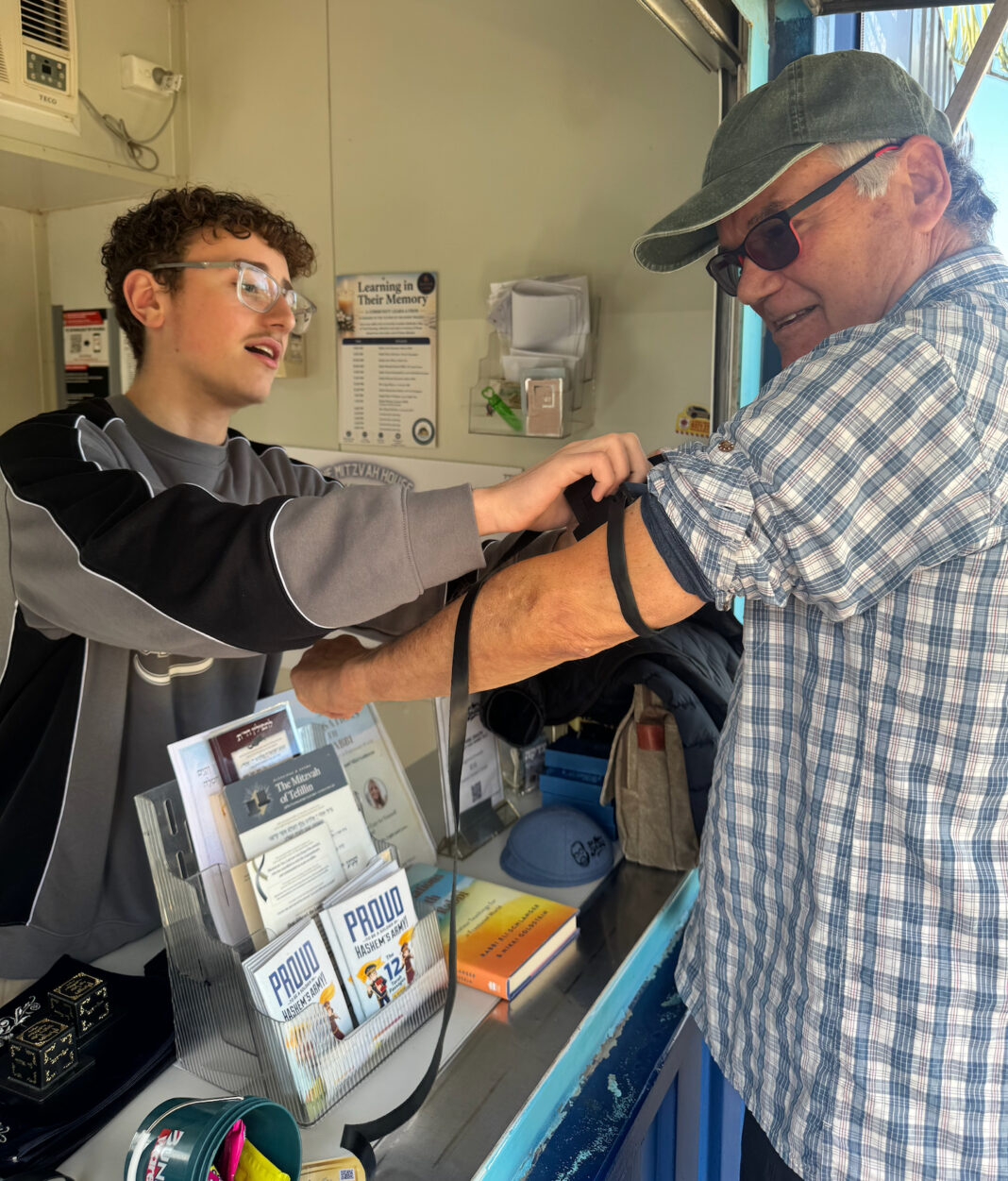
Rami Sherman was standing near the memorial to the 14 December terrorist attack at Bondi Beach when a Masada College Year 11 student volunteering at the adjacent Mitzvah House offered to help him lay tefillin.
The student, Avishai Kessel, was a survivor of the attack. He had been assisting Rabbi Eli Schlanger z”l, the assistant rabbi at Chabad of Bondi who was murdered in the massacre.
Schlanger’s final words to him were: “Keep going.”
Kessel now volunteers at Mitzvah House in his memory. He had no idea who Sherman was until Sarah Vanunu, the JNF Australia shlicha accompanying him, explained his role in the Entebbe rescue.
Kessel was overjoyed.
“I did a whole project about you at school,” he told Sherman, opening the assignment on his phone before asking for a photograph.
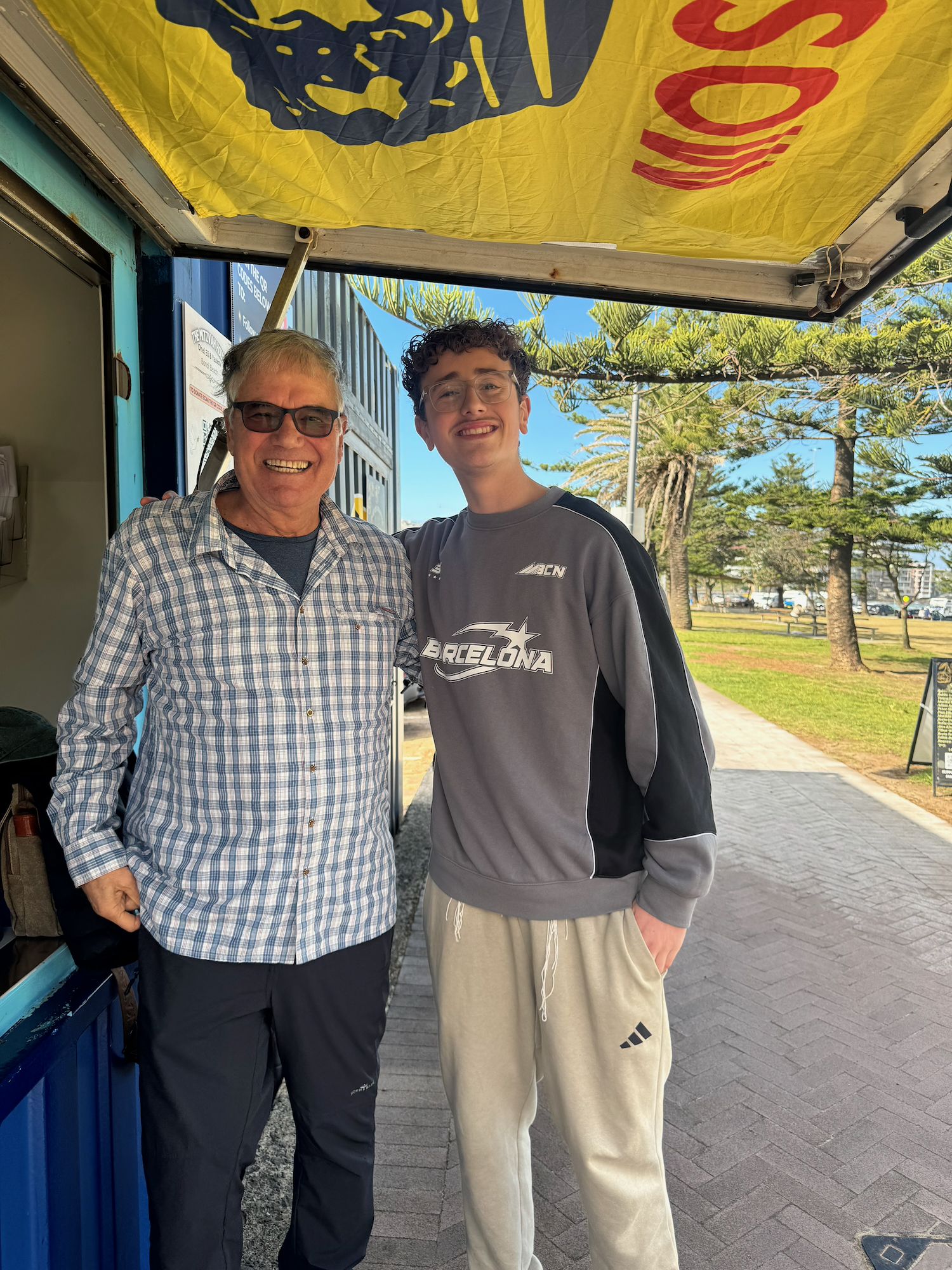
For one of the men who helped plan and carry out the 1976 Entebbe rescue, the encounter showed why the mission still carries such force.
“I think the message of this story determines why this event is still alive after 50 years,” Sherman told JWire. “It is not because of me. It is a story of values.”
This July marks the 50th anniversary of one of the most complex and daring hostage rescue missions in modern history.
Major (Ret.) Rami Sherman is touring Australia as a guest of JNF Australia, speaking about the Entebbe operation and the values he believes it represents. He spoke to JWire during the tour.
Sherman, the son of Holocaust survivors, grew up on Kibbutz Lehavot HaBashan in northern Israel. He joined the IDF in 1972 and was accepted into Sayeret Matkal, the elite special operations unit commanded in 1976 by Yonatan “Yoni” Netanyahu, the brother of Israel’s prime minister.
As the unit’s operations officer, Sherman played a central role during the week of planning, coordinating between the commandos, overall operation commander Dan Shomron and the Israeli Air Force.
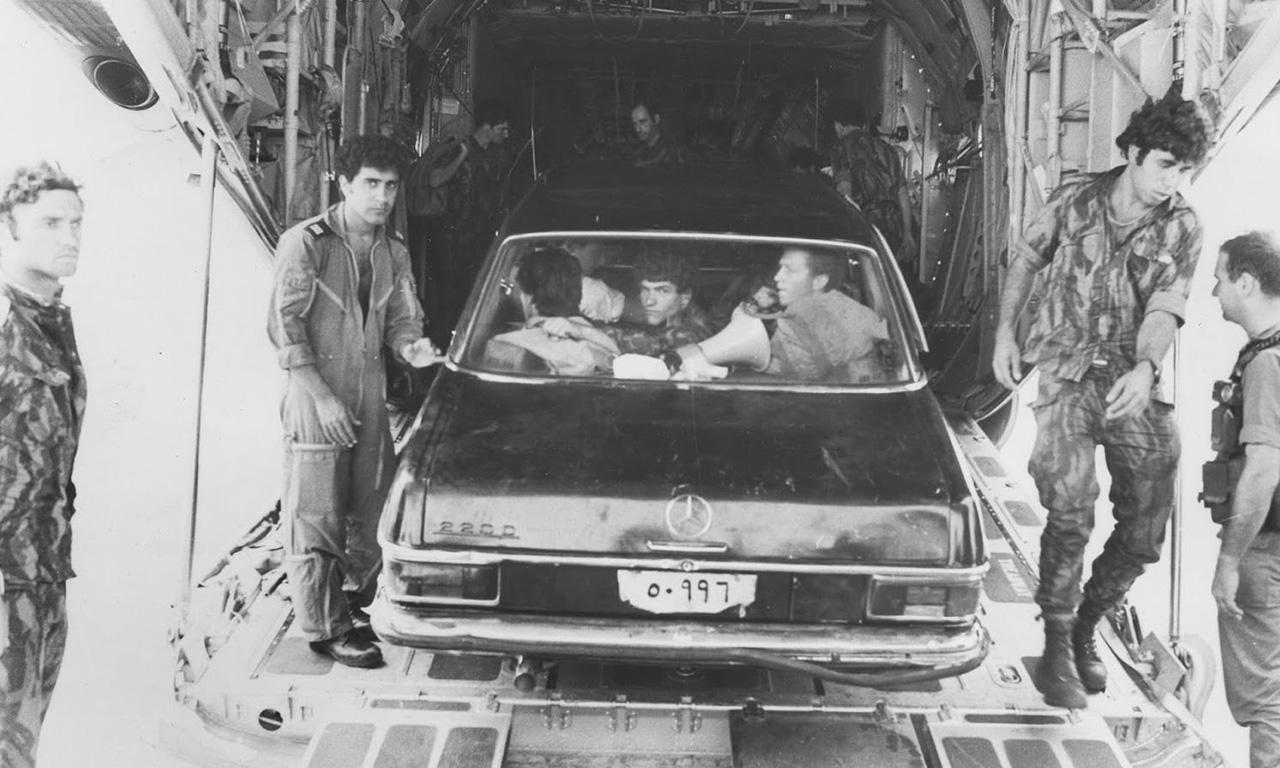
He was also part of the 33-member assault force in the first Hercules aircraft. After landing, the commandos travelled towards the old airport terminal in a convoy led by a black Mercedes intended to resemble Ugandan dictator Idi Amin’s official vehicle.
The hijacking
Air France Flight 139 was travelling from Tel Aviv to Paris via Athens on 27 June 1976 when two Palestinian terrorists and two members of Germany’s Revolutionary Cells seized the aircraft after it left the Greek capital.
The plane, carrying 248 passengers and crew, was forced to land in Benghazi, Libya, before continuing to Entebbe, Uganda. The four hijackers were joined there by three more terrorists and received support from Amin’s regime.
The captives were held in the old airport terminal. The terrorists separated the Israeli and Jewish passengers from most of the others, a selection carrying particular force barely 30 years after the Holocaust.
They demanded the release of 53 prisoners, including 40 held in Israel, as well as US$5 million.
Most of the non-Israeli captives were later released. The 106 people who remained comprised 94 passengers and the 12-member Air France crew, whose members refused an offer to leave their passengers behind.
Sherman’s first warning came when an alarm sounded at his unit’s base. The alarm was normally used when a terrorist attack was under way inside Israel.
“It was a normal day, nothing special,” Sherman told JWire.
The unit initially prepared for the possibility that the aircraft would return to Ben Gurion Airport. When it became clear the plane was moving farther from Israel, Sherman and other soldiers continued to Sinai for a separate assignment.
The crisis took on a different meaning after the terrorists separated the Israeli and Jewish passengers.
“No more Jews executed.”
Sherman said the selection forced Israel’s leaders to confront the state’s responsibility towards Jews beyond its borders.
“What is the responsibility of the State of Israel to defend Jews around the world?” he said.
He recalled the then defence minister Shimon Peres putting the issue plainly before ministers.
“No more,” Sherman quoted Peres as saying. “No more Jews executed. No more Jews killed without the intervention of the State of Israel.”
For Sherman, as the son of Holocaust survivors, those words carried particular meaning.
“The Jewish state was established to give a chance for Jews to live in security wherever they want,” he said.
By the middle of the week, Israel still had limited reliable information about conditions inside the terminal.
Some of the most useful intelligence came from released passengers. One woman drew a diagram of the area where the captives were being held, including the position of the doors and windows.
“It was very important information,” Sherman said.
Israel also drew on its previous relationship with Uganda. Israeli companies had been involved in building the old terminal, while Israeli personnel had earlier trained Ugandan forces.
Thousands of kilometres in darkness
Four C-130 Hercules aircraft left Israel carrying commandos, medical teams, support troops and vehicles.
They flew more than 4,000 kilometres, much of the distance at low altitude and under radio silence, without GPS and through two tropical storms, to reduce the risk of detection.
Sherman said the aircraft reached Entebbe just 17 seconds later than planned.
The first Hercules landed with its rear cargo door already open and the vehicles drove towards the old terminal.
“It was quiet,” Sherman said. “No one was awake.”
That silence was central to the raid’s success.
“One of the important features of the operation was the surprise that we were there,” he said. “Nobody knew that in a second we would open fire.”
Seven minutes
The Israeli soldiers crossed the exposed ground under fire from guards in the control tower and entered the dimly lit hall, where the captives had been sleeping on mattresses and blankets.
Sherman estimated that the main assault lasted about seven minutes.
All seven terrorists were killed. Sherman said about 25 Ugandan soldiers were also killed. Most of the soldiers ran away. Three hostages died during the raid.
Yoni Netanyahu was mortally wounded outside the terminal. Sherman drove him with a doctor to the medical evacuation aircraft.
“He was half-conscious,” Sherman said. “But the doctors couldn’t save his life, and he died after a few minutes in the medical plane.”
Sherman then assumed responsibility for the final evacuation stage and helped lead the freed captives towards the waiting aircraft.
The task proved harder than expected. Some Israeli soldiers were wearing Ugandan uniforms, and the terrified captives initially feared that troops had entered the terminal to kill them.
“They were quite sure we were Ugandans who had run in to kill them, even though we spoke Hebrew,” Sherman said, laughing at the memory.
The Israeli force left Entebbe in less than an hour, having rescued 102 people.
“We are not alone”
Sherman does not regard himself or the other commandos as the central moral figures in the Entebbe story.
That place, he said, belongs to Air France captain Michel Bacos and his crew, who refused to leave when they were offered freedom with the other non-Israeli captives.
Sherman recalled that one of the wounded hostages, lying on the terminal floor during the evacuation, wrote Bacos a note thanking him for what he had done and telling him that his decision had sent a message to the world.
“We should remember his decision,” Sherman told JWire. “I think we should bring it to every school, to every person who listens to that story.”
“The most important thing that should come out from that is that we are not alone,” he said.
Sherman compared Bacos’s decision with the actions of non-Jews who protected Jews during the Holocaust.
“It is a question of the values of life in many different aspects,” he said. “It is a message for all of us.”
Sherman remained in contact with Bacos for the rest of the pilot’s life.
When Sherman travelled to Nice to visit him in 2019, Bacos’s wife told him that the former captain had died the previous day, aged 95.
Sherman attended the funeral with an Israeli military attache. At Bacos’s request, Hatikvah was played at the end of the service.
“First, I cried,” Sherman said. “And the word which came to me was: what is Hatikvah? Hope.”
The spirit of Entebbe lives on through JNF’s work
Sherman’s national tour, hosted by JNF Australia with the involvement of Christian Zionist organisations, coincides with the launch of this year’s JNF 50 Families project.
JNF national board member Andrew Whitten said Sherman’s visit was an ideal way to mark the anniversary.
“It’s a fitting way to commemorate the 50th anniversary of the Entebbe rescue, having one of the key members of the Sayeret Matkal team who played a pivotal role in planning and executing the rescue of the Entebbe hostages,” Whitten said.
The 50 Families project brings together 50 Australian families each year to fund a specific project in Israel.
This year’s appeal will support the recovery of Kibbutz Nir Am, just over one kilometre from the Gaza border and one of the communities attacked on 7 October.
Funds will be directed towards a therapeutic space providing therapy, resilience workshops and emotional support for residents.
In its first year, the 50 Families project funded two programs, with donations supplemented by a further 25 per cent from KKL.
In southern Israel, it funded the Kibbutz Ein HaShlosha Community Nature Centre, an accessible therapeutic space containing a garden, greenhouse and outdoor kitchen.
In northern Israel, it funded 500 hours of trauma therapy for children, parents and educators in the Matte Asher Regional Council.
Sarah Vanunu said Entebbe represented a central principle of Jewish peoplehood.
“The story of Entebbe embodies the ultimate truth of our people: we share a united fate, and we put our necks out for one another,” she said.
She said Sherman’s tour reflected the bonds between Australian and Israeli communities.
“Through Rami’s firsthand account, we are able to show the true face of Israeli courage and resilience, strengthening the living connection between the people of Australia and Israel,” she said.
Vanunu linked Sherman’s story with the community fundraising behind the 50 Families project.
“This is peer-to-peer Zionism at its best: families coming together with strength and pride to directly fund the healing of communities like Kibbutz Nir Am,” she said.
“Whether it is a rescue mission 50 years ago or rebuilding the Gaza Envelope and our peripheral communities today, our commitment to standing together and building Israel’s future remains unbreakable.”
For details on Rami Sherman’s talks in Australia, see: https://jnf.org.au/events/