
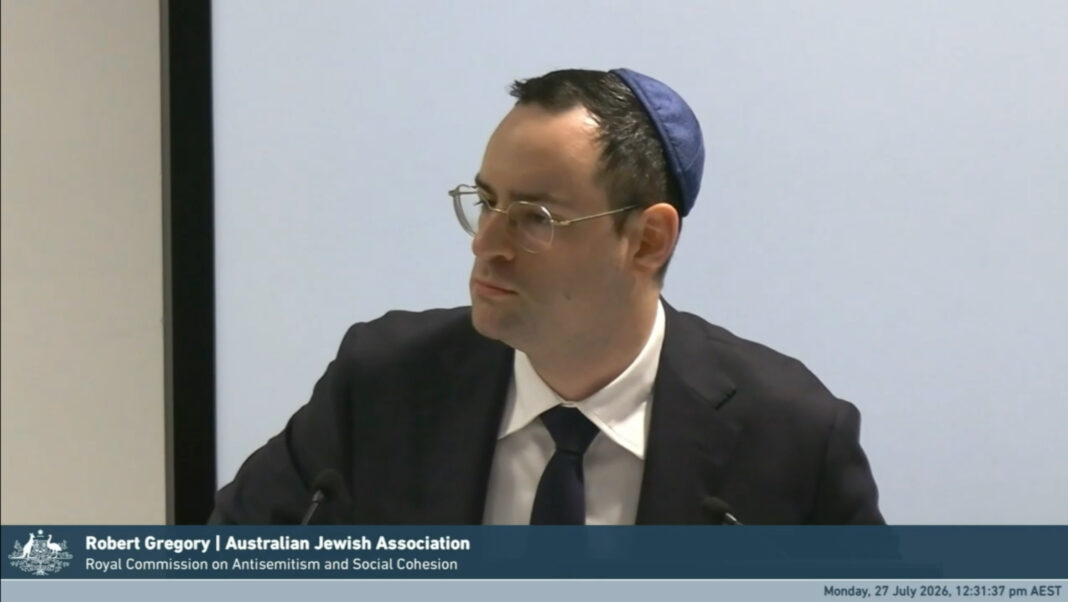
Physical security measures alone will not address rising antisemitism unless governments confront the social and political factors driving hatred against Jews, the Royal Commission into Antisemitism and Social Cohesion has heard.
Australian Jewish Association (AJA) CEO Robert Gregory said security funding and stronger protection were necessary, but their impact would remain limited without action against the forces contributing to antisemitism.
“You can bring in as many physical security policies and funding as you want, but if you don’t address the drivers of it, it can only have so much impact,” he said.
Gregory told the commission that antisemitism had become the main focus of his work since the Hamas attacks in Israel on October 7, 2023.
“In the early years in my role, it made up a very small amount of what I dealt with. Antisemitism existed, but it was quite small,” he said.
“I think what we saw after October 7, particularly at the Opera House immediately after, and at some of the celebrations in parts of Western Sydney, ushered in a very dark period for the Jewish community.”
He said weekly protests, terrorist symbols and images of Iran’s ayatollah had contributed to an environment that was “very hostile to Jews”.
“And now, the vast majority of my work is dealing with antisemitism,” he said.
Gregory said some existing antisemitic attitudes had been openly expressed after October 7 because people felt it was “socially acceptable to unleash” them.
He accused the federal government of contributing to the hostile climate through its policies and public statements.
“I think government policy, some of the statements and actions from people, particularly in the federal government, have egged on the situation,” he said.
Gregory referred to visa decisions affecting Jewish and Israeli visitors, comments by federal ministers and the Israel and Palestine policy adopted at Labor’s national conference on the weekend.
He also referred to the revoked visas of former Israeli minister Ayelet Shaked and Israeli parliamentarian Simcha Rothman. Gregory said Rothman had been invited by the AJA to speak at synagogues and Jewish schools and show solidarity with Australian Jews facing antisemitism.
“His visa was also revoked as he was on his way to the airport, which caused huge concern in the Jewish community,” he said.
Commonwealth counsel Peter Melican later rejected Gregory’s claim that the federal government had “egged on” antisemitism.
“That’s a very broad and somewhat political statement,” Melican said.
“I don’t think it can be adequately explored in the context of this hearing. But I just wish to note that that’s, of course, not a matter that the federal government accepts.”
Gregory also called for a review of the powers available to licensed security guards protecting Jewish events.
He said many members of the community would not feel safe attending events without armed protection.
“If the police can be there, that’s great. But they can’t be all the time,” he said.
He said relying solely on police would place a heavy burden on taxpayers and police resources, while trained security personnel already familiar with Jewish institutions and the threats facing them were available.
“If we’re trusting people to carry weapons to protect synagogues, I think, what’s the difference if they’re protecting Jewish events in other places?” he said.
Gregory said the AJA had never received government funding for security and paid its security expenses from its own resources.
“We’ve never got a cent for security. So, we pay for it out of pocket, and we’re also not getting advice on it,” he said.
He warned that imposing greater security duties on event organisers and venues risked making Jewish public life less accessible.
“If you’re putting extra responsibilities on venues and organisers, venues will refuse to host Jewish events,” he said.
Gregory said event organisers often faced a dilemma when discussing risks with councils and other venue operators.
“You don’t want to scare off the council,” he said.
“They’ve offered to host this event, and if I tell them, it’s a high risk of terrorist attack, well, they just won’t host it.”
He said details of planned events had been leaked to protesters, prompting venues to withdraw, while other venues had refused bookings because of concerns about protests or attacks.
Gregory said several major Jewish events had been cancelled by well-known Australian venues following pressure, although the organisations involved had not spoken publicly because they did not want to frighten attendees.
“These are not known to the public, but major Jewish events have been cancelled by major venues in Australia,” he said.
The commission also heard about an AJA webinar featuring former deputy prime minister John Anderson that was infiltrated by people Gregory linked to the University of Sydney encampment. He said they entered under false names, covered their faces and abused participants.
Many of those attending were elderly, and some had lost relatives in the October 7 attacks.
“It was quite traumatic,” Gregory said.
“Some of these people were scared. They were worried their accounts had been hacked.”
He said the incident was reported to the university, which began an investigation, but the AJA was not told of any outcome.
“The Jewish community shouldn’t have to live behind walls all the time,” Gregory said.
“These are public events for the community. We advertise them publicly. We want people to attend and listen.”
Gregory described the AJA’s experiences with law enforcement as mixed and called for clearer points of contact between community organisations and police.
He praised the engagement that followed the establishment of the Australian Federal Police’s Operation Avalite.
“When Operation Avalite was formed and they reached out to us and someone senior came and took things seriously, I felt there were results,” he said.
Gregory was also questioned about the relationship between antisemitism and antizionism.
He argued that Zionism was central to Jewish religious practice and identity, pointing to prayers directed towards Jerusalem, Jewish festivals connected to Israel and the breaking of a glass in memory of Jerusalem at Jewish weddings.
“No other minority group would be told by others how to define their identity,” he said.
“Zionism is central to Judaism. It’s central to the identity of Australian Jews.”
Commissioner Virginia Bell questioned whether his argument treated pro-Palestinian advocacy as necessarily hostile towards Jews.
Gregory said he was not referring to all Greens voters or everyone supporting Palestinian rights, but to the conduct and language of particular political representatives, protesters and activists.
He argued that old antisemitic claims had been transferred from Jews to Israel, including allegations about killing children and poisoning wells.
The royal commission is continuing hearings in Sydney examining security arrangements for Jewish communities following the December 14, 2025 Bondi Chanukah attack, in which 15 people were killed and dozens were injured.