
Book review by Dr Anne Sarzin
 It took courage and endurance for historian N. Koster to research and write Female Guards of Nazi Brutality; and it takes an equal measure of courage and endurance to read it and to look unflinchingly into its heart of darkness. Confronting unmitigated evil is always disturbing and frightening, but vitally necessary in an age such as ours, with antisemitism surging globally amid the proliferation of Holocaust deniers. We dare not turn away from the lessons of history that we need to reinforce and highlight for all generations, especially when a scholar as articulate, intelligent and insightful as Koster bears witness to the demonic actors in Nazi realms of cruelty, torture, medical experimentation and inhumanity. As the author states, ‘May this book contribute, in some small way, to the courage to speak, to educate, and to resist hatred in all its forms’.
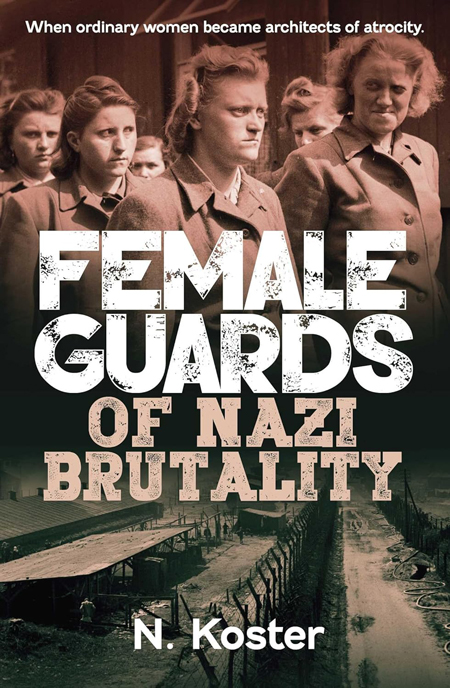
The world Kosten explores is stripped of empathy and humanity, a space where angels fear to tread. She brings the full force of her analytical intellect to bear on this territory of devilish brutality, a narrative focusing on ten female guards in Nazi camps during the Second World War. The result is a saga that compels our attention and involvement from the first word to the last. It is a mirror reflecting the descent of humanity into unrecognisable chaos where ethics, individuality, compassion and any vestige of humanity are obliterated. But it is also a fascinating and significant account of the metamorphosis of ordinary women—many of whom had been or aspired to be nurses, a profession associated with caring and nurturing—into brutal, sadistic and powerful despots inspiring fear in men, women and children during their reigns of terror.
This is an important book that rips the masks from the faces of women whose devilish careers belie conventional expectations of female roles in society and the ordinariness of their origin stories rooted in working-class or lower middle-class families. Their names constitute a roll call of evil doers: Irma Grese, Hermine Braunsteiner, Alice Orlowski, Elisabeth Volkenrath, Juana Bormann, Herta Bothe, Ilse Koch, Hildegard Lachert, Dorothea Binz and Maria Mandl. The author traces their transformation from the banality of their backgrounds and early career aspirations, through their apprenticeship and training in the Nazi concentration camps and, finally, to their reign as satanic and empowered wielders of torture and death. Was their orgiastic sadism innate? How did they expunge every skerrick of fellow feeling? What was the source of their bloodlust? If biography is destiny, why did their humble beginnings, their conservative upbringing and early career aspirations all end so abruptly? Why did their early religious convictions fail so completely to immunise them against the indoctrination and evil racism of their age?
Koster shows how, with fearsome rapidity, they jettisoned the conventions of their pasts and accommodated the new evils, the new ideology. They subscribed with enthusiasm to humiliating tactics and cruelty ritually inflicted on others, which demeaned and destroyed those over whom they ruled so mercilessly. As Koster states in her preface, ‘The question was not simply what they did, but how ordinary individuals adapted to roles within a system structured for dehumanisation’. Her book serves as an historical record and inquiry, her text confronting the actions of these Aufsherinnen, female guards, and the conditions that made their actions possible. She examines the fragility of ‘moral boundaries under pressure and the ease with which responsibility can be fragmented’. As she notes, history provides perspective and the recognition that people can be swept very easily into currents of cruelty, unless we resist and remember. In the ultimate analysis, her book is a clarion call for both resistance and remembrance.
In Kosterf’s Introduction, she outlines the role of thousands of women whose roles were integral to the Nazi camp system, women who were active enforcers of terror within the vast network of camps that comprised the Nazi killing machine. She states that these women guards signalled a normalisation of brutality and highlighted how deeply the regime relied on civilian complicity. In confronting the legacy of the female guards, she suggests that their capacity for cruelty lies neither in gender or class but in ideology, power, and the choices individuals make when faced with ethical imperatives. ‘Their history reveals how ordinary individuals, when exposed to dehumanising ideologies and coerced by state-sanctioned violence, can be remoulded into perpetrators of extraordinary cruelty,’ Koster states.
Irma Grese, known as the ‘Blonde angel of death’, was closely associated with personal brutality according to the testimony of survivors of Auschwitz-Birkenau and Bergen-Belsen. The system shaped her, promoted her and rewarded her. It is difficult to believe that she grew up in a conservative Protestant family, living on a farm in the German countryside. In 1942, she joined a group of female camp guard trainees in Ravensbruck, learning how to punish prisoners, detect sabotage and thwart subversive activities. Grese’s instructor was the notorious Dorothea Binz, who ‘shared with Grese a sinister predilection for bizarre and sadistic practices in the torture of female prisoners’. At Birkenau, Grese actively participated in selections alongside Josef Mengele, with whom she reportedly had a personal relationship. She was a brutal and sadistic overseer, whose specialty was unleashing trained dogs on defenceless people.
Alice Orlowski was raised in a structured , secure and respectable Berlin household, which underscores the troubling truth that ‘proximity to normality offers no immunity against moral collapse’. Between 1941 and 1943, she also trained in Ravensbruck, which Koster describes as ‘a crucible of moral annihilation—a place where cruelty was not merely tolerated but codified, where submission to authority was prized above conscience…where young women were systematically stripped of empathy and reshaped into instruments of terror’ Her exemplary performance secured her a post at Majdanek, the newly expanded concentration and extermination complex, where Orlowski developed her own macabre specialities. Transferred to Plaszow, where Amon Goth was in charge, he recognised in Orlowski a kindred spirit of brutality, entrusting to her the management of the camp’s death records. As the author notes, ‘she became a silent archivist of atrocity, a custodian of genocide rendered in numbers, names and dates’. She adds, ‘Her life demonstrated how authority was exercised within a system that rewarded cruelty, and how accountability, when it came, was partial and delayed’.
Koster presents arresting portraits of these female guards, who rose to power within the Nazi concentration camp system, ‘not through ideology alone, but through action, cruelty, and cold obedience’. Elisabeth Volkenrath, a former hairdresser, arrived in Ravensbruck in 1941 as a trainee overseer within the SS apparatus of terror; and was later transferred to Auschwitz where she enforced discipline with sudden violence. As Koster notes, ‘In Auschwitz, cruelty was currency, and Volkenrath spent it freely’. She supervised hangings, shootings and selections, enacting violence with precision and detachment. She performed her duties with efficiency, contributing to ‘one of the greatest moral catastrophes in human history’.
Every portrait documented in this book holds its own particular horrors. Juana Bormann immersed herself completely in the machinery of death. A woman once associated with missionary work became a functionary within multiple killing sites of the Third Reich. As Koster notes, ‘Devotion did not disappear in her life. It was redirected. The object of loyalty shifted from faith to state, from spiritual authority to institutional power’. Bormann provided presence, compliance and ‘the steady administration of harm’. Herta Bothe, who had worked as a nurse in a hospital, was also trained in Ravensbruck in ruthless tactics of control and punishment. Physically imposing, disciplined and brutal, her cruelty was sanctioned by a genocidal state. Among these titans of torture, Ilse Koch stood out for the way she revelled in suffering. She had a disturbing fixation with human skin, especially those with tattoos, an obsession that was horrifyingly real.
The remaining profiles are equally disturbing. Hildegard Lachert thrived on torture that reinforced her power and control. As Koster observes, ‘Her cruelty left a path of pain that no one who saw it could ever forget’. Through repeated violence, she shaped daily life for prisoners. Dorothea Binz entered Ravensbruck in 1939 for training as an Aufseherin. Surprisingly, she worked under Magda Goebbels, a powerful figure in the Nazi elite. Binz used her German shepherd dog as an instrument of torture; and witnesses recalled how she killed and returned to routine with a coldness that was ‘its own kind of horror’. Maria Mandel has been written about extensively and her role as the organiser of a women’s orchestra in Auschwitz-Birkenau is well known.
The arrests and trials of these perpetrators within the Nazi camp system is the subject of the book’s final chapter, which traces the legal frameworks and their individual responses in defence or denial of their actions. As the author concludes, ‘History cannot be undone. But it can be faced’. She states that it is important to examine their deeds as evidence of what happens when conscience is surrendered to system. Her book goes a long way to realising that aim.
Female Guards of Nazi Brutality
- Koster
Big Sky Publishing Pty Ltd, Newport, Australia
2026