

A record US$200 million gift from WhatsApp co-founder Jan Koum will help transform Jerusalem’s Shaare Zedek Medical Center.
The donation from the Koum Family Foundation is one of the largest gifts ever made to an Israeli institution, the largest single donation to an Israeli hospital, and will support a facility that has treated about 2,000 wounded Israeli soldiers since October 7, 2023.

The 124-year-old hospital will be renamed Koum Shaare Zedek Medical Center in recognition of the gift.
Speaking to JWire this week during a visit to Australia, Shaare Zedek president Professor Jonathan Halevy said the donation would help the hospital meet the needs of a rapidly growing Jerusalem.
“We have a little bit over 1,000 beds now, and it’s very congested,” Halevy told JWire.
“Jerusalem has one million people. It was half a million in 1998 when I came on board. The metropolitan area is now 1.4 million people and everybody agrees that within 10 years Jerusalem itself will have 1.5 million.”
The planned 24-storey tower will add about 1.5 million square feet of clinical and research space. It is expected to expand capacity from about 1,000 beds to 1,800, improve patient rooms, increase research facilities, strengthen protected underground areas and support new emergency facilities.
Koum, who co-founded WhatsApp in 2009 after immigrating to the United States as a teenager from the former Soviet Union, has become a major donor to Jewish causes in Israel, the United States and globally.
“This gift reflects our confidence in a future of medical innovation and research that will benefit patients in Israel and around the world,” Koum said when the donation was announced.
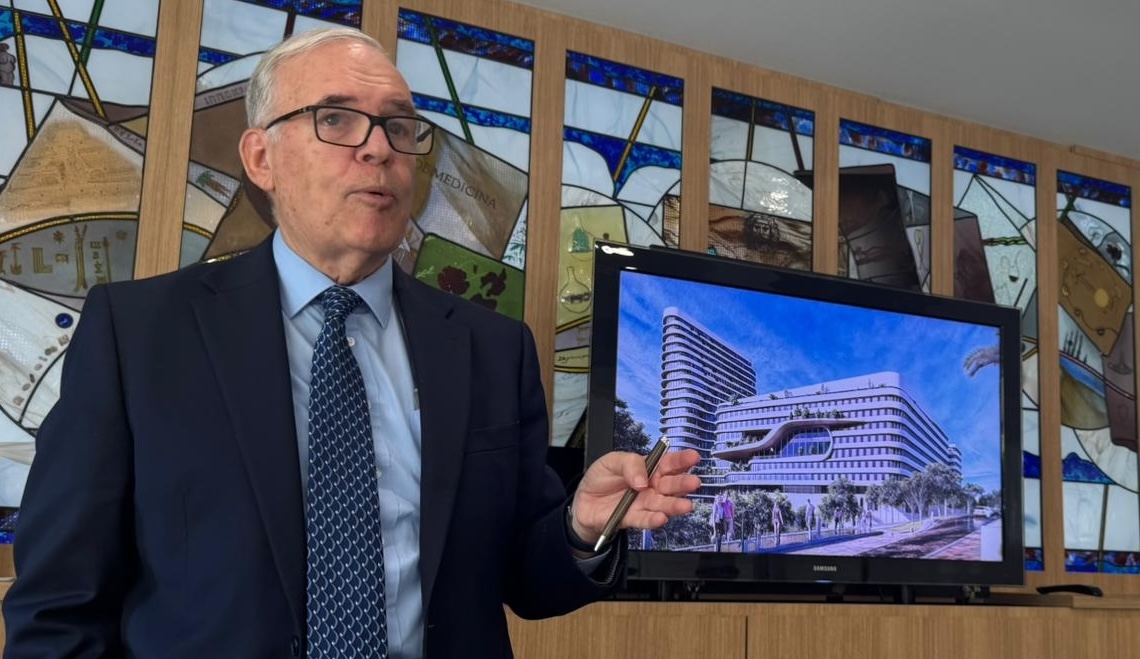
For Halevy, who served as chief executive of Shaare Zedek from 1988 until 2019 before becoming president, the gift is the latest chapter in a long period of growth.
When he arrived, Shaare Zedek had about 300 beds. Today it is one of Israel’s largest medical centres and operates Jerusalem’s only level-one trauma centre in the centre of the city.
“When a bomb detonates, unfortunately every minute counts,” Halevy told JWire.
“The location in the centre of Jerusalem is very important.”
Halevy, a gastroenterologist and liver specialist, continued clinical work throughout his years as chief executive and still sees patients as a consultant. As president, he advises the board and management, while also overseeing worldwide fundraising and medical risk management.
He said Shaare Zedek had developed centres of excellence that draw patients from across Israel, including complex surgery, paediatric gastroenterology, Crohn’s disease, ulcerative colitis, genetics and BRCA-related research.
The hospital’s trauma role has become more critical since the Hamas attacks of October 7, 2023.
Halevy said Shaare Zedek has treated about 2,000 wounded Israeli soldiers evacuated from Gaza since the war began.
“The army takes great pride in the fact that the average time elapsed from the injury in Gaza until the landing of the helicopter in a level-one trauma centre was 58 minutes,” he told JWire.
“Many, many lives were saved.”
Shaare Zedek has also opened a dedicated resilience centre for soldiers and civilians suffering post-traumatic stress disorder.
“We opened a special resilience centre for PTSD where soldiers and civilians are coming every day, many, many of them, with a large group of psychologists and psychiatrists,” Halevy said.
During the missile attacks from Iran earlier this year, the hospital undertook a major emergency relocation.
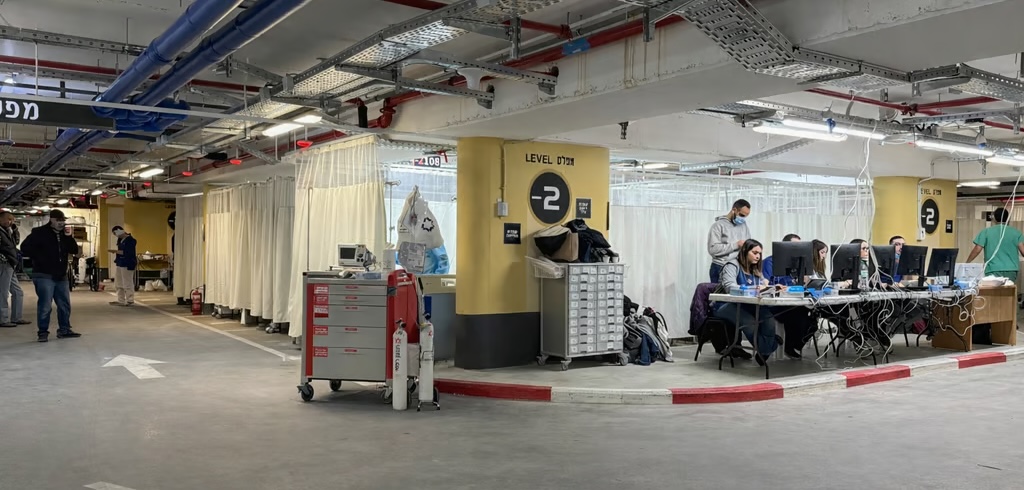
Within hours, staff discharged patients who could safely go home and moved hundreds of others underground.
“We moved 450 patients, in addition to 70 ICU beds and our birthing centre underground within hours,” Halevy told JWire.
“It was a major undertaking that really called for devotion from our 6,000 employees.”
The hospital’s maternity service is also one of its defining features. Shaare Zedek delivers about 20,000 babies each year, making it one of the largest birthing centres in the world.
“We deliver 12 per cent of Israel’s babies in one hospital,” Halevy said.
The scale has allowed the hospital to build Israel’s largest neonatal intensive care unit, with 70 bassinets and paediatric subspecialists across cardiology, gastroenterology and neonatal surgery.
Halevy explained that Israel’s national health insurance system funds the hospital’s day-to-day care, while philanthropy is used to build for the future.
“The operating budget of the hospital is balanced without donors’ money,” he told JWire.
“Donor money goes only for capital projects, to build a new building, even to replace equipment that has become obsolete.”
Halevy said fundraising had become an unavoidable part of hospital leadership, even though it was not the part of the job that originally drew him to Shaare Zedek.
“My great pride is not to be a ‘schnorrer’,” he said. “My great pride is developing Shaare Zedek over 31 years from 300 beds to 1,000 beds, recruiting the best physicians possible.”
He said successful fundraising depends on trust, credibility and long-term relationships.
“People give to people, not to institutions,” Halevy told JWire.
“You have to be trustworthy to donors.”
The same applied to recruiting leading doctors, he said.
“You have to have the reputation of someone who promises something he will deliver,” Halevy said.
He said donors often begin with modest gifts before developing a deeper relationship with the hospital.
“They start with a small gift and relationship development,” he said.
Over 38 years at Shaare Zedek, Halevy said he had raised about US$1.5 billion from donors around the world. But he said the most unexpected reward had been the friendships formed through the work.
“I made hundreds of friends from around the world, from the Jewish world,” he said.
During his Australian visit, Halevy spoke at several Sydney synagogues and to doctors at Wolper Hospital. He said Australian hospitals were medically strong, but Israel’s experience in trauma response and mass casualty planning was one area where Australia could learn from Israeli hospitals.
“I have high respect for the medical level,” he said.
“I think that Israel gained so much experience in trauma that organising the emergency plan for mass casualty events is one thing Australian hospitals could learn from us.”
Halevy said Shaare Zedek’s culture is built not only on medical skill, but on character.
“You define the best people not only as being the virtuoso surgeon, but also in terms of their personality,” he told JWire.
“You have the courage to send away a virtuoso surgeon in the operating theatre who does not relate to patients properly. That’s how you embed a culture of empathy in the hospital.”
That culture extends across Israel’s divided society, Halevy said.
He rejected suggestions that tensions between Jews and Arabs create difficulties inside hospitals.
“Hospitals all over Israel are havens for peace,” he said.
“I never in 38 years encountered a security problem.”
He recalled an incident during the Second Intifada when a nurse from Gush Etzion treated a Palestinian sniper who had shot at her and missed, after he was wounded and brought to Shaare Zedek’s emergency department.
“She took care of him,” Halevy said.
For Halevy, Shaare Zedek’s future will be measured not only by the scale of its new tower but also by whether it preserves the values that helped it grow from a small Jerusalem hospital founded in 1902 into one of Israel’s leading centres of medicine, research, trauma care and maternity services.
It is, he expounds, a hospital built on trust: between doctors and patients, between staff and management, and between the institution and the donors who help shape its future.