
Nikki’s Conversations with her Rabbi
Book review by Dr Anne Sarzin
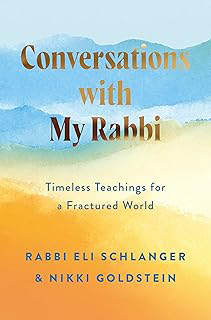 Writing the book Conversations with my Rabbi clearly proved both cathartic and transformative for author Nikki Goldstein and it is easy to understand why. Hers is a profoundly moving story of two lives—the secular and the sacred—woven together: Nikki, the secular journalist, and Eli Schlanger, the Chabad Rabbi, their intertwined narratives prompted by her pragmatic questions and, in response his spiritual answers, both voices in this dialogue and in their different ways redolent with messages, meanings and mysticism.
Their stated aims are to radiate light (Eli) and love (Nikki), with the intention of illuminating and potentially shaping the lives of others with the profound insights and power of ancestral wisdom found in the Seven Noahide Laws. These seven ancient laws were always intended as a universal inheritance for all humankind, their observance and enactment capable of elevating the lives of all humanity and, hopefully, creating a truly just society in the process.
These two very different individuals have merged their complementary skills to realise, as best they might, their somewhat daunting agenda of spreading knowledge and understanding of these sacred commandments, their efforts powered by their cherished individual goals of sharing light and love, yet united and merging their efforts to do so.
And in a strangely alchemical way, their unorthodox partnership succeeds in incalculable ways, impacting not merely their readers but also themselves, as their process works its magic on both of them. The result is a multi-layered narrative of scholarly depth and personal magnetism, their two voices uniting harmoniously in what is always a fascinating exposition of these ancient teachings and, at the same time, an insightful revelation of their personal quest to share the enlightenment at the core of these ancient precepts.
Then, suddenly, an apocalyptic event of horrific magnitude changes everything. On 14 December 2025, at Bondi Beach, at a public ceremony organised by Eli’s Chabad community to mark the first night of Chanukah, the festival of lights, two gunmen unleash a barrage of bullets that murderously end the lives of 15 people, including a ten-year-old child and a Holocaust survivor. Rabbi Eli is among those slaughtered so mercilessly.
In the aftermath of this tragedy, it would have been understandable if Nikki had stalled or even abandoned their joint mission. At that stage, the book was almost complete bar the final chapter. But Eli was Nikki’s Rabbi in many profound ways, and theirs has proved a mysteriously enduring bond. Their paths first crossed when, to all intents and purposes, she lay dying in an ICU ward, in a Sydney hospital.
Nikki’s husband, who is not Jewish, and her daughter spotted Rabbi Eli, who, serendipitously, was visiting the hospital at that precise time. At their request, he recited prayers at her bedside and blew the shofar, which he believed acted as a ‘spiritual defibrillator’, capable of recalibrating a human soul that was either transitioning to another realm or returning to life and strength. Happily, in Nikki’s case, it proved the latter.
Overwhelmed by grief at Eli’s death and the community’s catastrophic loss, her resolve to finish the book grew stronger; and the consequent change in the book’s tone and dynamic is palpable. At a certain point, there is an inversion of roles as she rallies her reserves and steers their ship with its precious cargo of Eli’s words into a safe harbour.
The realisation that his legacy to the world was in her hands motivated her to complete the task, now nothing less than a holy mission to fulfill Eli’s purpose of bringing the Noahide Laws to a wider world, to secure the certainty and continuity of his legacy for his family and their community; and to ensure his light would shine as brightly as before and serve to illuminate countless lives in the future.
Almost immediately, she set about writing the final chapter of the book in collaboration with Eli’s father-in-law, the venerable and wise Rabbi Yehoram Ulman, a chapter ironically and pertinently focused on the seventh Noahide Law, Establish Courts of Justice, an injunction to create a just society. Additionally, Nikki inserted contemporary references to the devastating event at Bondi and reflected on its ever-widening impact both locally and abroad.
The book’s context had changed dramatically. Now there were more layers, more analysis, more interpretations to make sense, if that were possible, of this irreparable loss. Yes, the central focus on the Noahide Laws, their theological strength still supported the book’s central purpose. But now it was all encapsulated in a greater purpose, memorialising a beautiful life lived with humility in the service of humanity.
What an authorial task and responsibility to shoulder so unexpectedly. Its sheer moral weight, complexity and depth might so easily have immobilised Nikki’s creativity. Instead, it spurred her onwards to deliver Eli’s advocacy of the Noahide Laws as a universal moral code for an age of chaos. At the beginning of the book, there is a straightforward explanation of these laws encoded in the Babylonian Talmud: Do not worship idols; Do not blaspheme; Do not murder; No eating flesh from a living animal; Do not steal; Do not commit acts of sexual immorality; and Establish courts of justice.
In Rabbi Eli’s enlightened commentary, there is an abundance of significant ideas. With immense thoughtfulness, he deconstructs these age-old concepts, prompted by Nikki’s astute and probing questions. His words have a disarming originality and directness that open up new spiritual vistas for the reader and offer recurring glimmers of profound understanding, a process he calls ‘aligning your inner wiring with that Divine flow’. His words are suffused with goodness and holiness, and he offers practical ways in which we can embed faith within our daily lives. There are moments that are intensely moving, such as his exposition of the Shema, the Judaic prayer that is a profession of monotheism.
Instantly, as Eli suggests, we can read this ancient text in three possible ways, depending on individual abilities—in Hebrew, in a transliterated phonetic version, or in English. There is something exciting and magical in becoming an active participant in this process rather than a passive reader. This is engagement with the text on a wholly different level, as we explore with Eli’s guidance these ancient teachings expressed through thought, speech and action. There are aphorisms and practical hints that can be incorporated easily in daily life, such as silently asking three questions before speaking as part of a modern discipline called Shemirat HaLashon, ‘Guarding the tongue’—Is it true? Is it necessary? Is it kind or at least constructive?
There are simple practices that transform speech, using your tongue to bless, to comfort and to acquire wisdom. Eli warns against dehumanising language that is akin to spiritual desecration. He urges that we should use conversation ‘as an opportunity to share God’s light. After all, that’s what we’re here for, to be a vessel of God’s light’.
With Eli’s absence from this literary partnership, there is, very occasionally, a tangible difference in textual quality. That’s an inevitable consequence of a changed dynamic, with Nikki, of necessity, taking greater control of content. My only criticism is of these rare descents—and they are exceedingly rare—into the deadening pragmatism of a self-help manual, evident, for example, in the discussion around sexual immorality.
Overall, this book written so fluently in a tangibly joyful collaboration and completed so tragically under great duress is insightful, moving, infinitely touching and a fitting tribute to the spirit of a good man whose words, thanks to these conversations, continue to teach and inspire.
Conversations with My Rabbi: Timeless teachings for a fractured world
Rabbi Eli Schlanger & Nikki Goldstein
HarperCollins Publishers, Australia
2026