
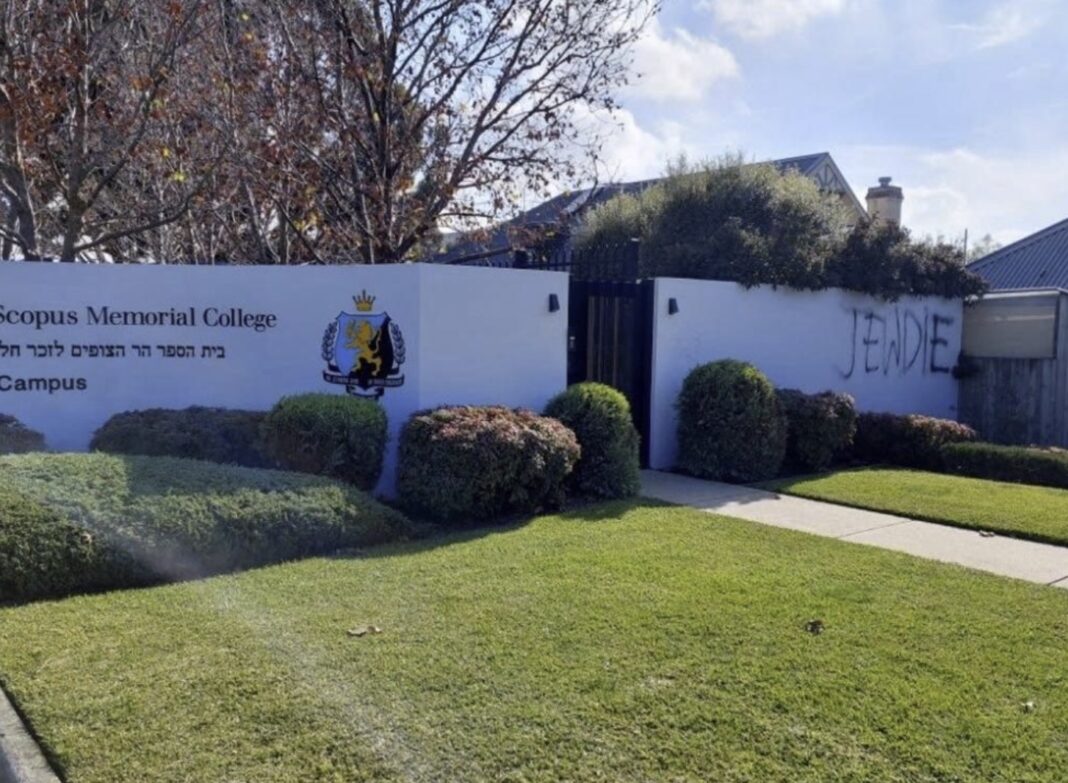
Australia’s Jewish community is being forced to spend increasing amounts of its finite philanthropic resources on security at the expense of education, culture and welfare, the Royal Commission into Antisemitism and Social Cohesion has heard.
Tahli Blicblau, chair of the Jewish Communal Appeal’s Allocations Committee and a former Community Security Group intelligence analyst, described the challenge as maintaining a “walled garden”.
The garden, she said, represents Jewish religious, cultural and educational life, while the wall represents the security and advocacy needed to protect it.
“In an ideal world, we wouldn’t need that wall. Certainly, we don’t want that wall, but unfortunately, it’s needed,” she told the commission.
Ms Blicblau said the sharp rise in security costs over recent years had forced the community to divert more philanthropic funding towards protection.
“There has been a need to invest far more heavily in the wall than the garden,” she said.
She warned that the community could no longer continue carrying that burden alone.
“It is no longer possible, and it should not be expected for Jewish philanthropy to cover the cost of protective security,” she said.
Drawing on her experience with both the Community Security Group and the NSW Crime Commission, Ms Blicblau said the Jewish community faced an increasingly complex threat environment requiring close cooperation with law enforcement agencies.
While relationships between police and Jewish security organisations had strengthened, particularly since the Bondi terrorist attack, she said there was still room for improvement.
“There is certainly strong cooperation … but it’s not perfect,” she said.
“If you accept that the level of threat is as severe as what we’ve discussed … there is a need to formalise and embed those relationships institutionally and organisationally,” she said.
Ms Blicblau also said many senior law enforcement officers had only a limited understanding of Jewish history, culture and the community’s unique security challenges.
“I think it’s fair to say … my senior colleagues at that time didn’t have a strong understanding either of Jewish history or culture, nor the unique threat environment as it impacted on the Jewish community,” she said.
The commission also heard evidence examining whether police systems are adequately identifying and recording antisemitic incidents.
Victoria Police Assistant Commissioner Martin O’Brien confirmed an anonymous abusive phone call to a Melbourne synagogue and a 5.5-metre swastika sprayed onto a construction site were not accompanied by Incident Fact Sheet references in police material examined by the commission.
The synagogue caller allegedly described Jews as “maggot rat Jews”, “genocidal”, paedophiles and warned that “your days are numbered”.
Mr O’Brien explained that Incident Fact Sheets are intended to provide officers across Victoria Police with near real-time awareness of significant incidents.
“It’s more for the flow of information across the organisation in terms of having a real-time understanding of what’s taken place and what is taking place,” he said.
He said the reports enable police to identify patterns, compare incidents with intelligence holdings and determine whether there is “a little bit more going on than what first presents”.
The commission also heard that while police can identify offences as prejudice-motivated in Victoria Police’s LEAP database, doing so is not currently mandatory, although work is under way to make it compulsory.
Victoria Police now operates a 24-hour State Command Coordination Centre, established in December 2025, which monitors live social media, crime reports, Incident Fact Sheets and intelligence feeds to identify emerging threats.
Counsel Assisting Richard Lancaster SC questioned whether police guidance reflected contemporary forms of antisemitism, including abuse directed at Jewish people through accusations linked to Israel.
Asked whether guidance should include examples such as describing Jews as “genocidal”, Mr O’Brien agreed.
“Yes, I would agree that type of example is a much better way of providing advice to members,” he said.
When asked whether current guidance already included examples of that nature, he replied: “Not that I’m aware of, no.”
The commission has heard throughout the week that Jewish schools, synagogues and community organisations continue to shoulder a substantial share of Australia’s Jewish security costs, despite significant Commonwealth funding.
The commission heard on Thursday that Commonwealth funding provided since 2023 has covered about half the security costs incurred by the Executive Council of Australian Jewry, which received a $25 million grant in 2023 to distribute funding to Jewish organisations, places of worship and community events.
The Royal Commission was established after the terrorist attack at the Chanukah by the Sea event at Bondi Beach on 14 December 2025, in which 15 people were killed and dozens more were injured.
Hearings in Melbourne this week continue to examine security funding, police intelligence systems and cooperation between law enforcement agencies and Jewish security organisations.
Including reporting by Lucinda Garbutt-Young and Melissa Meehan/AAP