
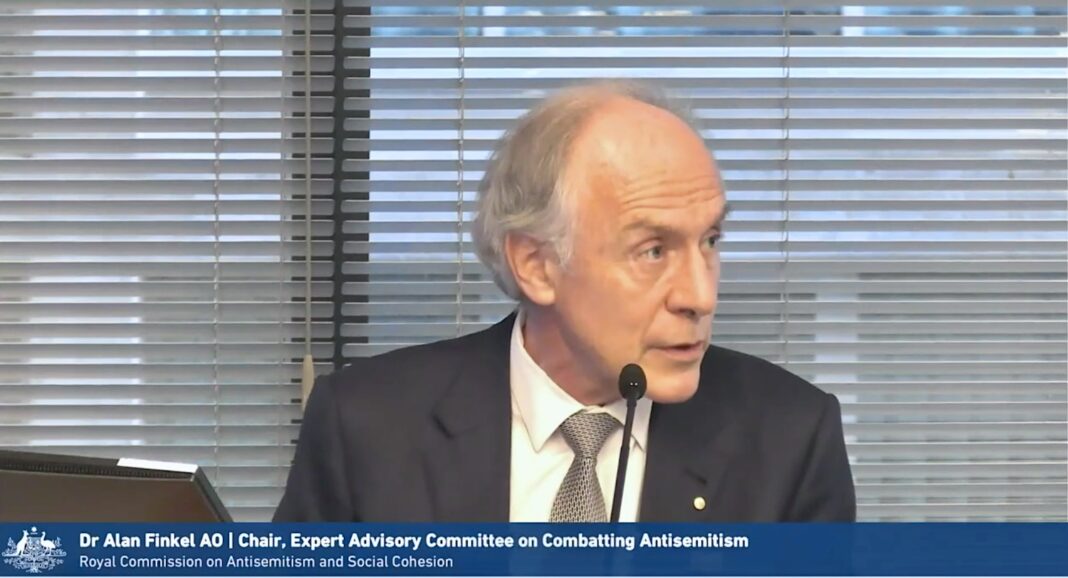
Former chief scientist Alan Finkel has urged Australian universities to turn their definitions of antisemitism into enforceable rules, warning that complaints have too often disappeared into institutional “oblivion”.
Finkel told the Royal Commission on Antisemitism and Social Cohesion that adopting a definition was not enough. Universities needed to incorporate it into codes of conduct, disciplinary systems, staff and student education, and complaints procedures.
Finkel chaired the Group of Eight’s Expert Advisory Committee on Combatting Antisemitism, which examined antisemitism at Australia’s leading research universities and the steps institutions had taken in response.
He presented the committee’s report to the Group of Eight board on June 4 and said vice-chancellors had responded positively.
“They were verbally pretty comfortable with all of the recommendations that we made,” he told the commission.
The committee recommended that universities use the Universities Australia definition of antisemitism, which was adopted by the organisation’s members in February 2025.
The definition describes antisemitism as discrimination, prejudice, harassment, exclusion, vilification, intimidation or violence that impedes Jewish people from participating as equals in public life.
Finkel said the definition should be used as more than a public statement. It can guide disciplinary action and help students and staff recognise contemporary forms of antisemitism.
He placed particular emphasis on complaints handling, saying the committee repeatedly heard that students and staff received little or no response after reporting incidents.
“One of the frequently heard concerns was that a complaint was made and effectively went to oblivion,” Finkel said.
“Nothing came back for more than a year, if anything at all.”
The committee recommended that universities provide an initial response within 10 days and aim to resolve complaints within 45 days where practicable.
Finkel said complaints staff needed to be properly trained, both to receive reports sensitively and to decide whether matters required formal investigation, informal resolution or escalation to senior management. Not every complainant was seeking punishment, he said.
“They’re not always looking for retribution. They’re looking for understanding and somebody to hear what the issue is.”
Finkel backed the annual publication of aggregated, de-identified complaints data, saying it would help universities, police and the broader community understand patterns over time.
“It’s a no-brainer,” he said.
“Universities should be doing it. The police want to see those kinds of reports. The community wants to see those kinds of reports, and councils, communities and everybody can learn from those reports, especially over a number of years when you’re looking longitudinally.”
However, he was more cautious about publicly identifying individual students or staff found to have breached university rules.
Finkel said secrecy can be overused, but universities also had to consider the lasting consequences of naming young adults who had acted foolishly.
“I do feel that the cloak of secrecy across our community, not just in universities, is possibly overused, especially if somebody has been found to have breached a code or the law,” he said.
“But I do have sympathy, especially in the case of somebody who is a young adult who’s possibly just been exuberant and stepped over a line and has a whole life ahead of them.”
Finkel also urged university leaders to establish strong relationships with police before protests or security threats escalated.
“You don’t want a police presence prematurely on campus, but you don’t want to delay calling the police if there is a significant risk of violence or an actual occurrence of violence,” he said.
He said vice-chancellors who regularly briefed senior or local police were better placed to seek assistance in a crisis.
“It was much easier for them to pick up the phone and have a discussion that was effective and understood, rather than calling up for the very first time in a panic and saying ‘help’.”
The committee recommended that universities give police aggregated and de-identified reports about hate-related incidents on campus.
Finkel said a senior police officer responsible for hate incidents had expressed frustration at receiving less information about antisemitism than other forms of hatred, despite the scale of reported antisemitic incidents.
He said police supported the proposal and universities showed little resistance.
Finkel also addressed the overlap between social media activity and conduct on campus.
He said public posts by lecturers, students and student organisations should no longer be treated as completely separate from university life.
“You really can’t say any more that people operating on social media are not as visible as somebody standing up on a soapbox on a university campus,” he said.
“Their actions on social media, if they’re on a public channel, have this permeability and overlap with their actions in the real world, the physical world, on university campuses.”
Finkel said affiliation agreements with student clubs and societies should make those groups responsible for social media channels they controlled.
The committee also recommended different levels of antisemitism and racism training for incoming students, student leaders, university executives, professional staff, lecturers and tutors.
Finkel said it was impractical to provide extensive face-to-face training to every student, but online modules could be used for new students.
Student leaders, lecturers and tutors should receive more detailed in-person training in constructive disagreement and the management of difficult classroom discussions.
“No one should be shut down,” he said.
“Opinion should be allowed, and lecturers and tutors should be well trained on how to manage that classroom decorum.”
Finkel’s evidence concluded a week of often confronting testimony from Jewish students, academics and university leaders, shifting the focus from what universities say about antisemitism to how they respond when it occurs.