
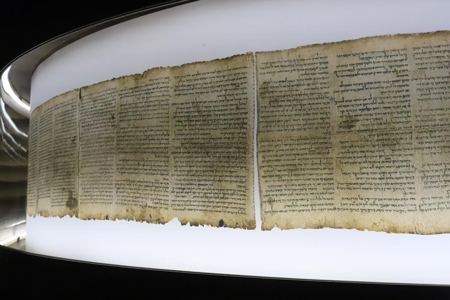
A new study by a Tel Aviv University researcher offers a possible resolution to a question that has divided scholars of the Dead Sea Scrolls for decades.
Was the Qumran sect’s unusual 364-day calendar ever put into practice, while suggesting the community’s famous break with Jerusalem, and its later reconciliation, were driven as much by shifting politics and a flawed calendar as by pure religious principle?
The Qumran sect is believed to have existed near the Dead Sea from roughly the mid-second century BCE until 68 CE, when the Roman army destroyed the settlement during the First Jewish-Roman War. Scholars believe that it either wrote or collected the Dead Sea Scrolls. The Dead Sea Scrolls, discovered beginning in 1947, include the oldest known copies of large portions of the Hebrew Bible and remain among the most significant archaeological finds related to Jewish history of the era.
The study, conducted by Tel Aviv University’s Prof. Eshbal Ratzon, suggests the sect’s distinctive calendar, based on a 364-day year rather than the lunisolar calendar used elsewhere in Jewish life during the Second Temple period, was put into practice during the community’s early years in the second century BCE.
She argues that the calendar was a central factor driving the sect’s break with the religious establishment in Jerusalem, since it reflected the belief that the timing of festivals had been fixed by God at the Creation of the world and should not be altered by human authorities.
However, the 364-day count had a built-in flaw: it fell short of the 365-day solar year by roughly a quarter day each year. Left uncorrected, the gap would have shifted festivals significantly out of alignment with the seasons within a matter of decades, a serious problem for a community whose holidays were tied to agricultural cycles such as harvests and first fruits.
According to the study, this drift, combined with improving relations between the sect and the Hasmonean ruler Alexander Jannaeus, led the community to quietly set aside its own calendar in favour of the more practical one used at the Second Temple. According to Ratzon, Jannaeus supported religious rulings similar to those favoured by the Qumran sect and opposed the Pharisees, a rival religious faction associated with the Temple leadership. The sect nonetheless preserved its 364-day calendar as an idealised model, one they believed had been valid at the time of Creation and would be restored in the End of Days.
Ratzon’s conclusion challenges two earlier theories that have dominated the debate: that the sect periodically inserted extra days or weeks to correct the calendar, or that the calendar was never used in practice at all. She points to nearly 20 scrolls found at Qumran dealing with calendrical and astronomical matters as evidence of the subject’s importance to the community. She also cites the Book of Jubilees, a key text in the Qumran library that criticises the mainstream lunar calendar and presents the 364-day system as the original calendar given to Moses at Mount Sinai.
“The Qumran calendar has long been regarded as one of the Qumran sect’s defining features, but also as one of the most baffling mysteries of the Dead Sea Scrolls,” Ratzon said. “This study proposes an alternative for the seeming contradiction between a functional calendar and a theoretical one.”
“It is quite possible that the calendar was in fact used for a certain period of time, but then, losing its practical role due to both inherent problems and political changes, became a religious ideal and a symbol of identity,” she said. “This would explain both its centrality in the Qumran scrolls and its gradual disappearance from historical reality.”
The study was published in the academic journal Tarbiz.