
Parents
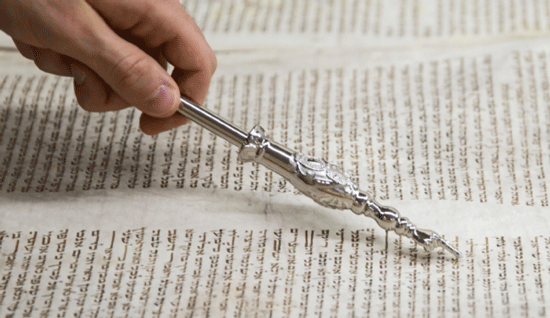
This week’s Torah reading is a fascinating combination of different and often conflicting themes. It starts off optimistically with the symbols of the Menorah and the eternal light.
All preparations for invading the land of Canaan have been made. Everyone’s placed in marching orders and looking forward to settling in a new land. At this moment the relationship with God is reinforced by the symbolic presence of God within the camp by night and day. And the promise of blessings was conveyed by the priests. But then things go wrong (BeMidbar Chapter 11).
The first sign, as you might expect, is food. In my days as Headmaster, the vast majority of student complaints were over the food! And as the saying goes “An army marches on its stomach.” In the desert, food had been taken care of both miraculously through the Manna, and through the natural resources and bird migrations. And Moshe struggles with the people’s demands.
The issue of delegation returns. It was Yitro, Moshe’s father-in-law, who had earlier advised him to set up councils for judicial and social management to help him cope with the challenges of leadership (BeMidbar 11:24). This time Moshe goes ahead. He invites 12 men from each tribe to serve. But that means that for there to be only seventy, the designated number on the council, two have to be left out, Eldad and Medad. Outside the Mishkan they started prophesying, whereas it seems that only within the circle they were gifted. The immediate reaction of Yehoshua, Moshe’s right-hand man, was to see Eldad and Medad as a threat, and he wanted to get rid of them. To which Moshe declared that if only everybody was prepared to be inspired and involved in government (so to speak), even outsiders, he would be happy.
Finally comes the episode in which Miriam and Aaron together complain against Moshe’s wife Ziporah, although not naming her (BeMidbar12). But it is not clear from the text, what the complaint was. It seems that Miriam and Aaron did not want to challenge Moshe’s leadership as others would. But they disagreed with some of the decisions Moshe had made in his personal life. In particular with his relationship with his wife Zipporah, and by implication his two sons. They accused him of setting a bad example by withdrawing from them. Moshe seemed to be so engrossed in his own problems that he failed to notice what was happening at home. And this is often the problem with great leaders and often the families that suffer.
The rabbis of the Talmudic era, often have different ways of understanding the Torah text. A fascinating Midrash says that Ziporah was standing next to the wives of Eldad and Medad when their husbands were excluded from being part of the Council of 70. They were upset because their husbands had been overlooked. She tried to reassure them by telling them they were fortunate that their husbands (unlike hers) were not involved in public affairs. Now their husbands would be able to pay more attention to them and their families and not neglect them. Miriam was standing nearby and overheard this conversation and reported it to Aaron. This was the issue that she/they were complaining about to Moshe, that he had, in fact, neglected his family and was setting a bad example to the community since he had separated from his wife to concentrate on his relationship with God.
The Midrash later mentions Biblical giants such as Eli and Shmuel, whose sons failed them. And even that Moshe had a grandson who was idolatrous. Miriam and Aaron were wrong to bring Ziporah into it, and of raising the issue in public. Undermining the position of Moshe rather than reinforcing it at a crucial moment.
So often we see in life how it is that great men in every culture and way of life, around the world and over time, fail to produce great children, and perhaps this is because they fail to find a balance between their public and private lives. Between the loneliness of leadership on the one hand, and the support of the family on the other.
Rabbi Jeremy Rosen lives in New York. He was born in Manchester. His writings are concerned with religion, culture, history and current affairs – anything he finds interesting or relevant. They are designed to entertain and to stimulate. Disagreement is always welcome.