
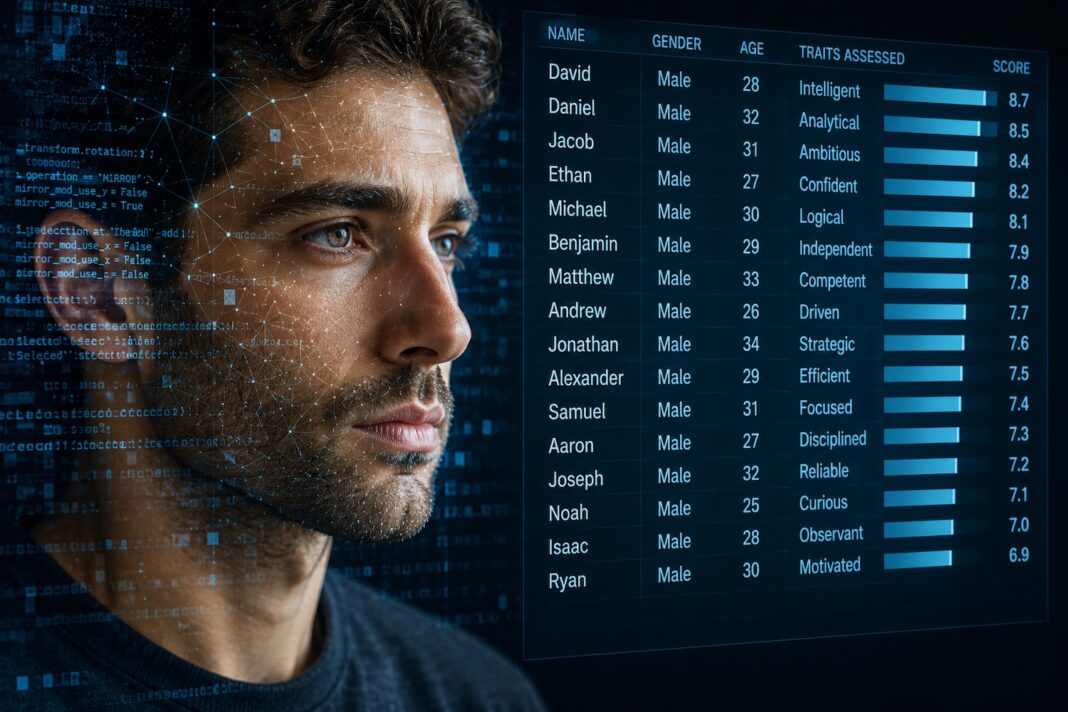
A new study published in American Psychologist has found that leading AI models carry biased representations of Jews that closely mirror antisemitic tropes dating back centuries.
The research was conducted by Professor Michael Gilead of the School of Psychological Sciences at Tel Aviv University’s Gordon Faculty of Social Sciences, together with Dr Gal Gutman of the Faculty of Business and Management at Ben-Gurion University of the Negev.
Rather than asking AI models direct questions about Jewish people, the researchers used an indirect test. They asked ChatGPT, DeepSeek and Mistral to generate 252 short biographies of characters with either Jewish or non-Jewish names, matched by age and gender.
The names and identifying details were then stripped out, and the models were asked to rate the characters’ traits. That allowed the researchers to examine what the names alone had triggered.
The approach was necessary because AI models often refuse or soften direct questions about ethnic groups. The study suggests this kind of safety training may change what the models say, without removing stereotypes embedded in the way they represent groups internally.
Across 19 separate dimensions, a consistent pattern emerged. Characters with Jewish names were rated as more intelligent, competent, confident, assertive and efficient, but less friendly, warm and likeable.
They were also rated as more dominant, orderly and emotionally controlled, less collectivistic, more accepting of hierarchy and more long-term oriented. The models also associated them with higher obsessive-compulsive tendencies and lower attention-deficit tendencies.
No single trait in that list is antisemitic on its own. The concern lies in the pattern: high ability combined with coldness, control and power. The researchers said that combination echoes long-running antisemitic images of Jews as clever, calculating and socially detached.
Despite the long history of Jewish persecution, the models tended to portray Jewish-named characters as privileged and as oppressors rather than as victims.
The researchers said the pattern reflects earlier work on human prejudice, including Princeton psychologist Susan Fiske’s stereotype content model. That model holds that stereotypes are often ambivalent rather than openly hostile. Groups seen as competent but cold are often envied, and envy can turn volatile in times of crisis.
Jews have long been placed in that uneasy category in public perception. The study found the models had reproduced a version of that pattern, with Jewish success framed as both earned through competence and unearned through privilege.
When the researchers fed the trait pattern back into the models and asked which fictional figures matched it, GPT nominated characters including Hannibal Lecter and Victor Frankenstein. Sherlock Holmes, Dr House, Walter White, Tony Stark and Lisbeth Salander appeared across all three models.
Asked what these characters had in common, the models pointed to high intelligence, social isolation, obsessive focus, disregard for rules and a personal moral code that overrides conventional morality.
The researchers said that description closely resembled the classic antisemitic “puppet master” trope, in which Jews are cast as brilliant hidden manipulators. That trope has appeared in antisemitic texts and conspiracy theories for generations, including the Protocols of the Elders of Zion.
The most telling finding came when the models made the link themselves. When shown the trait cluster with no mention of Jews and asked which group is most often targeted by prejudice involving these characteristics, ChatGPT, DeepSeek and Mistral all named Jewish people first.
The findings were not limited to the AI systems. Hundreds of US participants who separately rated the anonymised biographies identified the same patterns. The researchers said this showed the bias was present in the generated text itself, not just in how the models were questioned.
“For most of history, these tropes circulated through pamphlets, caricatures, and rumour,” Professor Gilead said. “Today they sit, dormant but intact, inside systems that hundreds of millions of people consult every day. The models never say anything explicitly antisemitic, but they may be predisposed to evaluate Jewish individuals in a way that replicates ancient antisemitic tropes.”
Dr Gutman said the bias was unlikely to be deliberate.
“Artificial intelligence systems do not express antisemitism in an intentional or conscious sense. Rather, they may reproduce patterns of representation and cultural stereotypes embedded in the data on which they were trained,” she said.
She said historical biases do not simply disappear. Instead, they can remain in the structure of a model’s learned knowledge even after alignment and bias-mitigation efforts.
“Jews are the case study here, but any group’s latent portrait can be extracted the same way, and we suspect many would be similarly troubling,” Dr Gutman said.
Professor Gilead also offered a broader observation beyond the study’s data, saying AI models may serve as an analogy for human minds.
“Like them, people absorb their culture wholesale, and it may leave deep structures that quietly prime how we interpret the world,” he said.
“If the analogy holds, the puppet master does not live only in the minds of avowed antisemites. It may lie dormant in the cultural unconscious of people who sincerely hold no prejudice at all, waiting, as in the models, for something to call it up.”
The researchers argue that the hidden nature of these representations makes them important. AI systems are increasingly used to screen job applications and support decisions about loans, services and other opportunities. In those settings, a name may be one of the few personal details available.
Because the bias does not appear as explicit hate speech, it may not be caught by standard moderation tools or safety filters.
The study concludes that scrutiny of AI systems needs to go beyond what they openly say. It also needs to examine what they silently associate, especially when those associations can affect real people in real-world decisions.