
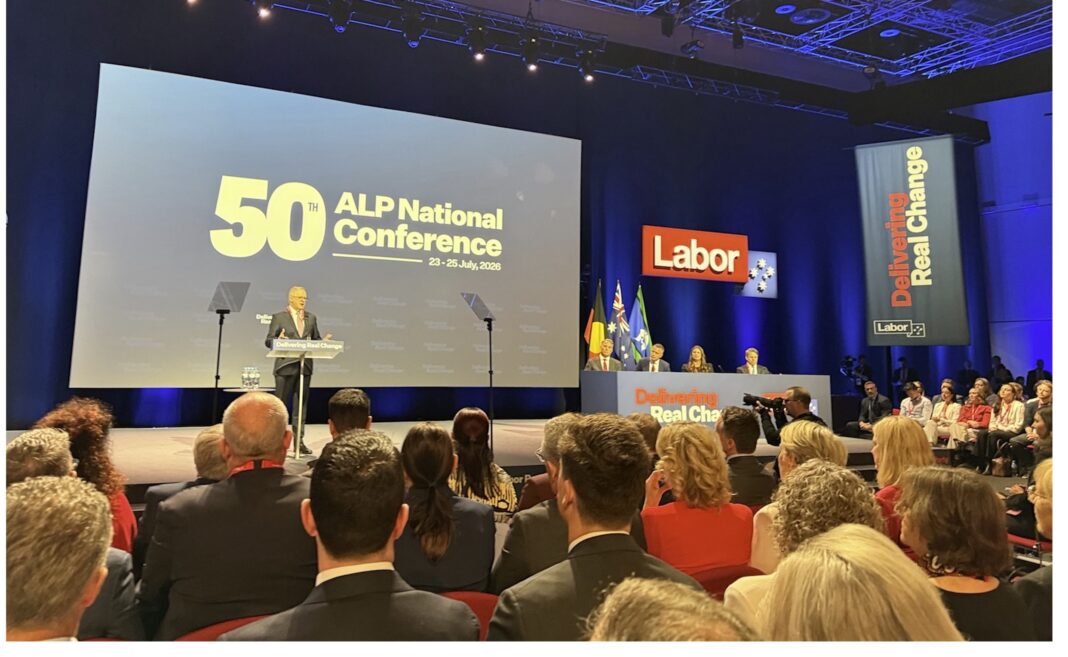
Labor is facing growing concern from Jewish leaders that its national conference will increase pressure on Israel while weakening demands on Hamas and the Palestinian Authority.
The concern intensified on Friday as delegates in Adelaide considered calls for an end to military trade with Israel, greater scrutiny of Australians who have served in the Israel Defense Forces, and stronger condemnation of Israel’s conduct in Gaza.
The proposals remain amendments rather than Labor policy, with the decisive foreign affairs debate expected before the conference concludes on Saturday.
For Jewish organisations, the central issue is broader than any single motion. They are watching whether the final platform retains clear conditions: that Hamas disarms, remains excluded from the Palestinian government, and releases the remaining hostages; and that the Palestinian Authority undertakes the promised reforms.
Those conditions were linked to the Albanese government’s recognition of a Palestinian state in September 2025 but are softened or absent in the conference draft.
The Executive Council of Australian Jewry has accused Labor of a “one-eyed obsession with blaming Israel”, arguing that the draft focuses heavily on Israel while failing to give comparable attention to Hamas, Palestinian rejectionism, and the need for reform of Palestinian institutions.
The Zionist Federation of Australia has also warned that Labor risks abandoning key conditions it previously presented as central to a viable Palestinian state and lasting peace.
Their concerns have been reinforced by amendments supported by sections of the union movement and pro-Palestinian Labor members.
Western Sydney MP Ed Husic is backing stronger legal scrutiny of Australians returning after service with the IDF. The proposal seeks a dedicated Australian Federal Police process to examine allegations that Australian citizens committed offences while serving overseas.
Supporters say Australians should be held accountable for any breaches of Australian or international law.
Critics say the proposal singles out people serving in Israel’s armed forces without evidence of wrongdoing and risks treating them as suspects because of their connection to Israel.
The Australian Manufacturing Workers’ Union is also calling for an end to military trade with Israel.
Neither proposal had been adopted by Friday afternoon, and Labor’s factions were continuing negotiations aimed at avoiding a damaging floor fight.
Further amendments reportedly call for Australia to withdraw diplomats from Israel and describe Israel’s conduct in Gaza as genocide.
The International Court of Justice has not issued a final ruling that Israel has committed genocide.
The Israeli Embassy in Canberra made an unusual public intervention before the conference, arguing the draft platform placed disproportionate blame on Israel while overlooking Hamas, the hostages, and failures of Palestinian leadership.
The embassy questioned why earlier language requiring Hamas to disarm and the Palestinian Authority to reform had been removed or reduced.
Some Labor figures rejected the embassy’s intervention, saying a foreign government should not seek to influence an Australian party’s internal policy process.
Senior Labor figures have nevertheless sought to reassure Jewish supporters.
Trade Minister Don Farrell and South Australian Premier Peter Malinauskas addressed a Jewish Labor Movement event alongside the conference, affirming Israel’s right to exist and Labor’s support for a negotiated two-state outcome.
Their comments came as the Royal Commission on Antisemitism and Social Cohesion heard further evidence about the insecurity facing Jewish Australians.
Liberal MP Julian Leeser told the commission on Friday that his son no longer felt safe attending Jewish events, adding to testimony about the personal impact of antisemitism on Jewish families.
The timing has sharpened concern about Labor debating punitive measures against Israel while the country is confronting a severe rise in antisemitism.
Labor’s draft platform still supports two states, Israel and Palestine, living in peace and security. It condemns terrorism and violent extremism, including by Hamas, and opposes Israeli settlement expansion, annexation, and extremist settler violence.
The dispute centres on balance and emphasis.
Jewish leaders are asking whether the final document will impose detailed demands on Israel while offering only general condemnation of Hamas and limited expectations of the Palestinian Authority.
The answer will determine whether the conference produces only a modest restatement of existing Labor policy or a deeper shift in the party’s approach to Israel.
Until the foreign policy debate is completed, the proposals on military trade, diplomats, and returning IDF personnel remain internal demands rather than government policy.
For Jewish Australians, the most important test will be whether Labor’s final platform recognises that Palestinian statehood and peace require obligations from Palestinian leaders and Hamas, not only further pressure on Israel.