
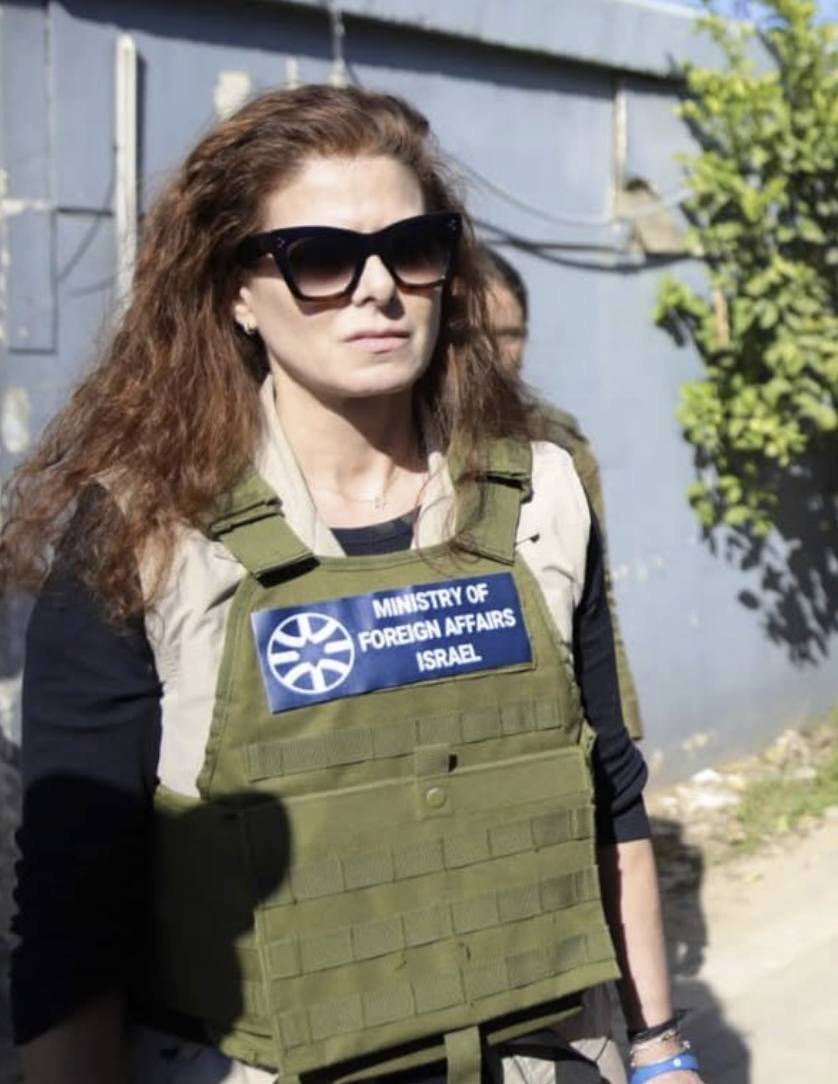
Actress Debra Messing has urged Sydney’s Jewish community to stand openly and proudly as Jews, telling JCA’s major campaign event that the answer to antisemitism is not silence but courage, unity and identity.
The Emmy Award-winning actress, producer and activist was the guest of honour at the event, held at Randwick Racecourse on Sunday, 31 May, where more than 1,600 people gathered for JCA’s first major communal gathering since the Bondi Beach terror attack on 14 December.
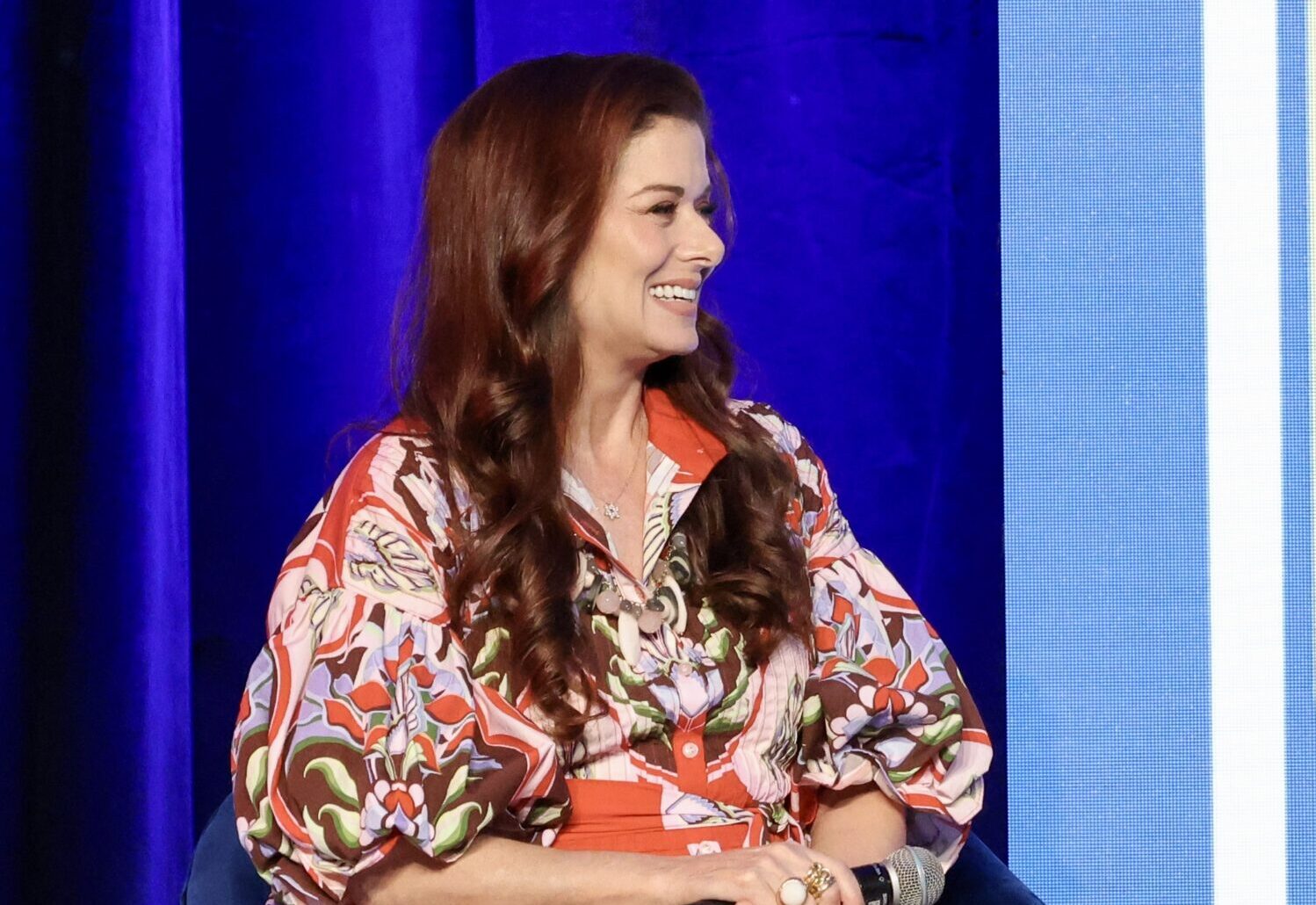
The event also launched JCA’s largest-ever campaign, with the organisation hoping to raise around $40 million, close to double last year’s total, to support victims, families, security, welfare, education, advocacy and long-term communal recovery.
In a deeply personal conversation with Sky News journalist Sharri Markson, Messing said her Jewish advocacy had been shaped by childhood experiences of antisemitism in Rhode Island, where she was one of only a few Jewish students in her school system.
She recalled being called an antisemitic slur in second grade and later waking to find a swastika painted on her grandfather’s car.
“It was very, very clear to me that we were hated,” Messing said. “I learnt very quickly that in order to feel safe I had to stay silent about my identity.”
Messing said that silence stayed with her for much of her life, even as she became one of the most recognisable Jewish performers on American television.
She told the audience that when she was cast as Grace Adler in “Will & Grace”, she deliberately pushed for the character to be openly and prominently Jewish, seeing it as a chance to normalise Jewish identity on mainstream television.
She said she wanted references to Jewish camp, Passover and other Jewish experiences included whenever possible.
The response from Jewish viewers, especially women and girls, had stayed with her.
“I started getting letters from young girls and women saying thank you. I finally see myself on prime-time TV,” she said.
Messing has become one of the most prominent Jewish advocates internationally since the Hamas attacks on Israel on October 7, 2023, speaking at the March for Israel in Washington DC, travelling to Israel to meet hostage families and survivors, and helping produce the documentary “October H8te”, about the rise in antisemitism since the attacks.
She said October 7 had changed her life.
“I feel like my life is everything before October 7 and then everything after,” she said.
She said she had expected the world to mourn with Israel and the Jewish people but instead saw rallies and public celebrations almost immediately after the massacre.
“The next day I saw the Sydney Opera House, and that was the moment that I realised that we were alone, and no one was going to mourn for us or with us,” she said.
Messing said she was shocked by the reluctance of many in Hollywood to speak up for the hostages, even when asked to sign a letter to then-US president Joe Biden calling for urgent action to free civilians taken hostage by Hamas.
“This wasn’t about Jews or Israelis. It was about citizens from 33 countries,” she said.
When many refused to sign, she said, “that was when I realised that we were really in uncharted territory”.
Messing spoke frankly about the cost of her advocacy, saying she had lost friends and felt abandoned by people she had known for years.
“I felt betrayed, I felt abandoned, I felt maligned, I felt like I was completely alone,” she said.
She also said the pressure had taken a serious personal toll.
“It has been the hardest thing that I’ve ever experienced in my life,” she said. “I felt incredibly depressed for a period of time. I felt enraged.”
Messing said her representatives had supported her advocacy, but she knew that some people in the entertainment industry privately praised her while remaining publicly silent.
She said her representatives would tell her they had received calls from people across the industry saying, “please tell her thank you” and “please tell her that I admire her courage”.
“And yet those people stayed silent,” Messing said.
Messing said she eventually came to understand her advocacy as her purpose.
“This is what I’m meant to do,” she said.
Her first trip to Israel, two months after October 7, became another defining moment. Messing visited kibbutzim that had been attacked, the Nova festival site, hospitals, hostage families, survivors and injured soldiers.
“I came back feeling such pride in being Jewish. I fell in love with Israel,” she said. “I felt safer there than I felt in New York City.”
Messing said that after falling in love with Israel during her second visit, she began the process of seeking dual citizenship.
“I thought, you know what, that is home,” she said. “I don’t understand it, but when I’m there, I feel it in my soul.”
Asked about the global rise in antisemitism, Messing said anti-Zionism had become the main form through which antisemitism was now expressed.
“The term ‘antizionism’ is being used as a shield,” she said. “Every generation, there’s a new way that antisemitism is expressed, and in our generation right now, this is antizionism.”
Messing said people who protest only against Israel while remaining silent on conflicts and crises in Sudan, Yemen and elsewhere exposed an antisemitic double standard.
“If the only thing that bothers you enough to make you put on a mask, make yourself unrecognisable, and run around your city with Hamas flags is the fact that it’s the Jewish thing, I feel like you are so brainwashed that it’s impenetrable,” she said.
Messing also addressed the Bondi Beach terror attack, telling the audience that Jewish communities around the world had mourned with Sydney.
“The Jews in the diaspora have been mourning the loss of your citizens and people from your community,” she said.
She said seeing coverage of the attack, including the death of 10-year-old Matilda and an 87-year-old Holocaust survivor, felt like “October 7 again on just a smaller scale”.
Markson noted that 15 people were killed and more than 40 were shot or wounded, with some victims still in hospital.
Messing said antisemitism was often minimised because many people saw Jews as resilient and successful, which fed resentment and conspiracy theories.
“I think it’s very hard for people to feel badly for the Jews,” she said.
Despite the fear felt by many Jews, Messing said the answer could not be withdrawal.
“It is our responsibility globally as Jews to be louder and stronger and prouder than we have ever been in the history of the Jewish world,” she said.
“If we allow them to make us feel like we can’t wear our Jewish star around our neck or a kippah … they win.”
She said young Jews gave her hope.
“The young Jewish kids who are in college or coming out of college, they are going to save us,” she said. “They are leaders that are stronger than any generation before us.”
Messing ended with a message of resilience.
“We’re still here after 3,000 years,” she said. “We are here to bring the light into the dark.”
JCA president Ian Sandler, delivering an emotional final annual campaign address, reflected on the organisation’s history since 1967 and the central role it has played in supporting Jewish life in NSW and the ACT.
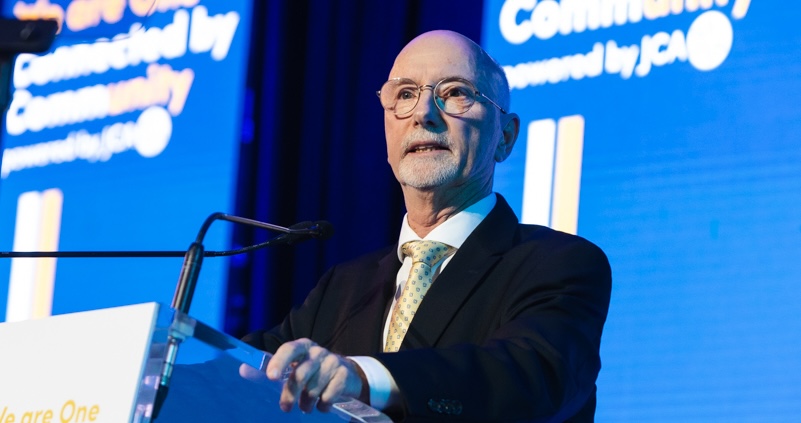
He said JCA began after the Six-Day War, when the community understood that “our collective future depends upon shared responsibility”. The first campaign raised $340,000 for 10 founding organisations. Today, JCA supports 24 core organisations across education, aged care, security, culture, advocacy, engagement, sport and welfare.
Sandler said his presidency had spanned some of the most difficult years in recent Jewish history, including COVID, October 7, the surge in antisemitism and the Bondi attack.
He also paid tribute to outgoing NSW Jewish Board of Deputies president David Ossip for his leadership since October 7 and also acknowledged that he would soon step down as JCA president, with Myra Salkinder to take on the role.
Sandler also said JCA had modernised its structure through a corporate trustee model and the creation of the Jewish Community Foundation, a deductible gift recipient (DGR1) charity.
He said the changes meant JCA was now positioned to support not only its 24 core organisations, but the broader communal network, including Jewish House, Community Health Support and Abraham’s Tent.
Speaking about the Bondi attack, Sandler said the tragedy had united the community across religious, political and organisational lines.
“Every divide fell away: Orthodox and Progressive, left and right, the big institutions, the small groups working out of someone’s lounge room. Everyone moved as one,” he said.
The event also heard from Jeff Finkelstein, president and chief executive of the Jewish Federation of Greater Pittsburgh, whose community endured the 2018 Tree of Life synagogue massacre, in which 11 worshippers were murdered.
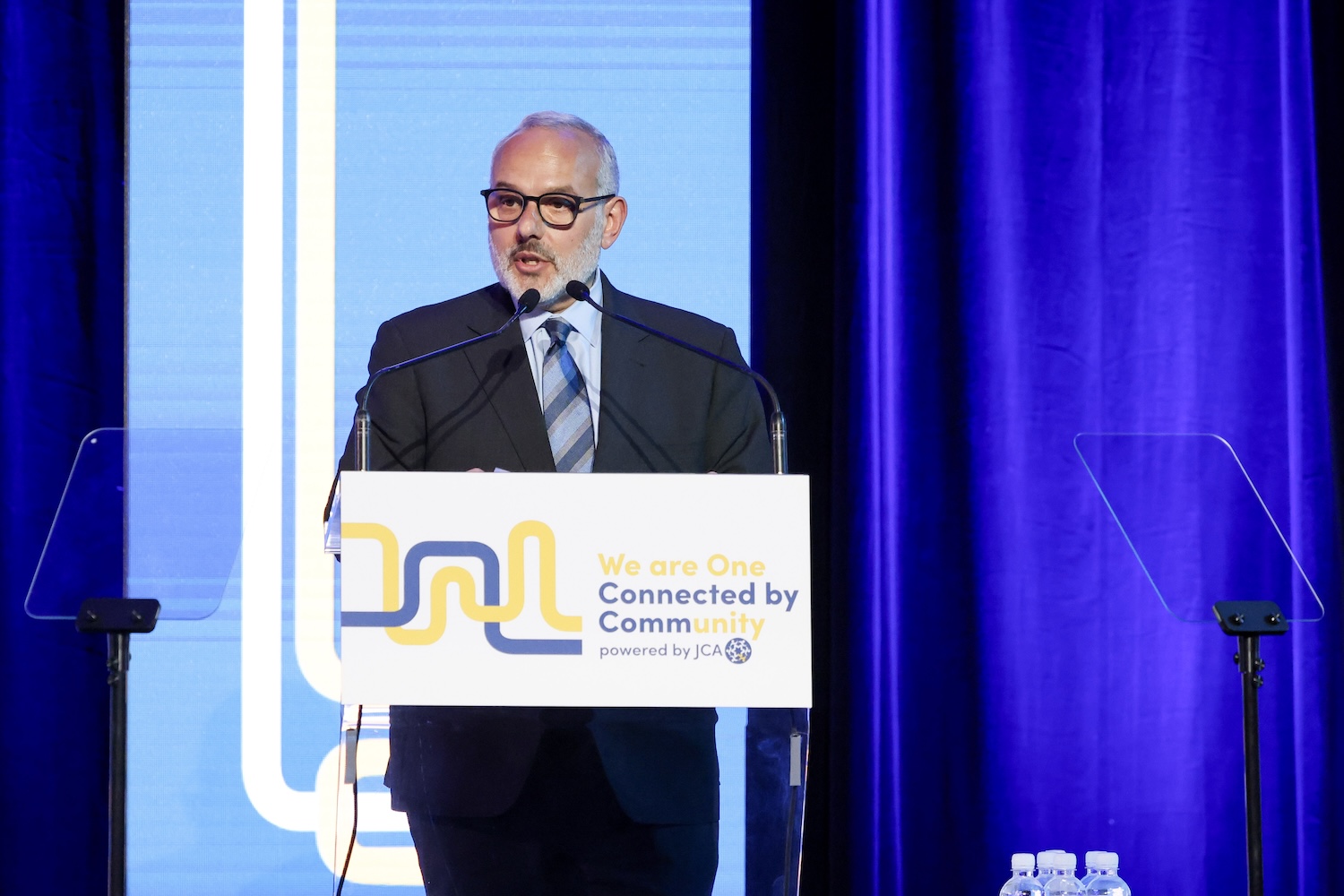
Finkelstein said watching a video of Sydney’s response to Bondi reminded him strongly of Pittsburgh’s own response to trauma.
He described arriving near the Tree of Life synagogue while the attacker was still inside and later helping coordinate welfare, security, family support, funerals and communal recovery.
He told the Sydney audience that trauma does not disappear, but communities can learn to carry it.
“I came to Sydney to stand in solidarity with all of you on behalf of the Pittsburgh Jewish community,” he said. “What I’ve discovered since arriving is that I feel just as comfortable here as I do at home.”
JCA chief executive Alain Hasson said JCA had hosted 15 senior leaders from the Jewish Federations of North America in the week before the event, in a visit that reflected global Jewish solidarity after the Bondi attack.
He said the delegation came in a spirit of support and that Jewish communities around the world remained deeply connected.
Hasson said many of the overseas support teams that arrived after the Bondi attack were able to do so because of Jewish Federation support.
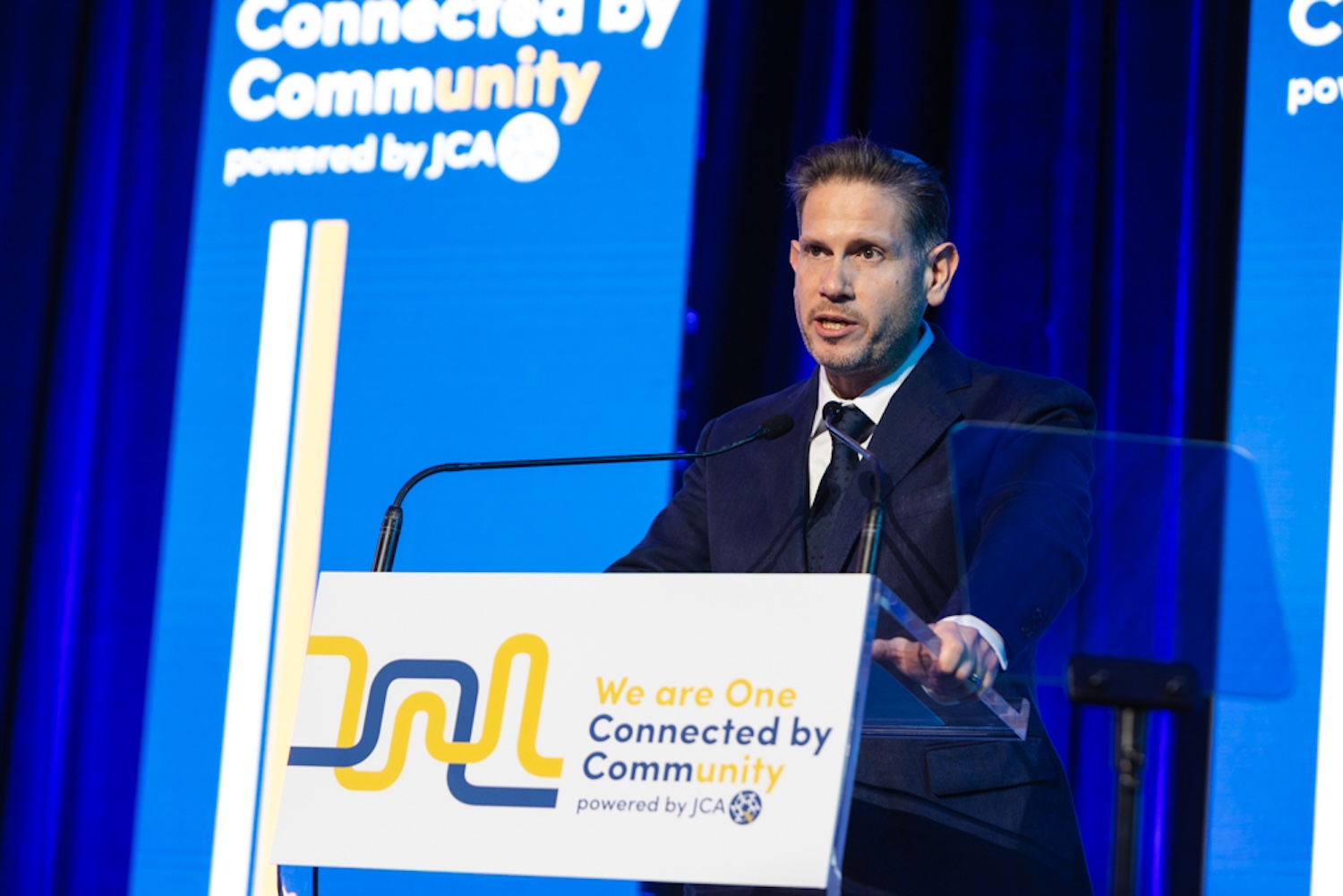
Hasson said the 2026 campaign would need to meet demands far beyond a normal year, including support for victims and families, increased security, welfare services, mental health care and the community’s engagement with the Royal Commission into Antisemitism and Social Cohesion.
He said JCA estimated that community organisations and recovery initiatives would need almost $40 million in 2026, more than double the previous year’s fundraising.
“The needs before us are not ordinary,” he said. “They are the extraordinary needs of a community that has been wounded.”
Hasson said the answer to antisemitism was not only protection, but deeper investment in Jewish identity, education, youth movements, culture and belonging.
“A Jew who knows who they are, who is rooted in their people’s history and values, is a Jew who can weather anything and everything,” he said.
For all the grief discussed on stage, the dominant message was defiance. Sydney’s Jewish community had been attacked, but it would not hide.