
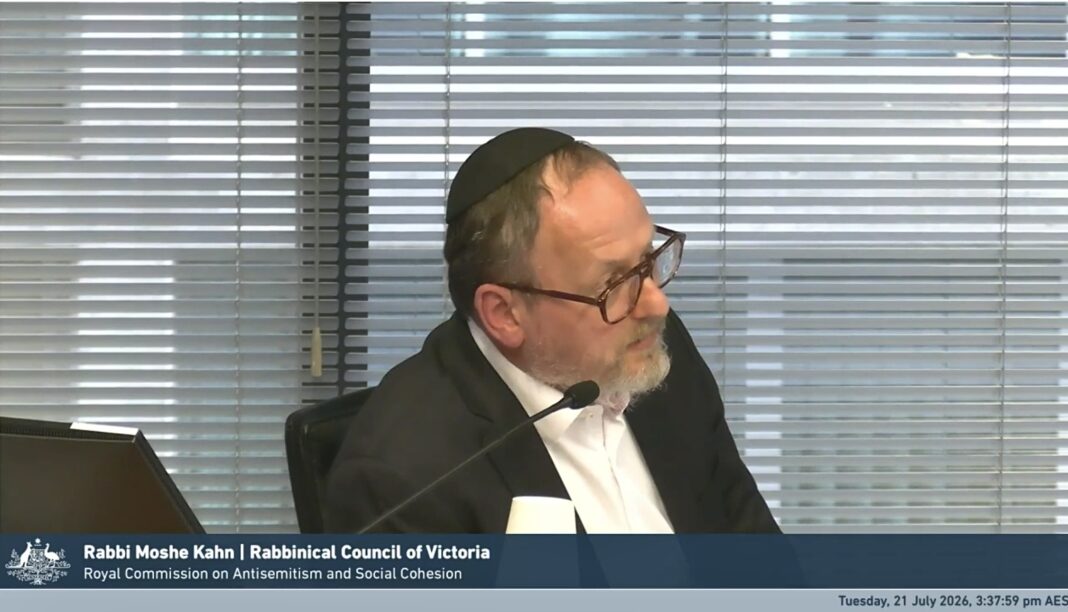
Jewish Australians are concealing signs of their religious identity to avoid abuse, while rabbis are carrying growing levels of fear and anxiety within their congregations, a royal commission has been told.
Rabbi Moshe Kahn, president of the Rabbinical Council of Victoria, said personal safety had deteriorated sharply during the past year, with rabbis and community members regularly subjected to antisemitic conduct.
The commission heard on Tuesday that 90 per cent of rabbis surveyed by the council in April had observed congregants concealing or minimising outward signs of their Jewish identity.
Of the rabbis surveyed, 85 per cent had personally experienced antisemitic conduct, while 95 per cent said their sense of personal safety had significantly deteriorated.
“Rabbis are very visibly Jewish … and many live in communities in which they may be one of the only visibly Orthodox people, and therefore easily identifiable,” Rabbi Kahn said.
“The incredible amount of abuse just walking to and from shul, synagogue, on a Saturday morning is something that was just normalised.
“Something that maybe for the rabbis they could tolerate to a degree, but when they have their children and are walking together with their families, it’s something that’s incredibly, incredibly confronting and challenging.”
Rabbi Kahn said rabbis had spent years carrying the emotional strain of communities affected by antisemitism, beginning after the October 7 attacks and continuing through the Bondi Beach Chanukah attack.
“This has now been multiple years where we felt we’ve had to literally carry the emotional anxiety of the community, the stress for the community, and it takes a toll,” he said.
“There’s no mental switch-off. There’s no ability to disconnect.”
He said rabbis were increasingly being asked questions they were unable to answer.
“People want to know: Are we safe here? People want to know, are we welcome? Are we part of the community or not?” he said.
“And that level is only increasing.”
Rabbi Kahn said antisemitism had also changed the way rabbis used their own homes, which traditionally operated as an extension of their synagogues and regularly hosted congregants for meals.
“What was always deemed your home is your safest place … all of a sudden, that’s become a place where we’ve got to second-guess ourselves. Is it safe?” he said.
He said private addresses were no longer printed on flyers, even for small events such as lunches at a rabbi’s home.
The commission heard Jewish religious and cultural events had also been moved out of public spaces because of security concerns.
Rabbi Kahn said Melbourne’s Lag BaOmer parade, which traditionally attracted thousands of people to a public street, had been moved to an enclosed venue following advice from police and the Community Security Group.
“You’re talking about something that, for years, had taken place on streets of Melbourne … all of a sudden now has to be closed into an enclosed area,” he said.
He said organisers no longer publicly released the locations of many events and had begun screening registrations before sending venue details.
Rabbi Kahn appeared alongside representatives of Jewish schools, who said parents were paying annual security levies totalling millions of dollars.
He said smaller synagogues faced particular pressure because they lacked the resources to meet rising security costs.
“All of a sudden that becomes a genuine choice. Do you do an event tonight? Do you not do an event? Do you have security? Do you not have security?” he said.
“It’s something that, every single day, we’ve got to calculate.”
He said some community members would no longer attend synagogue services unless guards were present.
“There are a lot of people who would not come to a service unless they know there’s security,” he said.
“They will ask in advance: Will there be security? Will there not be security? If the answer is no, they won’t come.”
Rabbi Kahn said responsibility for protecting Jewish communal life should not rest solely with Jewish institutions.
He also raised concerns about the response of authorities to reported incidents, saying only 15 per cent of surveyed rabbis believed complaints had been followed through.
“That is incredibly low,” he said.
Victoria Police Superintendent Amanda Bowden told the commission that police did not specifically collect data on antisemitic conduct. She said recording whether an offence was motivated by anti-Jewish prejudice was not mandatory in the force’s main crime database.
The commission earlier heard that a synagogue later targeted in a firebombing had been unable to secure government grants to improve security in the years before the attack.
Two buildings belonging to the Adass Israel Synagogue in Ripponlea, in Melbourne’s south-east, were gutted in a blaze on 6 December 2024.
The royal commission was established after 15 people were killed and dozens more injured when two gunmen opened fire at a Chanukah event at Sydney’s Bondi Beach on 14 December 2025.
Hearings in Melbourne this week are examining security risk assessments and the relationship between law enforcement agencies and Jewish community security groups.
Witnesses scheduled to appear on Wednesday include Jewish Community Council of Victoria chief executive Naomi Levin and Acting Commander Kelvin Gale from Victoria Police’s Crime and Counter Terrorism Investigation Services.
By Allanah Sciberras and Eleanor Wilson/AAP