

Book review by Dr Anne Sarzin
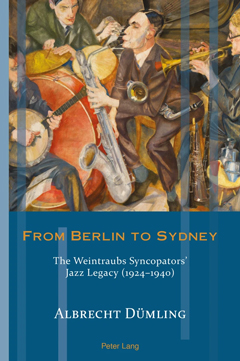 From 1924 to 1933, a jazz band comprising seven young, creative and brilliant musicians—six of whom were Jewish—reached the heights of popularity in the Weimar Republic. Known as the Weintraubs Syncopators, they were the celebrities of their time and even featured alongside Marlene Dietrich in the iconic film The Blue Angel. Tragically, with the end of the Weimar Republic, the rise of Nazism and Joseph Goebbels’ denunciation of jazz as degenerate art, the band’s days in Germany were numbered. When that happened, the band set off on a highly successful tour that took them through Europe to Russia, then to Harbin in Manchuria, and from Japan to Australia. In Sydney the public raved about their innovative dance music, dazzling musical virtuosity—every member of the band had mastered six or seven instruments—their comedic gifts and acting ability. Their artistry even won over Australian Prime Minister Robert Menzies, who applauded their performances. But professional jealousy and a venomously unrelenting campaign waged by the Secretary of the Musicians’ Union of Australia, Frank Kitson, seriously frustrated their efforts to find employment and to integrate into the musical scene. The hostility of the Musicians Union and other malicious actors brought about the band’s downfall and untimely demise in 1940.
The history of this jazz band is told in Albrecht Dümling’s book, From Berlin to Sydney: The Weintraubs Syncopators’ Jazz Legacy (1924-1940). Originally published in German in 2022, Dümling’s book is now available in this excellent English translation by Michael Fisher, the son of one of the Weintraubs Syncopators, Emanuel Fischer. For Michael, this English translation from the German has clearly been a labour of love, allowing readers to access Berlin musicologist Dümling’s comprehensive and academically rigorous study. It is a scholarly contribution to the field of exile studies and a welcome addition to the only other book on this subject that I’m aware of, Silences and Secrets by Kay Dreyfus, which was also published as an academic monograph.
With themes of persecution and displacement that resonate painfully in our contemporary world, Dümling’s book addresses the historical, political and social concerns of these Jewish artists fleeing National Socialist persecution before and during the Second World War. Dümling describes the bigotry and obstacles they encountered on arrival in Australia in 1937, as artists—they never thought of themselves as refugees—desperately seeking safe spaces in which to prosper and thrive as musicians. Theirs is a frustrating quest in a world of closed doors, deep-rooted antisemitism, Nazi propaganda and local opposition fueled by professional jealousy and malicious actors, a situation aggravated by the depressed economy of the time and high unemployment.
Dümling probes the lives, careers and destinies of these gifted musicians, who tumbled from the heights of popularity in pre-war Germany and several European countries into the mayhem of Jew-hatred wielded by Nazi propagandists. Undoubtedly, it is the drama of their Australian story that Antipodean readers will find riveting. As the author charts the employment hurdles and handicaps they encounter at every turn, he outlines the poisonous vendettas waged by hostile members of the Musicians’ Union of Australia who erroneously viewed the Jewish migrants as interlopers competing with and displacing Australian musicians. Dümling also shows the impact of venomous and damaging reports submitted to authorities by over-zealous informers in a climate that favoured malicious espionage among the general public, who were urged to observe and report on anything suspicious. Directives such as these had unfortunate consequences for the band and intensified the anti-Jewish prejudice that seeped through society and officialdom. In a country supportive of Britain’s war effort, fearful of German domination and the potential penetration of fifth-column spies into Australia, this was definitely not a time for nuanced explanations. There was little or no understanding of the major differences between Germans who supported Nazism and the vulnerability of German Jews defined as non-Aryan and subject to Nazi persecution. There was little or no understanding that German Jews faced death at the hands of the Nazi regime and their collaborators, and there was minimal empathy for their situation. Thus, it is ironic that, in many cases, Jewish German refugees fleeing Nazi tyranny were interned in Australia as enemy aliens and were sent to the same camps as Germans who openly supported Nazism, gave Hitler salutes and celebrated Hitler’s birthday.
Nevertheless, the Weintraubs had several important friends, who appreciated their honorary and generous participation in ‘high-profile patriotic occasions’ for important charities. The Weintraubs played free of charge at several such events, including a major Red Cross benefit concert in Sydney’s Town Hall, under the patronage of the Governor General and his wife, Lord and Lady Gowrie, and the Governor of New South Wales, Lord Wakehurst. Shortly after the start of the war, on 11 September 1939, the band performed free of charge for the Lord Mayor’s Fund in Sydney. The Governor-General’s wife, Lady Gowrie, invited the band to perform at a garden party in Canberra in aid of her War Funds, which triggered a bitter and critical response from Frank Kitson, Secretary of the Musicians’ Union. Still waging his relentless campaign against the band, he wrote to Lady Gowrie stating that the appearance of a foreign band in Canberra had created an unfavourable impression. However, the Governor-General’s private secretary defended their invitation, stating that three of the Band’s German-Jewish members were victims of Nazi tyranny whom Lady Gowrie had wanted to help. Kitson promptly wrote another letter advising that these successful musicians had no need of help.
Although the Anglican Bishop Dr Venn Pilcher had warned against the internment of fugitive Hitler opponents, three members of the Weintraubs were arrested—Horst Graff, Stefan Weintraub and John Kurt Kaiser. Graff and Weintraub were transferred to the Orange transit camp and then to Camp 1, near Tatura in Victoria, designated a ‘Nazi camp’ for single men deemed especially dangerous. After three months of internment, Weintraub wrote to the camp commander requesting his release. ‘What have I done that I have to go through all this and that I cannot find a place in the world where I am welcome?’ he asked. His letter had no effect; his designation as an ‘enemy alien’ was retained, and he remained in Camp 1 with Nazi supporters and other Nazi opponents.
In addition to Dümling’s extensive research, he notes that ‘personal encounters’ enhanced his narration of the Weintraubs’ story. In August 2000, he interviewed band member Emanuel Frischer, also known as Mannie Fisher, in his apartment in Sydney’s Bellevue Hill, and later also interviewed Mannie’s brother, Addy Fisher. Mannie recalled that in 1999 he and his wife organised a ball at the Westin Sydney Hotel in Martin Place to commemorate the Weintraubs Syncopators, at which Tommy Tycho and his orchestra played music that the Weintraubs had performed next door at Prince’s Restaurant. It was Mannie’s son, Michael Fisher, who translated this current edition of Dümling’s book into English, as it was previously available only in German.
In February 2004, Dümling also met Sydney John Kay’s son, Anthony Kay, who was deeply moved that anyone still remembered his father. He showed the author photographs, program notes and newspaper reviews of the Weintraubs, and gave him tapes and scores. Together they travelled to Rookwood Cemetery where they paid homage to Cyril Schulvater, one of the Weintraubs. In September 2024, Tony Kay and Michael Fisher met for the first time when they both attended the commemorative concert in the Konzerthaus Berlin to mark the centenary of the Weintraubs Syncopators founding in August 1924. As guests of honour, they recounted their fathers’ roles in the evolution of a jazz band reputed to be as famous in their day as the Beatles were in ours.
The book’s dust cover features a painting of the Weintraubs by Max Oppenheimer. Known as ‘Jazzband’, it is owned by the Jewish Museum in Berlin and also has an interesting story of restitution in which Dümling’s research played a part. The book includes a discography, an extensive bibliography, and information of the book’s website with links to annotated audio and video files.
From Berlin to Sydney
The Weintraubs Syncopators’ Jazz Legacy (1924–1940)
Albrecht Dümling (Author)
Michael Fisher (Translator)
©2026MonographsXXII, 340 Pages
Series: Exile Studies, Volume 25