
The rise in antisemitism since October 7, 2023 and the Bondi terror attack last December is not simply a security or legal problem.
A new research paper argues it also reflects a decades-long collapse in civic education as well as shared national identity, and calls for major reforms to Australia’s school system.

A Nation of Strangers: How a civic vacuum enabled antisemitism, published by the Centre for Independent Studies (CIS), by researcher and historian Alex McDermott argues that Australia has weakened the idea of a common civic culture, leaving young Australians less connected to democratic values, institutions and the duties of mutual citizenship.
The paper is part of the CIS research program The New Intolerance: Antisemitism and religious hatred in a fracturing civic compact, led by Peter Kurti, Director of the Culture, Prosperity and Civil Society program.
McDermott told JWire he had submitted the paper to the Royal Commission into Antisemitism and Social Cohesion, saying he hoped it would help diagnose the civic conditions that allowed antisemitism to spread and offer a path beyond legal and security responses.

“There’s one group of Australians and one group only who are currently being subjected to violence and intimidation and, ultimately, the massacre at Bondi, essentially for being Jewish,” he said. “I can’t think of a clearer demonstration of the collapse of a shared sense of mutual citizenship and mutual Australianness.”
McDermott calls this problem a “civic vacuum”. He argues that Australia has moved away from teaching young people that they are part of a shared national community, bound by rights and obligations that apply equally to all citizens.
Instead, he says, schools and universities have too often encouraged students to see society through the lens of separate group identities, power relationships and grievance.
“Part of the phenomenon of antisemitism is the treatment of fellow Australian citizens as strangers and enemies,” McDermott said. “That sense of a common political community has been weakened.”
The paper cites national testing showing only 28 per cent of Year 10 students meet basic civics proficiency standards, the lowest result since testing began. But McDermott argues the problem is deeper than students not knowing how Parliament works or what the Constitution does. He says Australia has failed to teach the culture of democracy: why citizens owe each other respect, why minorities must be protected, and why democratic systems require a shared sense of belonging.
McDermott told JWire schools and universities were a significant factor, but not the only cause. He also pointed to identity politics, social media, international media and the ability of old ethnic and sectarian conflicts to be carried into Australian life.
He said the shift did not begin with October 7. He pointed to historian Suzanne Rutland’s work identifying the First Gulf War in the early 1990s as a turning point, when more explicit antisemitic rhetoric began appearing in parts of migrant media and among some Islamist preachers in Australia.
He also identified a longer ideological shift after the 1967 Six-Day War, when sections of the left increasingly recast Israel from a vulnerable democratic state into a colonial oppressor. McDermott said that framework later became entrenched in universities and helped explain why hostility erupted so quickly after October 7.
He said the scenes outside the Sydney Opera House soon after the Hamas attacks were especially telling because they occurred before Israel had launched its military response.
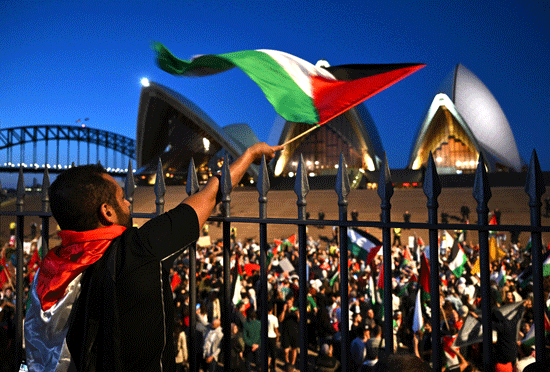
“There was all this material already primed and waiting,” he said. “October 7 was the match that was put to it.”
The paper draws on historian John Hirst’s description of Australia’s “democracy of manners”, a tradition in which people of different backgrounds treated one another as equals in daily life. McDermott argues that this culture helped Australia manage religious, ethnic and class differences from the colonial period onward.
He says Jewish Australians played a significant role in proving that this democratic culture could extend beyond British and Christian communities. The paper points to the prominence of Jewish Australians in public life from the 19th century, including Edward Cohen, who supported Victoria’s 1872 Education Act, and later national figures such as Sir Isaac Isaacs and Sir John Monash.
“The Jewish Australian community is one of the great success stories of Australian civic life,” McDermott said.
He argues that Jewish Australians were among the earliest groups to show Australia’s civic culture could apply broadly, not just to English, Irish and Scottish settlers or to Christian denominations.
The paper contrasts that earlier integration with what McDermott sees as the public nature of antisemitism today. While antisemitism existed in earlier periods, he argues it was often private, socially constrained or limited to exclusion from particular clubs and institutions. Today, he says, hostility to Jews is publicly chanted, posted online and normalised in parts of cultural and university life.
Democracy 101
The paper’s key recommendation is a mandatory national civics curriculum from primary school through to Year 10. McDermott says this should teach students not only the mechanics of democracy but also the moral and historical reasons liberal democracy matters.
“We need a democracy 101,” he said. “We need to be much clearer about what life looks like when you’re living in a democracy like Australia and what life looks like when you’re living in one of the many parts of the world which is not democratic.”
He said students should be taught how democratic systems compare with authoritarian regimes, including contemporary dictatorships. He also said Holocaust education should remain important, but should be taught as part of a broader civics framework showing how democracies can collapse into totalitarianism. At the same time, McDermott said Jewish history in Australia should not be taught only through trauma.
“The experience of Jewish Australians doesn’t want to be solely located in the trauma of the Holocaust,” he said. “The story of Jewish Australians as one of the earliest great success stories in colonial Australia is also important.”
The paper also recommends reforming teacher education so teachers are better equipped to teach Australian democracy, constitutional principles and the development of liberal democratic institutions.
McDermott said curriculum change alone would not be enough if teacher training remained shaped by hostility or indifference to liberal civic ideas. He said many teachers had themselves been trained in systems influenced by identity politics and a view of society centred on oppression and power.
He also calls for stronger national accountability. The paper argues the Commonwealth should set clear expectations for civics education and use funding incentives and penalties to ensure states take it seriously.
Among the practical school-based reforms proposed are regular cross-sector forums, mock parliaments and speech competitions involving students from state, Catholic and independent schools. McDermott argues these would help prevent students from growing up in separate civic worlds.
Drawing on earlier briefing frameworks by Deidre Clary and Fiona Mueller, the paper calls for mandatory monthly debating and annual speech competitions, saying students need to learn to challenge arguments without demonising opponents. Another recommendation, adapting models from a Page Research Centre report by Warren Bishop and Fiona Mueller, details a mandatory, non-military community service program for school-age Australians designed to bring students from different backgrounds into settings based on shared responsibility.
An “Australian Compact”
McDermott also recommends that every classroom display an “Australian Compact”, a charter setting out core democratic freedoms and civic obligations. He argues this should sit alongside a curriculum that restores Australian history to the centre of civics education, linking Australia’s democratic settlement to the longer history of liberal democracy, including Magna Carta, Westminster and the rule of law.
The paper looks closely at the Howard government’s Discovering Democracy program of the late 1990s, which was led by Hirst. McDermott praises its materials and ambition, but says it did not lead to lasting change because it was not deeply embedded in teacher training, state systems and school culture.
Beyond education, McDermott argues that social media and global communications have made social cohesion harder to sustain. He says migrant communities can remain deeply connected to the politics, conflicts and media of their countries of origin in ways that were not possible in earlier decades. He said this does not mean migrants are the cause of antisemitism, but Australia must be more honest about the risk that old hatreds can be imported and sustained if there is no strong shared civic culture to counter them.
McDermott said the current wave of antisemitism had not come primarily from the right of politics, but from universities, the arts sector and other educated cultural institutions.
He believes legal responses to antisemitism remain necessary but are not enough. Kurti makes a similar point in the foreword to the paper, writing that law is “only ever the perimeter fence” and that the true security of a minority lies in the culture within it.
For McDermott, the warning is that Australia has been living off social capital built by earlier generations.
“We’ve spent some decades drawing on the social cohesion capital accumulated by previous generations,” he said. “My fear is we’ve now run out of that social cohesion capital.”
He said rebuilding it would take years, but argued it was possible if schools, governments and public institutions again taught Australians to see one another first as fellow citizens.
“Human nature and human society are not such that a free and harmonious society spontaneously appears,” he said.
“It requires work.”