
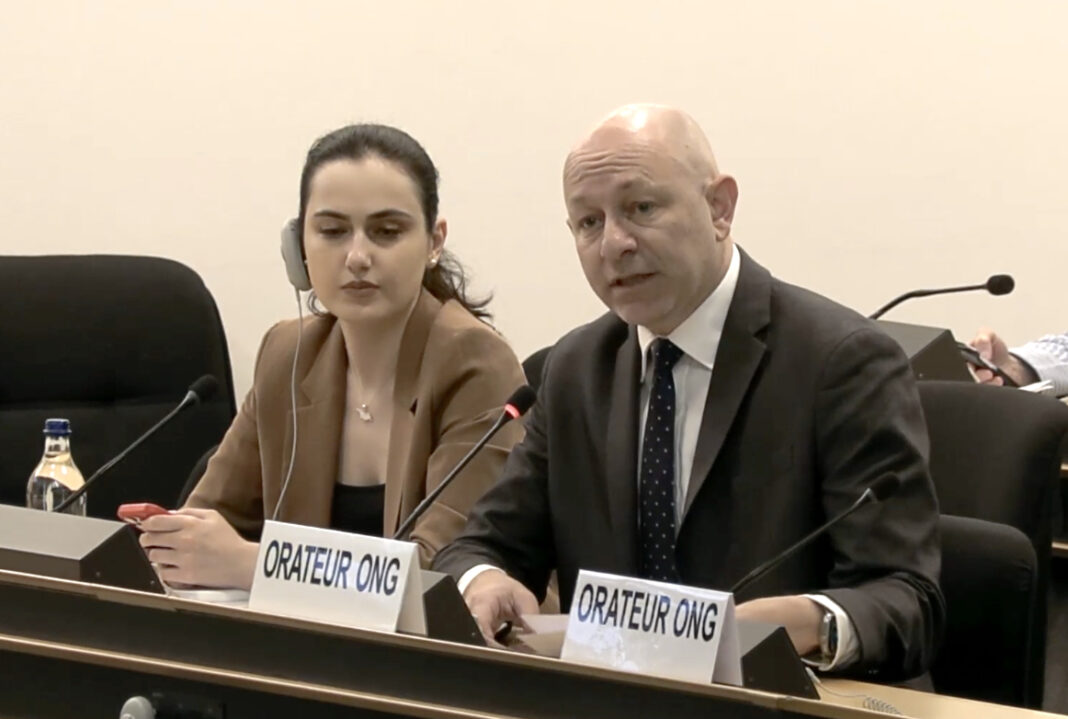
Bondi terror attack survivor Arsen Ostrovsky has told the United Nations Human Rights Council that his own experience shows what happens when antisemitism goes unchecked, warning it inevitably leads to violence.
Ostrovsky, a human rights lawyer and head of the Sydney office of the Australia/Israel & Jewish Affairs Council (AIJAC), addressed the council in Geneva on Wednesday during its review of Australia’s human rights record.
His UN appearance came just days after he gave evidence to the Royal Commission into Antisemitism and Social Cohesion in Sydney about the Bondi attack and the torrent of online abuse directed at him afterwards.
Speaking on behalf of UN Watch and AIJAC, Ostrovsky said he had travelled from Sydney not to seek sympathy but to warn the international community about the consequences of failing to confront antisemitism.
He was attending a Chanukah celebration at Bondi Beach with his family on December 14, 2025, when gunmen opened fire on the crowd.
Fifteen people, including a 10-year-old girl, were killed and more than 40 were injured. Ostrovsky was shot in the head as he ran towards his family.
“That hatred directed at Jews, when ignored, excused or mainstreamed, inevitably leads to violence,” he told the council.
Ostrovsky said the attack had not occurred in isolation but followed two years of growing hostility towards Jewish Australians.
“Bondi did not occur in a vacuum. It was built chant-by-chant, march-by-march,” he said.
He said repeated warnings from the Jewish community had largely gone unheeded as synagogues were attacked, Jewish children were harassed and people became afraid to wear a Star of David in public.
He also said some teachers were now reluctant to teach the Holocaust because they feared causing offence.
Ostrovsky warned that allowing antisemitism to spread threatened not only Jewish Australians but the entire country.
“When antisemitism is allowed to thrive, it erodes the very foundations of a free society: tolerance, social cohesion, the rule of law and moral clarity,” he said.
Quoting the late British chief rabbi Jonathan Sacks, Ostrovsky described antisemitism as an early warning sign of broader social breakdown.
During his recent Royal Commission appearance, Ostrovsky described a “relentless tsunami of Jew hatred” after the Bondi attack.
The commission heard that images of his injuries were manipulated and circulated online, while conspiracy theorists falsely accused him of being a “crisis actor” and claimed the attack had been staged.
Ostrovsky acknowledged steps taken by the Australian Government, including establishing the Royal Commission, but said much more needed to be done.
At the UN, he called on other nations to encourage Australia to confront antisemitism in every form, including when it presents itself as antizionism.
“I urge this international community to encourage Australia to confront antisemitism in all its forms, including when it masquerades as antizionism, so every citizen can live openly and safely,” he said.
He concluded, “History teaches that while Jews may be the first target when antisemitism flourishes, we are seldom the last.”