
The story of the Jewish children who fled to France and America during the Holocaust
Book review by Dr Anne Sarzin
 When Jewish boys and girls turned 17 towards the end of 1941 and early 1942 in France, they were regarded as adults in the eyes of the Vichy government’s regime and, as such, these teenagers were in immediate danger of deportation. These deportations, which began in March 1942, dispatched these young people to slave labour camps where they faced brutal conditions, starvation and death, or they were murdered in Auschwitz and other extermination camps in Eastern Europe. Humanitarian efforts focused on the well-being and fate of younger Jewish children in France, those under the age of 16, many of whom suffered from malnutrition, health issues and abandonment in French internment camps for enemy nationals. Jewish child refugees had flooded into France, with or without their families, seeking refuge from Nazism in Central European countries, an influx that prompted desperate attempts by organisational networks and well-intentioned individuals in France and in the United States, as well as by the children themselves and their families, exercising whatever autonomy they had, in the first instance to improve their living conditions and, secondly, to identify potential escape routes and to secure rare exit visas from the Vichy government for the fortunate few on emigration lists.
For the past decade, Laura Hobson Faure, who holds the Chair of Modern Jewish History at the Université Paris 1 Panthéon-Sorbonne, has peered into the sadistic darkness that enveloped Jewish children threatened with extermination throughout Europe during the Second World War, focusing especially on those who arrived in France on a Kindertransport seeking sanctuary, which they were ultimately denied, after Marshal Petain’s armistice treaty with Germany and his government’s active and, indeed, enthusiastic collaboration with the Nazis and their Vichy-Nazi persecution policies. She has written an authoritative and comprehensive record of these times and events, as well as presenting her original interpretation of the conditions to which Jewish children were subjected during the war years in France and the many consequences for the children and their carers. She also acknowledges the black holes in databases and government archives that were ‘plundered, destroyed, or lost’. French state archives were also destroyed, while ‘Nazi and Soviet pillaging furthered the losses and dispersal’ in European countries. This paucity of records contrasts with the abundance of private archives in the United States, scattered among families and individuals. Importantly, she deduces that this loss of records and archival material influenced Holocaust historians’ specialisation in a single organisation or location, rather than adopting, as she has done, a transnational and multi-organisational point of view.
In her penultimate chapter, Faure summarises the impressive scope of her research over the past ten years, including the compelling oral histories she recorded with child survivors around the world, and her in-depth history of two child evacuation schemes negotiated between states and individuals. Finally, she provides a portrait of children and their caretakers, interweaving these with larger historical trends that shaped children’s experiences during the Holocaust. Faure highlights Saul Friedlander’s observation that it is at the micro level that one discerns the interactions of Holocaust protagonists—its perpetrators, victims and bystanders. Additionally, the author provides evidence of the important advocacy role women played in working towards the evacuation of Jewish children from Central Europe to France and, later, from occupied France to the United States, reflecting gender dynamics within Jewish communities in France and in the United States.
The author’s interviews with child survivors tug at the heartstrings and provide valuable insights into the reality perceived by the children and recorded in their diaries, autograph books and correspondence. They produced collective newspapers and documented their lives through letters, songs, poems, photography and drawings. Faure states, ‘Ties to parents, siblings, other children, and caretakers are richly documented in these child-produced sources’. Examination of these documents provides a ‘near-sighted vision’ of their agency and of the Holocaust, beyond simply ‘understanding decisions Jews made that helped them survive or perish’. As the children grew into adulthood, they wrote letters and memoirs that ‘grappled with the past and provided insightful testimony’, providing a ‘far-sighted’ perspective on their experiences. Faure concludes, ‘Distance from the event does not make these materials less authentic than sources from the period, but it does provide an additional narrative of distanced reflection that requires analysis in and of itself’.
As Faure states, she did not search for heroes but for humans in all their complexity, in their networks and groups. She adopts the perspectives of the historian rather than the sociologist in her research into the horizontal alliances formed to evacuate Jewish children from Nazi territories. ‘While the actions of individuals are important,’ she writes, ‘so are the groups and societies in which they operated’. Nonetheless, while I appreciated her meticulous research and documentation of the sterling work accomplished by the Kindertransport movement in bringing about 500 children into France, and the equally valorous work and complex collaborations among Jewish, Quaker, American and French organisations in evacuating a total of 280 Jewish and non-Jewish refugee children from France to the United States from 1941 to 1942, it was her record of interviews with child survivors that moved me profoundly.
These oral histories tell us less about the events themselves than about the meaning ascribed to these events by those who lived through them. Aron Pruszinowski, now Henri Parens, writes, ‘my old life had been violated, fragmented; and it is taking me the rest of this life in America to bring some closure to what happened to my life of origin….with the help of many on the way, it evolved into a very different, new and eventually very good life’. In later life, reflecting on his experiences, Ernst confided that a precious slice of bread and butter, a ‘holy delicacy’ in wartime France, which he gave to a girlfriend, was the greatest gift he ever gave to anyone, demonstrating how children forged close relationships in extreme circumstances. ‘I’ve given my wife jewellery, clothing, a grand piano I bought for her, our wedding rugs, clothing—nothing compared to that slice of bread,’ Ernst stated. These oral histories enable the reader not only to traverse periods of extreme persecution and historical complexity but also provide access to the meanings these children, as adults in future decades, ascribe subsequently to the torturous experiences of their childhood and youth in France. While the author is diligent in showing the kindness and humanitarian concerns of well-intentioned caretakers and organisers of schemes to protect and, ultimately, to save the children, she also documents the turbulence, the fear, the loneliness and trauma the children experienced. Many, however, looked back fondly on their collective lives in institutions where they felt protected for several years, and where they created new bonds and surrogate families. Others recalled times of oppressive anxiety, such as those experienced by children in Chateau Leroy in Quincy-sous-Sénart who, for several months, shared their accommodation with a Wehrmacht unit, fortunately well before the deportations began. As Faure points out, ‘the upheaval of May-June 1940 completely reconfigured the children’s networks’.
While the book expressly avoids hagiography, there are those who dedicated themselves selflessly to the welfare of these children, multiple characters who go above and beyond their human capabilities to ensure better outcomes for their charges. Ernst Papanek, a director of the OSE children’s homes in France, dedicated his life to bringing children to safety in France and in the United States. There are many others featured in this book, including the committed Strausbourg activist Andrée Salomon, who forfeiting a chance to leave France and remained to help the children; Baroness Yvonne de Gunzbourg who, together with her husband, funded OSE homes; Baroness Germaine de Rothschild, who was directly involved with the children; and Judge Justine Wise Polier, a member of the American Jewish elite, who was well informed on the situation Jews faced in Nazi territories. There are chapters outlining the work of organisations such as the Quaker’s AFSC, the American Friends Service Committee; USCOM, the United States Committee for the Care of European Children; OSE, Oeuvre de Secours aux Enfants, the French organisation that ran homes for the children; and, of course, the JDC, the Joint Distribution Committee that funded these organisations.
Laura Hobson Faure has given us an in-depth and impressively researched account of the Jewish children who fled to France and America during the Holocaust. She is to be congratulated on her persistence, focus, dedication and original scholarship that have ensured a significant and substantive contribution to Holocaust studies.
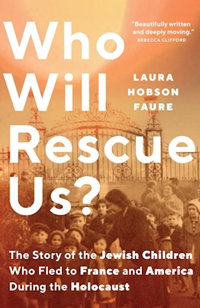
Who will rescue us? The story of the Jewish children who fled to France and America during the Holocaust
Laura Hobson Faure
Yale University Press, New Haven and London