
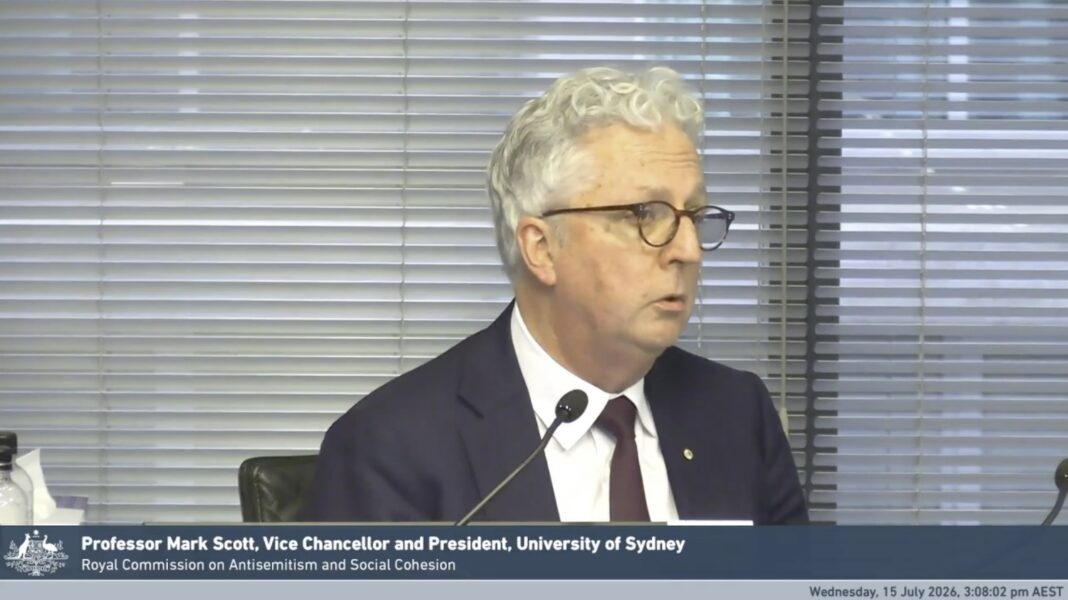
University of Sydney vice-chancellor Mark Scott has defended his institution’s decision to negotiate an end to its 2024 pro-Palestinian encampment rather than call police, while acknowledging the cost to Jewish students and staff.
“How can we bring this encampment to a close peacefully without seeing the destruction and the turmoil that we’d seen at major universities around the world?” Scott told the Royal Commission on Antisemitism and Social Cohesion today.
He said forcibly removing protesters risked escalating the situation.
“I still felt the risk of the encampment blowing up by forcibly ending it,” he said.
Scott acknowledged the prolonged protest had come at a significant cost.
“I can see that our Jewish students and staff paid a price for that as the encampment dragged on. And I am sorry to them that it took so long for us to get it done.”
He described the university’s failure to consult Jewish students and staff more closely during negotiations as a “real failure”.
The encampment ended after the university agreed to disclose more information about research and institutional arrangements involving defence, weapons and security.
Sydney University has since banned encampments and indoor protests, introduced notification requirements for demonstrations and required posters to identify those responsible for them. Scott said the changes had led to a “significant reduction” in complaints while allowing protests to continue.
Representing major Jewish organisations and the Australasian Union of Jewish Students, Gabi Crafti SC questioned Scott about campus safety and an address by Students for Palestine organiser Yasmine Johnson.
Scott said he had not known Johnson would appear at the university event and rejected her call for Israel’s abolition.
“I totally reject her views,” he said. “I do not believe that that is an appropriate use of academic freedom and discourse.”
Crafti accused the university of failing to protect Jewish students, although Commissioner Virginia Bell intervened over the way the proposition was put.
Scott conceded the university had not responded adequately to Jewish concerns during the encampment but said conditions on campus had improved.
He was also questioned about reports that Hizb ut-Tahrir members had been present on campus. Scott said police and security authorities had advised the university at the time that their presence did not require action.
University of Melbourne interim vice-chancellor Glyn Davis condemned the targeting of Jewish physics professor Steven Prawer, whose office was occupied by up to 20 masked protesters on 9 May 2024.
Prawer was singled out over his involvement in a joint PhD program with the Hebrew University of Jerusalem.
“For him to be singled out and treated in this way was appalling,” Davis told the commission.
He rejected claims that the academic partnership implicated the university in Israel’s actions in Gaza.
“That’s not just a slander; it’s unspeakable,” he said.
Under questioning by David Knoll, representing the Australian Academic Alliance Against Antisemitism, Davis said he had contacted Prawer personally after the incident.
“It is intimidating to have 20 people in your room wearing face masks and threatening you,” he said.
The commission heard that two students were initially expelled and two suspended over the occupation, with the penalties later reduced on appeal.
Davis said the university decided against publicly identifying the students to avoid leaving “a stain on the rest of their lives”.
Melbourne University has since banned camping and indoor protests, restricted the participation of people not connected with the university and strengthened its security powers.
Davis said university officials had consulted Victoria Police regularly, but officers would not intervene unless laws were broken. He said the institution had also sought to avoid the violent confrontations seen at some overseas universities.
He acknowledged the encampment had created fear among some members of the university community.
Earlier in the hearings, a former Flinders University student appearing under the pseudonym Mika said Jewish students were frequently treated as political representatives of Israel.
He recounted calls for “death to Israel” and “death to Australia” at a 2022 student council meeting and said a Jewish student had been called a “dirty Zionist”.
Mika said Jewish and Israeli students were often expected to pass political tests before being accepted into student groups.
The commission is examining the experiences of Jewish university students and staff, institutional complaint systems and whether universities adequately protected their communities while allowing political protest.
The Melbourne hearings are continuing.