
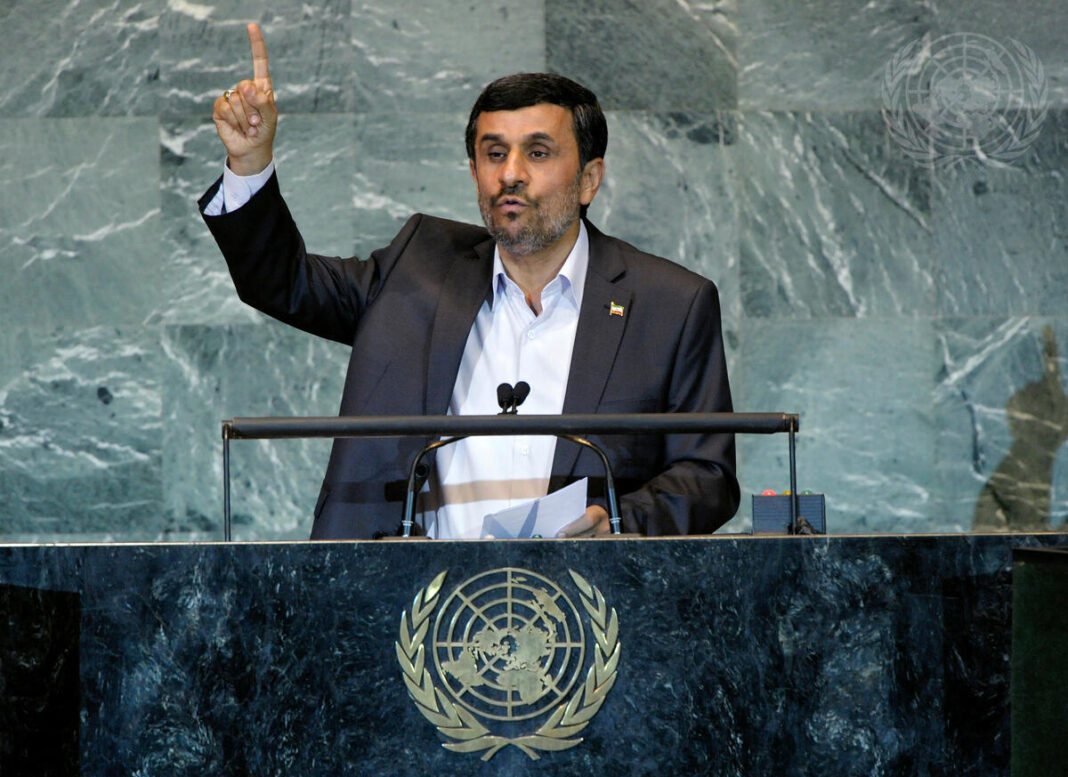
Former Israeli intelligence officers and an American defence expert are expressing deep scepticism regarding a July 13 New York Times report alleging that the Mossad attempted to recruit former Iranian President Mahmoud Ahmadinejad as part of a regime-change operation.
The article claimed that Israeli intelligence built a years-long operation to groom the former hardline Iranian leader as an asset, secretly financed his travel to an academic conference in Budapest for meetings with then-Mossad Director David Barnea, and ultimately executed an audacious rescue mission using a black Peugeot to extract him to an Israeli safe house following a Feb. 28 airstrike on his Tehran compound.
The report further alleged that Ahmadinejad eventually left the safe house and was subsequently placed under house arrest by the intelligence wing of the Islamic Revolutionary Guard Corps.
However, Ahmadinejad was seen in Tehran during a recent memorial ceremony for Supreme Leader Ayatollah Khamenei in Tehran, speaking and smiling with people around him. Khamenei was targeted and killed in the opening Feb. 28 Israeli Air Force strikes of “Operation Roaring Lion.”
Reacting to the July 13 publication, Maj. (res.) Alexander Grinberg, an expert on Iran at the Jerusalem Institute for Strategy and Security, and a former member of the IDF Military Intelligence Research Department, expressed reservations.
“It is claimed they wanted to recruit Ahmadinejad. Now this term, ‘to recruit,’ in HUMINT [human intelligence] can have a thousand and one meanings, and the assumption that this was about getting Ahmadinejad to sing ‘Hatikvah’ isn’t one of them,” Grinberg told JNS. “There are many examples in HUMINT of a target being recruited without him or her knowing, even to whom they were recruited, and for what purpose, but rather they find some shared interest,” he explained.
If Ahmadinejad has issues with the Iranian regime, there could have been a decision to exploit this, but to what end is a complex question, Grinberg argued.
“All of these things are very complicated, time-consuming. Pointing out the target, creating initial contact, every recruitment is complex. Nothing is guaranteed. This is not a technical action. One can invest and do everything seemingly correctly, and it still might not succeed in the end,” he added.
A burned asset?
Also reacting to the publication, Jason Brodsky, policy director at the American United Against Nuclear Iran (UANI) organisation, raised sharp questions regarding the plausibility of the narrative, pointing to Ahmadinejad’s lack of a domestic military support base.
“I have questions about this story,” said Brodsky. “I think it’s plausible that Ahmadinejad was a person of interest to certain foreign intelligence organizations given his falling out with the leadership in Iran. But that does not necessarily mean that serious people viewed him as the linchpin of an Israeli regime-change strategy in Iran,” he added.
“Any serious Iran analyst—even those without access to classified information—could tell you that Ahmadinejad was alienated from Iran’s military and security apparatus and had no base of support there,” Brodsky said. “Defections from the Iranian military and security services would be a key part of any successful regime change strategy. The U.S. government and Israel have sophisticated intelligence capabilities, and so I question whether Ahmadinejad was truly the centerpiece of a regime-change strategy,” he continued.
“Ahmadinejad could have been a burned asset, and it doesn’t hurt to publicize this story to inject paranoia in the Iranian regime as well,” Brodsky added. “I think the motive for the disclosure of this story is more important than the story itself.”
In some Israeli reporting, he noted, a “domestic Israeli political angle here [is] being amplified—long-running rivalries between Aman [IDF Military Intelligence] and Mossad, internal rivalries within the Mossad, and the political knives being out for the prime minister ahead of the Israeli elections.” (Israeli elections have now been set for Oct. 27.)
Brig. Gen. (res.) Hanan Geffen, a former commander of the IDF’s elite Unit 8200 intelligence unit, expressed deep skepticism regarding the described mechanics of the Hungarian cultivation attempt.
“This story raises a great many questions,” Geffen stated. “The first question is about what is being called ‘the recruitment,’ because according to the most detailed description, in Hungary they held a conference on the subject of the global climate in order to invite Ahmadinejad.”
Initiating contact directly with Mossad chief “Dadi” Barnea would never work, he said. “He [Barnea] certainly did not speak with him. He has no chance to speak with him.”
Furthermore, Geffen said, the claim that Israel was interested in “crowning” Ahmadinejad as a leader has serious problems.
“How does one crown him afterward? There is a complete vacuum here. In implementation, you need to recruit supporters, who are absent here,” said Geffen. “In this story, there is an attempt to recruit an agent, perhaps, in the best case; certainly not a man who will manage Iran afterward.”