
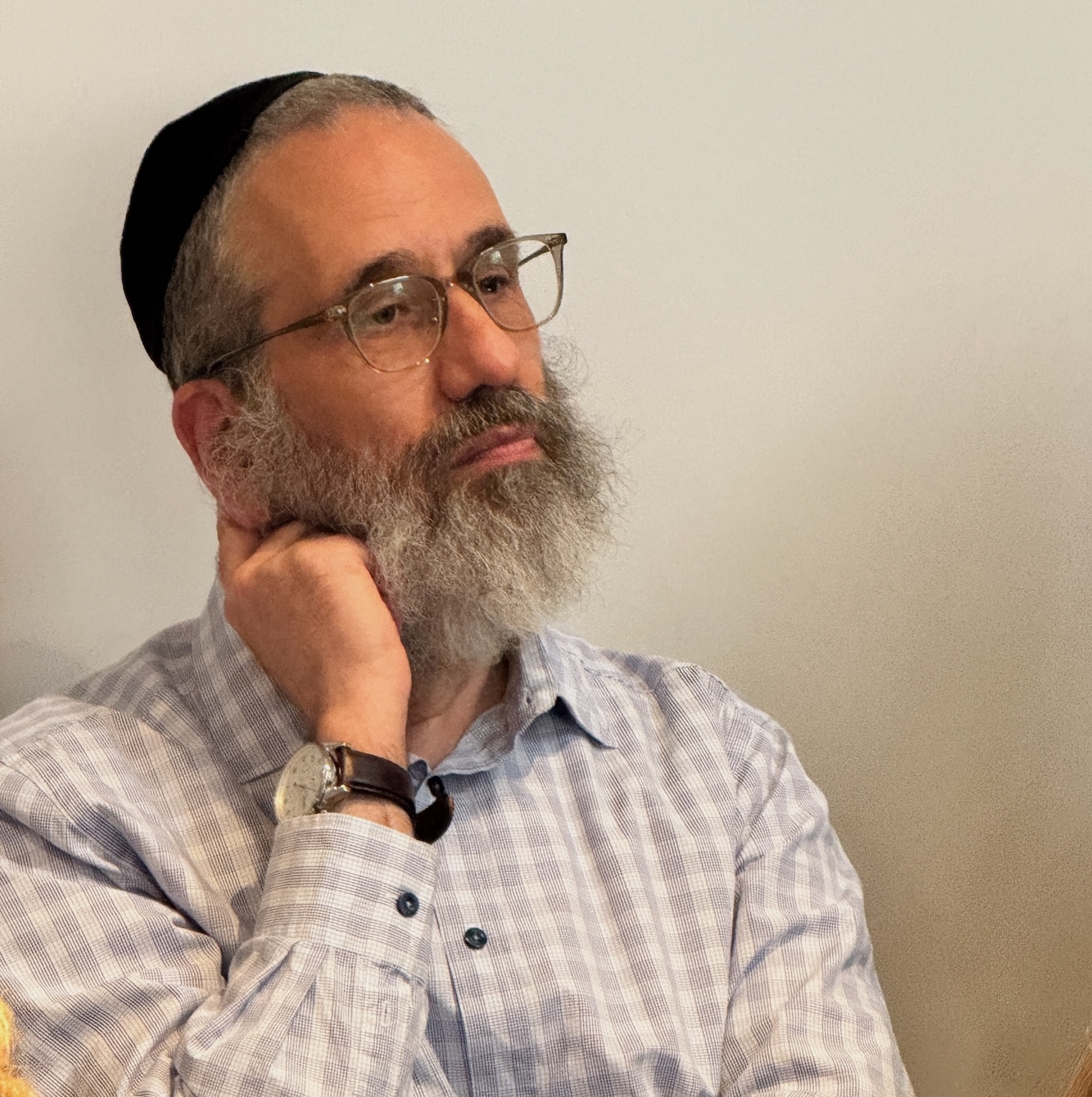
Earlier this year, Rabbi Zalman Kastel had a personal encounter with some people that seemed to him to be antisemitic.
His initial response was to feel very stirred up with a mix of fear and anger. On closer examination, he realised that they were teenagers, possibly drunk, and that they also exhibited the same behaviour toward a non-Jewish person.
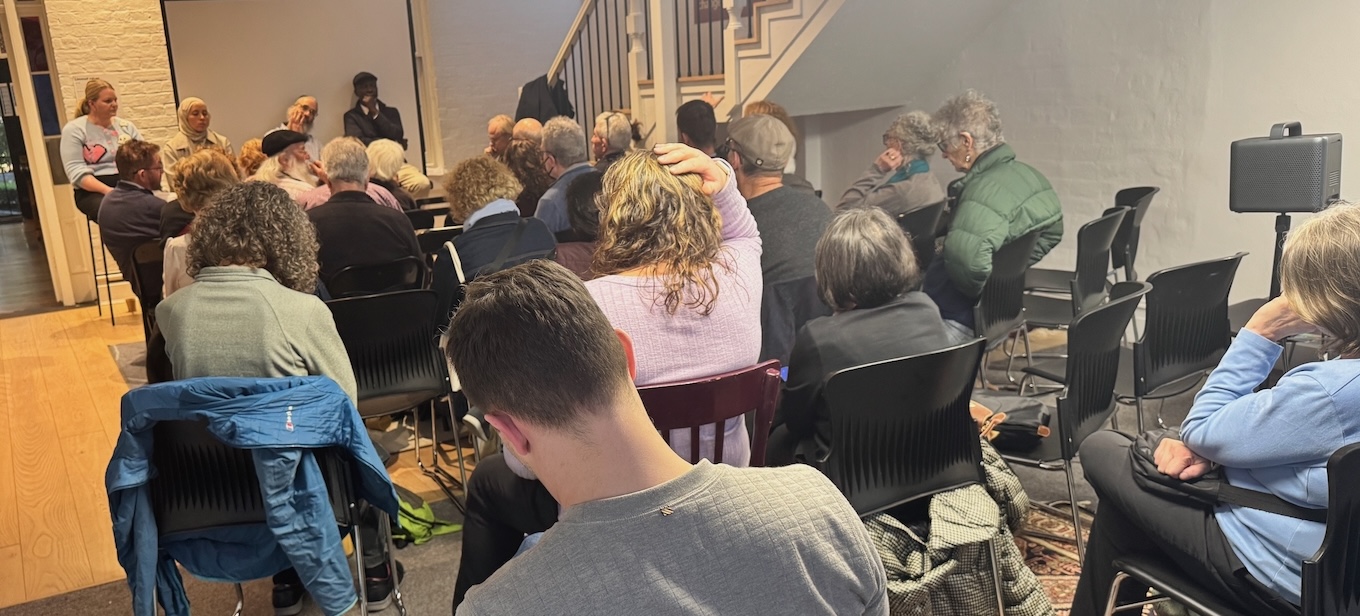
“I just want to illustrate my own experience of the kind of fear that many of us are feeling at the moment,” he told the audience at Limmud Oz last weekend.
“Our initial response to provocation is involuntary. We just feel an automatic reaction. What I think is more important is the question, what happens afterwards? Do we climb down, do we settle ourselves, or do we continue to feel very, very stirred up?”
It was a moment that cut to the heart of two sessions at Limmud: “Talking with ourselves in times of alienation” and “Talking with others in times of alienation.” At a time when Jewish-Muslim relations in Australia are under severe strain, the panels confronted one of the most pressing questions facing both communities: how do you keep talking when fear, grief and suspicion are pulling you apart?
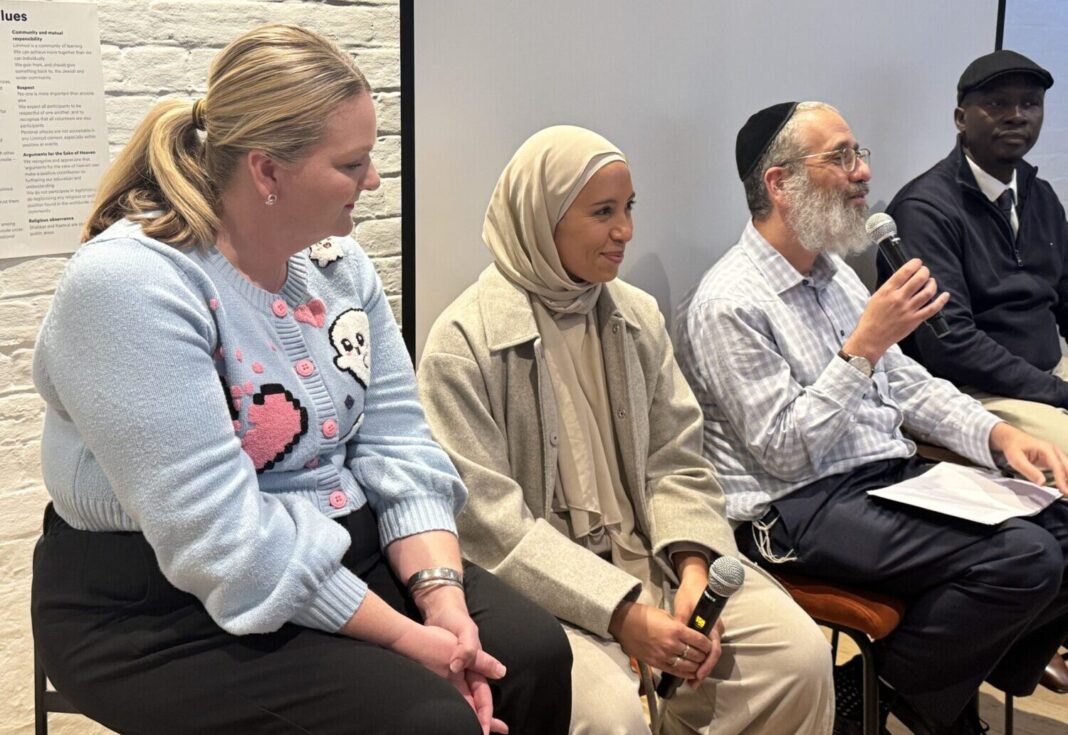
Rabbi Kastel was joined in the first session by Mohamed Dukuly and Ms Bennett. Kate Xavier, Professional Learning Lead at Together for Humanity, joined the second session. All four are connected with the organisation.
Its programs include student workshops, teacher professional learning and interschool encounters that bring young people from different cultural and religious backgrounds together for structured dialogue. For many of the students they work with, it will be the first time meeting a Jew, for example.
The Australian government committed $4 million over two years, announced in 2024-25, to Together for Humanity to strengthen student wellbeing and social cohesion, with a specific focus on combating antisemitism, Islamophobia and other forms of discrimination in schools.
The conversation before the conversation
Rabbi Kastel, Together for Humanity’s national director, said the starting point for any hard conversation is not public debate but the private dialogue people have with themselves.
“When I say talking to ourselves, there are two layers to that. One layer is actually as individual people, the kind of dialogue that goes on in our minds before we can actually talk to other people, even within our own communities. There are a lot of internal conversations we need to have.”
For many Jews, he said, that internal conversation is now shaped by fear. He cautioned against dismissing it, and acknowledged that we have good reasons to feel afraid, but also warned against comparisons with 1930s Germany.
“It’s important to recognise the difference between state-sponsored oppression and the misbehaviour of individuals. Even though the misbehaviour of individuals can lead to death and terrible destruction, there is a difference between when a whole society turns on you and when there are lots of bad actors.”
Mohamed Dukuly, a social worker, assistant imam and long-time interfaith practitioner, drew on his childhood in Liberia during the civil war to explain how fear becomes entangled with anger a sense of injustice.
Members of his Muslim tribe had been targeted for their perceived ties to the government. He described later encountering a woman his family believed had exposed his mother and siblings to danger.
“The natural reaction from me was, ‘I’m going to teach her a lesson today,’” he said. “That was a normal thing to do at the time. I’m going to pay back, not only to satisfy myself, but to prove my patriotism, my loyalty, my connection.”
What stopped him was a single moment of internal reflection, a private argument with himself about individual responsibility inside collective action.
“From nowhere, another thought came in. That’s when I started talking to myself. There’s this collective effort, collective happiness. But there’s also individual responsibility.”
He confirmed he knew the woman, and she was released. The lesson he drew was not heroic but precise: that the instinct toward collective retribution can be interrupted, and that interruption begins with the individual, not the group.
“It’s our individual ideas, aggressions and actions that create the bigger collective picture.”
An Australian Muslim experience
Ms Bennett, Together for Humanity’s Education Program Coordinator and an Islamic educator, spoke about growing up as a Muslim girl in regional Western Australia.
She described being the only Muslim student at a public school in a country town, where she wore a headscarf and, on her first day, found herself surrounded at recess by a crowd of students asking who she was and where she was from. “The assumption was that I was a nun,” she said. When she explained she was Muslim, they asked, “Where’s Islam? Is it a country?”
This was challenging for her as a young girl whose identity was still forming. Later in her schooling, once her family moved to the city, Ms Bennett herself experienced and witnessed her community being on the receiving end of misdirected prejudice.
Before September 11, she said, the Islamic school she attended experienced regular arson attacks, graffiti and bomb threats requiring evacuations. After the attacks, waves of hostility became part of daily life for her community.
“As a Muslim woman, going out with your children and being assumed a terrorist, and having cans thrown at you while you’re walking your kids to the park. Knowing that every day, choosing to wear what I wear, choosing to be identifiably Muslim, poses a serious risk to my safety.”
“In recent times, being able to work in Jewish schools and see armed guards, makes me wonder whether my community should make the same effort to protect our schools and Mosques, too.”
Particularly challenging for members of the Australian Muslim community, she said, is the expectation and/or demand for individuals to condemn the acts of extremists locally and around the world.
Rabbi Kastel said Jews had encountered a version of the same demand since October 7.
“Some people from other communities saying to Jews, “If you don’t condemn Israel, then you are considered completely in agreement with every single of their interpretations of what Israel has done.” In the dumbed-down world we live in now, where everything’s binary, everything’s on social media, it’s all very black and white.”
The photos sitting on a phone
One of the most striking moments came when Rabbi Kastel described conversations he had, two days after the Bondi Beach terror with senior Muslim community leaders and consultations with Jewish communal leadership about these conversations.
“We were really thinking this through. What happens if a group of Muslim leaders go to Bondi and lay flowers, and people yell at them? And then mainstream media shows it, and it just reinforces the story about us and them.”
The decision was to bring Muslim leaders to offer condolences directly to both progressive and Orthodox rabbis, and to visit the home of Rabbi Ulman, father-in-law of victim Rabbi Eli Schlanger.
“There were photos taken, but then we couldn’t work out what to put on social media, and how it was going to be misinterpreted. Those photos are sitting on my phone, and no one can see them, because it’s just such an incredibly stupid, dumbed-down world we live in that everything you put out there is misinterpreted. It’s not if, it’s how.”
Bennett said her own bridge-building work had cost her standing in parts of her community. After an Islamic magazine published an article about her bringing Jewish students into a mosque, she became a target online.
“It actually affected my position in the Islamic community as a teacher. My deeply important religious role in my community, I put that at stake in order to continue doing this work. We do what we can, and we hope that that little bit is enough, but it comes at cost and a risk too.”
Talking between communities
The second session turned to direct engagement between faiths. Rabbi Kastel warned against claiming authority over another community’s texts.
“If you Google the word ‘Talmud’, you will find it being defined by antisemites. The Talmud has about 40 volumes of vast discussion. It is a bit like someone switching on a tape recorder in a noisy room and then just publishing the transcript.”
Genuine interfaith dialogue, he said, required curiosity rather than certainty. “We should not be talking for each other. We should be talking for ourselves, for our own texts. Google is not particularly useful for managing religious difference.”
Bennett made a parallel argument about Islam. “People say religion is the root of all evil. I think religion is a magnifier. If you are a sick, twisted, dark individual with agendas, you’ll use religion to justify. If you’re looking for a greater relationship with God, purity of heart, to improve your character, it will magnify that in you.”
She was also direct about how it feels when Islam is associated with extremism. “I find it both offensive and hurtful when people think that Islam or my scripture teaches anything of the sort. Sharia law is my culture. Do you see me wishing harm on anyone? No. My religion doesn’t teach me that at all.”
Audience members raised the experience of Jewish people losing friendships or being socially excluded because others assumed they endorsed every action of the Israeli government. Bennett said much of that pressure came from “allyship by association”.
“If you’re hanging out with, being seen with, that person, are your allyships shifting? You can’t have trust when there’s ambiguity.”
She said both Jews and Muslims enter shared spaces carrying the same unspoken questions about who is safe.
“If I am a Muslim, I come into this space, and the main questions are, who of you is okay with what’s happening to innocent Palestinian victims? Because I can’t come and ask each and every one of you to put a sticker, safe, unsafe, likes me, doesn’t like me. It’s too much. And that’s happening both ways.”
Dukuly brought it back to responsibility across generations.
“You are strong now to defend your community. If we don’t bring peace, what’s going to happen with our next generation? If we don’t go on the other side to understand their point of view, for them to understand ours, to become the cycle breakers, what’s going to happen?”
Refusing to cancel
When a member of the audience asked the panel about their red lines, Rabbi Kastel was sceptical of the social value of refusing to engage.
Asked whether there were red lines for conversation, Rabbi Zalman Kastel said he was cautious about refusing to speak to people.
“What is the purpose of cancelling somebody? What benefit is there in not talking?” he said.
“This ridiculous idea that if we talk to someone, we’re going to legitimise them. I think a lot of the cancelling and refusal to talk to people serves no social purpose at all.”
Kate Xavier, Professional Learning Lead at Together for Humanity, told the audience that when someone criticised her on social media for attending an antisemitism conference in Brisbane, she invited him for coffee.
“I thought two things were going to happen. He’s going to say no or he’s going to say okay, ‘let’s do it.’”
“And he said, ‘Okay, let’s do it.’ We had a great conversation.”
She said rather than drawing a hard line, she prefers to extend an invitation. “Sometimes it’s not really about you being out of place. It’s something else that’s happening for them.”
On social media, Rabbi Kastel said communities could not shut down the internet but could work within their own sphere of influence.
“I’m astounded by the number of adults who spend vast amounts of time actually rewarding the platforms. They’re selling our time to advertisers. The way we process information needs to change based on the pace of information.”
He added that Together for Humanity had been in discussions with antisemitism envoy Jillian Segal and the Education Department, including a meeting with the education minister. “We need a next generation to actually have the skills and the attitudes and dispositions to learn how to live and function in this world.”
Dukuly said lasting change begins with the individual. “The moment you give responsibility out, you talk about it externally, you don’t really get to find any solution. You start from yourself.”
Finding the universal
The sessions ended with the communities urged to hold firmly to their own traditions while recognising what they share. Rabbi Kastel said every tradition contained teachings that could be used for harm or for good.
“People gravitate to those bits that serve their purposes. If we’re going to continue with a tradition that’s 3000 years old with all kinds of messages, it’s really important to ask ourselves, what are those universal values, what kind of people do we want to be, and how do we ensure that we interpret our text in ways that support those kinds of values?”
The final word belonged to Ms. Bennett. For all the difficulty, she said, Muslim Australians recognised something in Jewish fear because they had lived inside a version of it for decades.
“If anyone can relate to that sense of fear and worrying about the way wider Australia is feeling about them, it’s the Muslim community. I feel like there’s an opportunity there to lean in. Muslims understand what you’re feeling right now.”