
Gwen Green – a woman ahead of her time
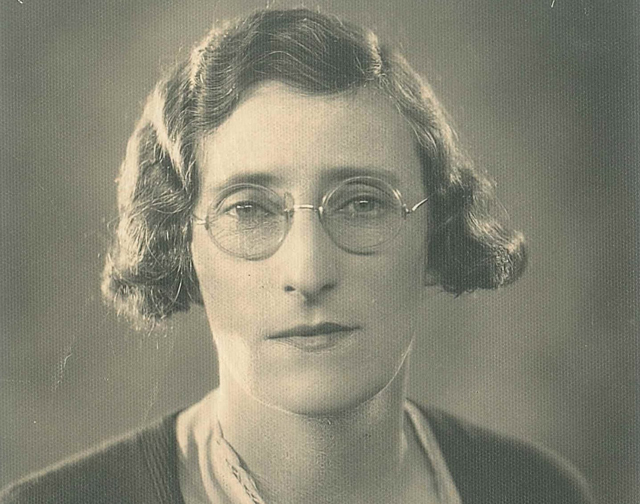
Gwen was born on 22 July 1900 in Orange, NSW, to parents Abraham and Carlotta Lowenthal, who were among the oldest Jewish families in Australia. Abraham was one of twelve children whose German-born father was an early storekeeper at Lawrence on the Clarence River. There was a family tradition that tells of Gwen’s Scottish grandmother standing on the rooftop of their home while the children were passed through a chimney when the river flooded. On her mother’s side, Gwen’s great-grandfather, John Isaacs, had come to NSW as a free settler from England in the late 1840s. Gwen was an accomplished pianist, having attended the Conservatorium of Music in Sydney.
In 1925, Gwen married Judah Green at the Great Synagogue. Judah’s parents had emigrated from Poland to NSW in 1921 and settled in Leeton, NSW, part of the Murrumbidgee Irrigation area, which was known for its great cannery, which apparently could produce seven thousand cans of mixed products per day or, if only peaches, ten thousand. The total quantity of fruit handled during March was one hundred and twenty tons, and this was all from an industry that was only four years old. Gwen and Judah opened a general store there, Gwen working in the store as well as managing four children under five.
She wasted no time in becoming involved in pioneering work in the community during the Depression, as well as her activities with the NSW Country Women’s Association, which began when the Leeton branch was established in 1926. Gwen took on the role of honorary secretary, and made a name for herself as one to step up to fight for Australian fruit growers in their hour of need. In 1934 she was credited with saving the country’s extensive fruit industry, as the township would not be able to accept the next season’s crop. It was sitting on an estimated 4.5 million tins that it could not sell. International markets had collapsed, and Australians were buying half the quantity they had previously bought, possibly because of the Depression. She certainly was a woman ahead of her time.
In an article through the CWA, Gwen recalled the district going into “mourning”, with the economic fallout set to hit the entire community, including the couple’s general store. In her mid-thirties, having recently been elected president of the Leeton branch, she decided to call on them to take action: “Look girls, if the men can’t help themselves, what say we try and do it?” At a women’s rally in March, she explained her intention to appeal directly to Australian housewives and CWA members across the state. All they had to do was buy two extra cans of fruit a month, or two more pounds of dried fruit, to help clear the surplus. Nothing was going to stop her, and with the wider community behind her, she set off for the NSW CWA’s State Conference in Sydney, where she easily convinced delegates to back the campaign. Many of the women lived on fruit blocks and juggled running households with working alongside their husbands in the orchards to keep wage costs down, so they readily agreed to Gwen’s seemingly simple plan.
Leaving the conference, Gwen began walking towards Castlereagh Street, where her father worked. “I passed the Sydney Morning Herald building, and I thought, that’s what I’ve got to do. I’ve got to get the newspapers to do what I wouldn’t have voice enough to do. And I went in, and I said, ‘Can I speak with the editor?’, and of course the girl on the counter laughed at me.” This was explained by Gwen in an oral history interview with Brenda Factor, which forms part of the National Library of Australia collection. Back out in the street, Gwen noticed a staircase leading to the building’s upper floors. Refusing to give up, she took the stairs to the editorial floor and button-holed the editor in his office. The paper ended up running four full pages on Gwen and her courageous campaign over the next few months. Noting her tiny five-foot stature and inexperience, offset by a burning enthusiasm, the women’s editor described her as “a shining example of what a lay person, unskilled in the ways of politicians and public platforms, can do when she has a mission before her and a stout heart to bring to the job”.
All the major papers in Sydney, Melbourne and in country towns gave the campaign publicity, and Gwen found herself a public figure overnight. The Sydney Morning Herald wrote, “It appears that the heroic efforts made by Mrs Judah Green of Leeton are a shining example of what a lay person, unskilled in the ways of politicians and public platforms, can do when she has a mission before her and a stout heart to bring to the job and lead to important developments’’ as reported in the Murrumbidgee Irrigator of 18 June 1934. Within weeks of the conference, the campaign had both government and industry support. Two members of the CWA State Executive joined a special committee that included representatives from every sector of the fruit industry. Gwen was appointed Honorary Organiser by the Australian Fruit Growers’ Federation and given money to cover expenses. She used some of it to post letters to every women’s organisation in Australia and generated interest by speaking at meetings and on the radio. Consumers snapped up six million extra cans of fruit within months, not only securing the immediate future of the Leeton cannery, but also putting the entire Australian industry on a firmer footing. The campaign was so successful that supplies ran out, and it had to be suspended!
Gwen compiled a recipe book introducing tinned fruit for winter desserts, and the Prime Minister, The Honourable Joseph Lyons, wrote the introduction, and the federal government distributed two hundred and fifty thousand copies free. Samples of the puddings and pies were served at CWA meetings, and further promotion was carried out via radio stations and the Retail Groceries Association. The ABC gave her fifteen minutes on air in each state to publicise the ‘Eat More Fruit’ campaign. She wrote five hundred and fifty letters (and received eight hundred replies) plus two series of fifteen hundred circulars. Early in 1935, The Sydney Morning Herald printed a half-page illustrated feature article, reporting that the campaign developed had been an amazing success and, in fact, nine months later they were asked to desist – the canneries could not supply the demand! The Storekeeper of 30 December 1935 called her the ‘Fruit Canners Joan of Arc…having lifted local sales by forty-five per cent in eighteen months.’ The story goes on with fruit being exported to England and in 1936, an exhibit of Australian tinned fruit was included at the Canadian National Exhibition in Toronto.
In 1936, Gwen was elected foundation president of the CWA of NSW – Murrumbidgee Lachlan Group, and the following year, she was awarded the King George VI Coronation Medal for her efforts. Around this time, she and Judah moved to Goulburn and became wool producers. Gwen remained actively involved in the CWA, and during the 1950s, she broadcast each week over Goulburn radio, Women’s Session, talking about fashion, cooking, and lots more.
Judah died in 1960, and she retired to Sydney. Always community-minded, as were her parents, she put their example into practice all her life. She continued to volunteer for the CWA, of which she was a life member, Woollahra Senior Citizens’ Centre, and the National Council of Jewish Women’s Meals on Wheels program. One of her daughters pointed out that she was older than many of the people she visited. She grew African violet plants, which she propagated from their leaves and gave these away to charities and friends. “The Montefiore Home made three hundred pounds last year from my African violets’ she said with some pride. She lived life to the full, with zest and the gentle charm that endeared her to people. As a reminder of her campaign of the 1930s, she was presented with a canteen of cutlery by the Fruit Industry Sugar Commission Committee, on the lid of which a brass plate was engraved as follows: ‘in recognition of her Fine Services to the Australian Canned Fruits Industry 1934-5’.
Gwen died on 30 December 1987 at the age of 87.
The AJHS acknowledges the following references in the preparation of this story:
CWA edited extract from The Women Who Changed Country Australia, by Liz Harfull; Beginning with Esther – Lysbeth Cohen; The Australian Women’s Register; The Australian Jewish Historical Society – Louise Rosenberg

The Australian Jewish Historical Society is the keeper of archives from the arrival of the First Fleet in 1788 to the present day. Whether you are searching for an academic resource, an event, a picture or an article, AJHS can help you find that piece of historical material. The AJHS welcomes your contributions to the archives. If you are a descendant of someone of interest with a story to share, or you have memorabilia that may be of significance to our archives, please contact us via www.ajhs.com.au or [email protected].
Edited by Ruth Lilian