
A music review by Shirley Politzer
What does a 30-year-old composer do when faced with the loss of both his mother and his greatest mentor, Robert Schumann? For Johannes Brahms, the answer was to write a Requiem — but not an ordinary one.
Traditionally, a Requiem is a Latin liturgical mass for the dead. Brahms instead created something far more personal and humane: a deeply moving meditation written not for the souls of the departed, but for the consolation of those left behind. In a rare choice to draw his own text from the Lutheran Bible, Brahms shaped his “German Requiem” to offer comfort through gorgeous melodies and profoundly human emotion.
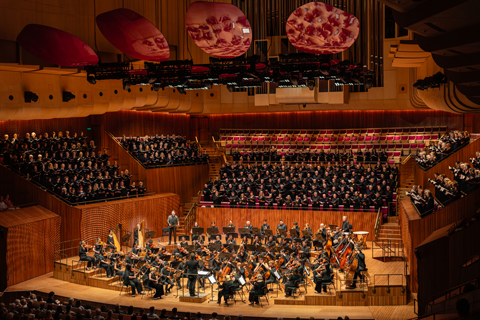
This large-scale work, performed at the Sydney Opera House, is among the most challenging ever undertaken by the Sydney Philharmonia Festival Chorus. The soprano melodies sit at the top of their range, the tenor lines are long and exhausting, and the seven movements — nearly 80 minutes of sustained concentration — demand both stamina and expressive sensitivity. The choir, standing for six of the seven movements, met these challenges very capably. Their warm tone and clarity in the German text clearly displayed the music’s consoling power.
The choir was beautifully supported by the Sydney Youth Orchestra, whose young musicians played with maturity and heart. Founded in 1973, the SYO fosters teamwork and dedication in players aged 5–25, and their collaboration here with members of the Sydney Philharmonia Orchestra produced an ensemble of beautiful colour and balance. The strings and woodwinds brought tenderness and warmth, while the brass added weight and majesty. The harp, used sparingly, framed the work gracefully. High above the choir, David Drury’s organ playing bound everything together, and played a key role in the overall emotional impact of the work.
Conductor Brett Weymark shaped the performance with sensitivity and poise, maintaining a perfect balance between chorus, orchestra, and soloists.
Australian baritone Samuel Dundas brought authority and warmth to his solos, particularly in the reflective third movement, “Herr, lehre doch mich” (“Lord, make me to know mine end”), and in the dramatic sixth movement, “Denn wir haben hie keine bleibende Statt” (“For here we have no lasting home”). Though placed behind the orchestra, his rich, resonant tone could still be heard. Dundas is a familiar and much-admired artist with Sydney Philharmonia Choirs (SPC) since singing this role for ChorusOz in 2013.
Soprano Cathy-Di Zhang, in her first appearance with SPC, made her solo in the fifth movement unforgettable. Entering from the side of the stage in a striking one-shoulder, bright-red gown, she sang with a silken tone, her voice floating effortlessly over the orchestra. As she walked slowly across the stage, her gentle phrasing transformed “Ihr habt nun Traurigkeit” (“You now have sorrow”) into a moment of pure solace — as though she were in an intimate conversation with the audience.
Brahms’s German Requiem is about tenderness, hope, and the healing power of music rather than about suffering and death. This performance captured that spirit perfectly. If you need comfort, you will find it in this performance.
Sydney Opera House, 25 October 2025