
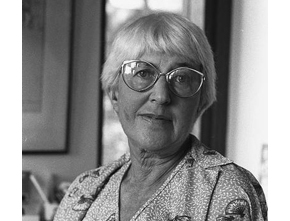
Nancy Florence Keesing AM – a force in the Australian literary world
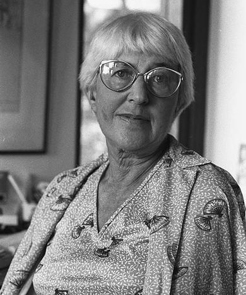
Nancy Florence Keesing was born on 7 September 1923 at Darling Point, Sydney. She was the eldest of two daughters of New Zealand-born parents, Gordon Samuel Keesing, an architect, and his wife, Margery, who were prominently involved in Jewish communal life.
Her grandfather, Henry Keesing was associated with the establishment of the Auckland Jewish Synagogue in 1885.
Nancy was educated at Sydney Church of England Girls’ Grammar School, Darlinghurst, and Frensham, Mittagong. Her parents were avid readers, her mother being interested in contemporary poetry and fiction. Nancy remained close to her mother, inheriting her love of books and wrote her own poetry and stories from childhood.
During World War II, Nancy worked as a clerk in the Department of the Navy on Garden Island, a job she described in her 1975 memoir, Garden Island People. She then studied social work at the University of Sydney, completing her degree in 1947 and took up a position at the Royal Alexandra Hospital for Children until 1951. On 2 February 1955, she married Adolphus Marcus (Mark) Hertzberg, a chemical engineer, at the Great Synagogue, Sydney. Nancy retained her Dutch Jewish surname for professional purposes throughout her life. The couple had a daughter and a son.
Nancy had already begun to make a name for herself as a poet, with such verse as “Imminent Summer” (included in an anthology of her then Australian poetry published during 1946) and “Manifesto”, a highly commended submission to the Sydney Morning Herald verse competition in 1949. In 1951, she began working with the Sydney magazine, The Bulletin, a long-established Sydney periodical on politics, current affairs, literature, and humour. Nancy had had the opportunity for her poems to be published in the magazine before 1946, when she met Douglas Stewart, the literary editor. She formed a close association with Douglas and Sydney’s literary circles that continued throughout her life. Initially, she worked one day a week, carrying out research for a proposed history of The Bulletin, and later assisting Douglas in the preparation of two jointly edited anthologies, Australian Bush Ballads (1955) plus Old Bush Songs and Rhymes of Colonial Times (1957), which were significant contributions to the reassessment and rehabilitation of iconic Australian verse. “Australian Bush Ballads is a valuable part of our history, but not representing our greatest verse,” she explained in 1953. “We can see that, now that we are far enough away. However, at the time of their writing, chiefly in the ‘90s, ballads were given a false value. This was followed by a revulsion and a campaign against them… which brought about the suppression of many of real interest” (Quoted in The Worker, Brisbane, October 19, 1953). She thus played a pioneering part in plucking old Australian country folksongs out of the oblivion into which they were starting to fall. Identifying the works in question entailed numerous hours on her part trawling through old newspapers and other sources in archives, public and private, typing them out, and then, with editor Douglas Stewart, making a final selection.
Nancy became active in the Sydney branch of the English Association, publishers of the literary journal Southerly, and continued to serve on its committee until her final illness. She was not a foundation member, but was very involved in the Australian Society of Authors (ASA), being elected in 1969 to the management committee and editing an anthology of members’ work, Transition in 1970, as well as their journal, Australian Author, from 1971 to 1974. She was chair of the Literature Board, Australian Council, from 1974 to 1977. She was also active in the Australian Jewish Historical Society and the Kuring-gai College of Advanced Education as a council member.
In 1973, the Whitlam government announced a reorganisation of the Australian Council for the Arts, which was now to include a literature board. Nancy was one of eleven writers and academics appointed to the new board, which she chaired from 1974 to 1977. In 1979, she became a Member of the Order of Australia (AM) in the Australia Day Honours for service to literature.
Throughout her life, Nancy continued to write and edit, publishing twenty-six books in a range of genres. Her first collection of poems, Imminent Summer, appeared in 1951; her fifth, the posthumous The Woman I Am (1995), was edited by Meg Stewart, daughter of Douglas. She also wrote a short critical monograph of Douglas Stewart (1965) and two children’s books set in nineteenth-century Australia. Her edited works included collections of material on the gold rushes, the Kelly gang, and Australian motherhood, as well as Shalom (1978), an anthology of Australian Jewish stories. Her continuing interest in folklore led to Lily on the Dustbin: Slang of Australian Women and Families (1982) and a sequel, Just Look Out the Window (1985). Riding the Elephant (1988), which was her memoir, recalls her family life, youthful enthusiasms and ambitions, and later literary associations, giving lively portraits of friends and the occasional foe.
She also reviewed Australian fiction, poetry, and non-fiction for The Southerly, the Australian Book Review, the Sydney Morning Herald, and other major newspapers, and was an early champion of the work of David Martin AM, a Hungarian-born Australian writer, poet, and editor and Elizabeth Jolley AO, an English-born Australian writer, among others. In 1975, when critical material on recent Australian fiction was difficult to come by, Nancy edited Australian Postwar Novelists: Selected Critical Essays.
Nancy was short-sighted from her early childhood and was known for her large glasses, wide smile, and ready laugh. Friends remembered her honesty and generosity, and her affectation. In addition to providing personal encouragement to many writers, she helped establish the ASA Writers Benevolent Fund in 1984 with a donation of $5,000. In 1985, she endowed the Keesing Studio in Paris in memory of her parents. This writer’s fellowship is administered by her children.
She died from breast cancer on 19 January 1993 at Hunters Hill. A bequest left to the ASA was used to establish the Keesing Press. In her honour, Mark, who had served as a past President of the Library Council of New South Wales, donated funds to the State Library for an annual Nancy Keesing Fellowship, which supports research using the library’s resources into any aspect of Australian life and culture. Nancy went on to pay a fond tribute to her elderly mother in the poem “Three Ring Circus,” published in The Penguin Book of Australian Women Poets in 1986. She was instrumental in the establishment of the Miles Franklin Literary Award, Australia’s most prestigious literature prize, which is named after Stella Miles Franklin, another famous female author.
Through her association with the Australian Jewish Historical Society, she edited Shalom (1978), an anthology of Australian Jewish short stories, and financed the invaluable Bibliography of Australian Judaica compiled by Dr Serge Liberman and edited by Joy Ruth Young. She and Judy Cassab, well-known artist, were among thirty-three prominent, mainly non-Jewish, Australians (four of them women) from various fields who signed a letter to the Canberra Times (April 11, 1979) deploring the “blatant politicisation” of UNESCO and its consequent demonization of Israel and calling on other concerned Australians to follow their example in communicating concerns about UNESCO’s anti-Israel animus to that organisation’s director-general in Paris.
The AJHS acknowledges the following references in the preparation of this story:
Wikipedia – Research edited by Karen Fox; Jewish Women’s Archive (Sept 7 1923 to January 19 1993) by Hilary Rubinstein; Australian Dictionary of Biography by Elizabeth Webby; Australian War Memorial; Riding the Elephant – ABC Radio Listen App; Jewish Women’s Agency, State Library of NSW

The Australian Jewish Historical Society is the keeper of archives from the arrival of the First Fleet in 1788 to the present day. Whether you are searching for an academic resource, an event, a picture or an article, AJHS can help you find that piece of historical material. The AJHS welcomes your contributions to the archives. If you are a descendant of someone of interest with a story to share, or you have memorabilia that may be of significance to our archives, please contact us via www.ajhs.com.au or [email protected].
From Australia’s Jewisnh past is edited by Ruth Lilian
The form you have selected does not exist.