
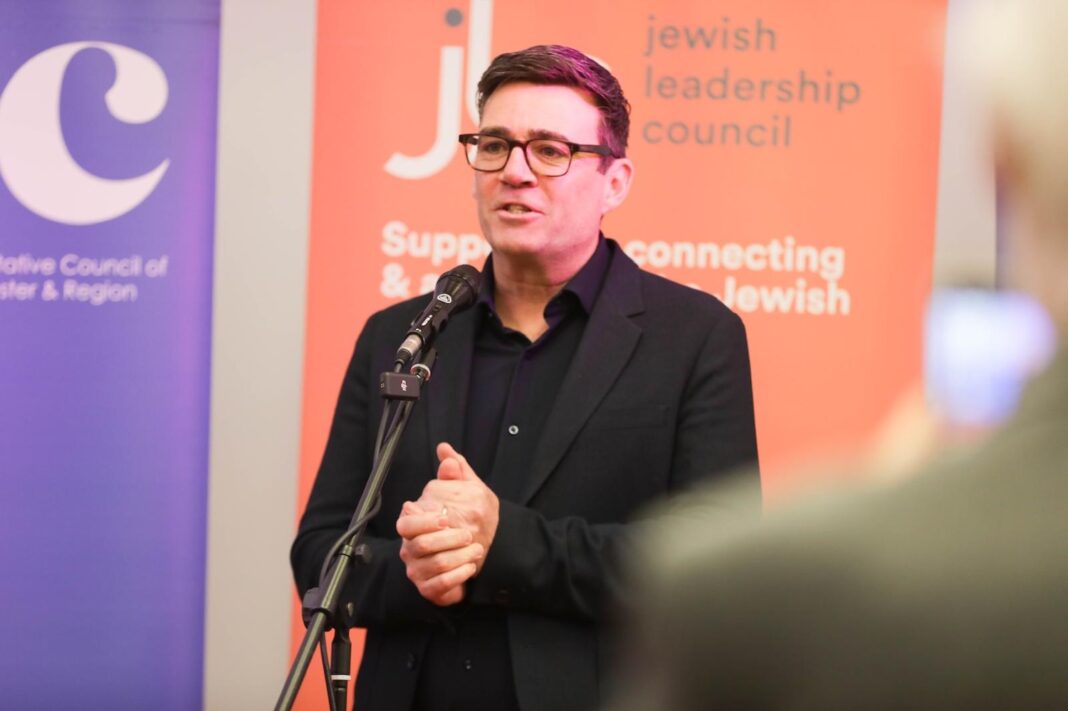
Andy Burnham’s record on Israel, Gaza and antisemitism is coming under renewed scrutiny after he entered the race to succeed British Prime Minister Keir Starmer as Labour leader.
Burnham returned to Westminster after winning the Makerfield by-election on 18 June with 55 per cent of the vote. He defeated Reform UK’s Robert Kenyon by 9,231 votes.
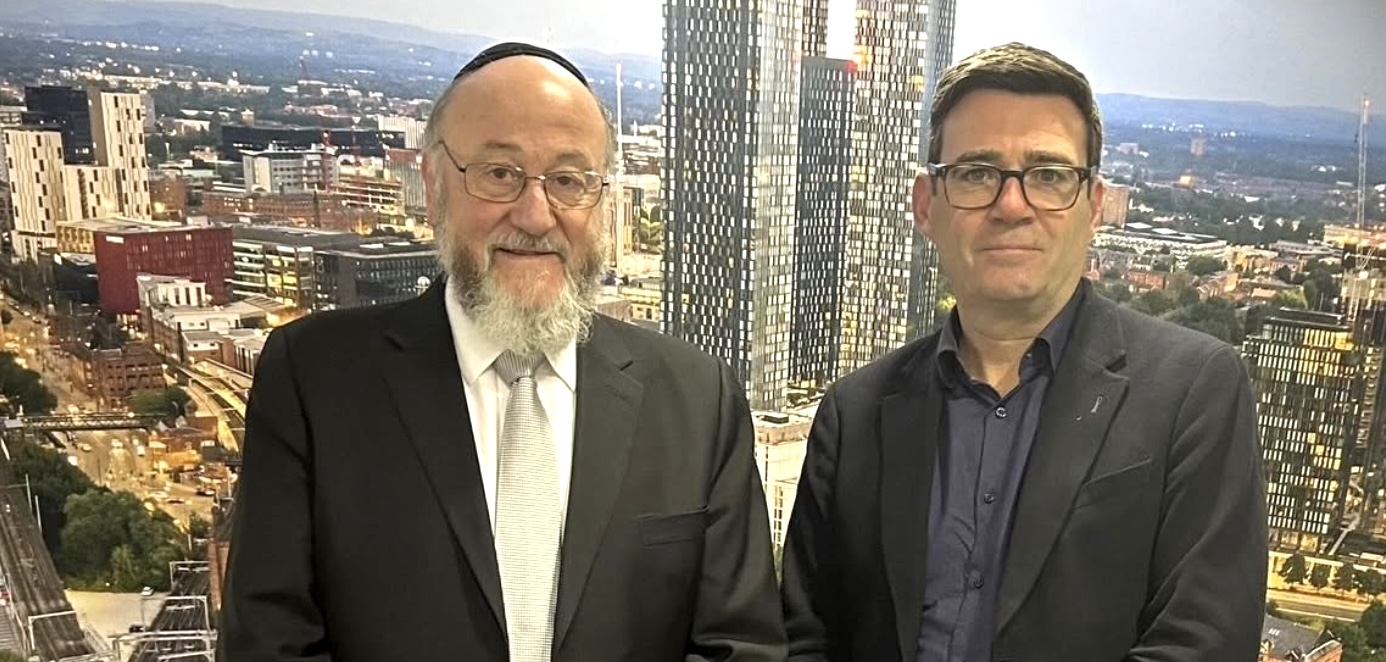
Four days later, Starmer announced that he would resign as Labour leader and remain prime minister until a successor was chosen.
Burnham has confirmed he will stand for the leadership and has emerged as the clear frontrunner, particularly after former health secretary Wes Streeting ruled himself out and endorsed him.
Labour is expected to open nominations on 9 July. A new leader could be installed quickly if Burnham is the only candidate to qualify, while a contested election is expected to conclude before Parliament returns in September.
Sources close to Burnham have told Jewish News UK that he intends to set out a clearer position on Israel and the Palestinians after largely avoiding foreign policy during the Makerfield campaign.
His record combines a long relationship with Manchester’s Jewish community with an increasingly critical position on the war in Gaza, Palestinian statehood and British policy towards Israel.
During his unsuccessful Labour leadership campaign in 2015, Burnham was a parliamentary supporter of Labour Friends of Israel.
Jewish News UK reported at the time that he told a Jewish community meeting that Israel would be his first foreign destination if he became Labour leader.
Burnham opposed the Boycott, Divestment and Sanctions movement and criticised what he called the “unjustified spitefulness” directed at Israel.
He praised Israel’s record on gay rights, trade union rights and civil liberties and described the Balfour Declaration as an example of “British values in action”.
His position was not wholly aligned with pro-Israel organisations. In the same year, he told the Palestine Solidarity Campaign that Palestinian statehood was “not a gift to be given but a right to be recognised”.
Burnham’s public statements became more critical after the Hamas-led attacks of 7 October 2023 and the war that followed.
He condemned the attacks as “barbaric” and “appalling”, supported Israel’s right to defend its citizens within international law and addressed a Manchester Jewish community vigil organised at 24 hours’ notice.
Later that month, he joined Greater Manchester council leaders in calling for a ceasefire, placing him among the first senior Labour figures to take that position.
The statement condemned Hamas, called for the hostages to be released unharmed, recognised Israel’s right to take targeted action against terrorism and urged that humanitarian aid be allowed into Gaza.
Jewish community representatives argued that the statement did not give sufficient weight to Israel’s right and responsibility to defend its citizens while hostages remained captive.
Mark Adlestone, chair of the Jewish Representative Council of Greater Manchester and Region, later wrote in Jewish News UK that communal leaders contacted Burnham and held a formal meeting with him within 72 hours. Adlestone said they remained divided over the ceasefire call but that Burnham heard their objections and continued to engage with the community.
Burnham has since supported British recognition of a Palestinian state and expressed concern about the scale of destruction in Gaza.
In June 2025, he joined Welsh First Minister Eluned Morgan and senior Labour figures Emily Thornberry and Andy Slaughter in urging Britain to recognise Palestinian statehood “without further delay or equivocation”.
During the Makerfield campaign, Burnham told a pro-Palestinian activist that he had called for a ceasefire soon after October 7 and had held a consistent position on the issue for many years. He also referred to a visit to the region with Labour Friends of Palestine in 2012.
Burnham has nevertheless resisted calls from some on Labour’s left to describe Israel’s conduct in Gaza as “genocide”.
Speaking during the campaign, he said he was deeply concerned about what he regarded as the disproportionate scale of the destruction but did not believe he was in a position to make a judgement of such gravity.
His response disappointed some pro-Palestinian campaigners but left him closer to Starmer’s position than many figures on Labour’s left.
Jewish Labour members are now seeking more detail about the policies Burnham would pursue as party leader and prime minister.
Jewish News has reported that the Jewish Labour Movement wrote to Burnham on at least two occasions seeking clarification about several issues, including his engagement with the left-wing website The Canary.
The organisation also reportedly contacted him after he said former Labour figures Faiza Shaheen and Jamie Driscoll should never have been “kicked out”. However, he ruled out supporting Jeremy Corbyn’s return to the Parliamentary Labour Party.
Labour’s national executive committee declined to endorse Shaheen as the party’s candidate for Chingford and Woodford Green after citing her social media support for Green Party candidates.
Jewish Labour figures had separately raised concerns about social media material connected with antisemitism and what they regarded as the divisive use of Gaza and Palestine during her campaign. Shaheen later stood as an independent.
Driscoll was blocked from seeking Labour’s nomination for the North East mayoralty after appearing at an event with director Ken Loach and declining to condemn controversial remarks attributed to Loach concerning Jews, Israel and the Holocaust. Driscoll also later stood as an independent.
His remarks have caused concern among some Jewish Labour members that a Burnham leadership could weaken the tougher approach to antisemitism adopted after Starmer replaced Corbyn.
His record in Greater Manchester has, however, earned respect from many local Jewish leaders.
According to Adlestone, Burnham maintained regular contact with communal organisations during his years as mayor and attended election meetings, civic functions and Holocaust remembrance events.
He also took part in meetings with Jewish community leaders and visited welfare, security, medical, youth and sporting organisations.
Among the people with whom he formed a personal relationship was Holocaust survivor Ike Alterman. Burnham later spoke at Alterman’s shiva and supported The Fed’s My Voice project, which records the testimony of Holocaust survivors.
At a civic reception in December 2024, Burnham praised the Jewish community’s contribution to Greater Manchester and said the region would always be a place where Jewish people were safe and celebrated.
His relationship with the community faced its most serious test after the terrorist attack on Heaton Park Hebrew Congregation on Yom Kippur in October 2025.
According to Adlestone’s account, Burnham contacted Jewish representatives, publicly described the attack as antisemitic terrorism and stood alongside community leaders at a hastily arranged press conference and vigil.
He later attended a Shabbat service at the synagogue with deputy mayor Kate Green, took questions from congregants and returned for a Chanukah candle-lighting ceremony.
Adlestone described Burnham’s response to the attack as “exemplary”.
He said Burnham had remained accessible to Jewish leaders, supported the community during periods of fear and continued meeting its representatives when they disagreed over Israel and Gaza. Burnham has also condemned antisemitism within Labour.
Addressing a Board of Deputies of British Jews meeting in Manchester in 2019, he said it was inconceivable that a party proud of its record against racism had become caught in an antisemitism crisis.
“Racism needs to be dealt with firmly, quickly and decisively,” he said, adding that Labour under Corbyn had failed to respond in that way.
Culture Secretary Lisa Nandy, a long-time friend and political ally of Burnham, has said he would “always stand with” Britain’s Jewish community.
She told Jewish News UK that Burnham understood the historical need for a safe Jewish homeland while also believing strongly in the rights, dignity and justice of Palestinians.
Prominent Jewish Labour figures, including peer Luciana Berger, Courts Minister Sarah Sackman and Hendon MP David Pinto-Duschinsky, campaigned for Burnham in Makerfield.
Individual members of the Jewish Labour Movement’s north-west branch also canvassed for him, although the organisation did not send an official delegation.
Their involvement reflects a relationship that cannot be reduced to a simple division between support for Israel and support for the Palestinians.
Local Jewish leaders have expressed confidence in Burnham’s record on communal security, antisemitism and direct engagement. Their greater concern is the foreign policy a Burnham government could pursue towards Israel.
Adlestone has said there is a widening divide between the Jewish Representative Council and Labour over Palestinian recognition, possible restrictions on arms and trade, statements about the conflict and Britain’s voting positions at the United Nations.
He said he expected little improvement in those areas under Burnham and believed that further British pressure on Israel was possible.
Those comments were Adlestone’s assessment of Burnham’s likely direction, rather than policies announced by Burnham.
At the same time, Adlestone credited him with remaining accessible to the community and showing public solidarity during periods of crisis.
That distinction is likely to shape the Jewish community’s assessment of Burnham during the Labour leadership contest.
His engagement with Manchester’s Jewish community is long-standing and well documented. The direction he would take British policy towards Israel is less certain and is likely to be closely examined as he campaigns for Downing Street.