
Book review by Dr Anne Sarzin
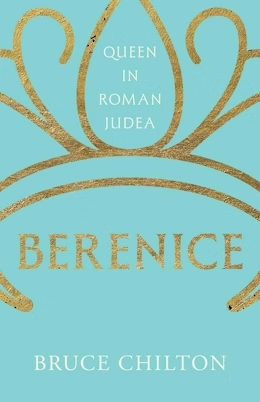 While eclipsed in history and literature, right up to the present day, by the seductive and celebrated saga of lovers Cleopatra and Mark Antony, the life of Jewish Queen Berenice from first-century Judea and the story of her sexual liaison and well documented partnership with Titus, the future Roman Emperor, constitute one of history’s most fascinating chapters.
It was Titus, representing his father Vespasian, who masterminded the relentless siege of Jerusalem, the devastating destruction of the city in 70 CE amid the eventual pillaging and demolition of this revered jewel in the crown of the Jewish people in Judea, their beloved Temple, only recently rebuilt and refurbished by Herod the Great, Berenice’s great-grandfather, who became King of Judea by proclamation of the Senate in Rome in 40 BCE. Herod also acquired royal status through marriage to a Maccabean princess named Mariamme, a union that united his Idumean and her Hasmonean ancestry.
Queen Berenice and Titus emerge as significant players in the tumultuous and bloody intersection of Judean and Roman imperial history. In Bruce Chilton’s engrossing book, Berenice: Queen in Roman Judea, a story unfolds that will surprise and enthral those unfamiliar with the career trajectories of the ruling Herodian dynasty or the lives of the Roman elite and their military generals ruthlessly promoting the interests of the Roman Empire while seeking personal recognition and imperial honours. This was a time when, within a blinding instant, predictable and, at times, unforeseen and capricious reversals of fortunes changed the course of lives for better or for worse.
At the heart of this book that seethes with skirmishes and battles is the eponymous and magnetic heroine, the multifaceted Berenice, a Jewish queen in ancient Judea with a proud dynastic heritage as great-granddaughter of King Herod. She confounds the reader with her multiple conflicting personae, including that of a dedicated and sincere Nazarite with shorn hair and bare feet, embarking on a penitential pilgrimage to the Temple in Jerusalem, as well as that of a thrice-married woman—once divorced and twice widowed—and a mother of two sons. While scheming Herodians and Romans inevitably enforced major developments and directions in her life, she was always much more than a mere pawn in their competitive stratagems.
Author Bruce Chilton has written a slender book but engaging text that is consistently balanced between his delineation of imperial Roman ambitions and the parochial Judean concerns and issues. These contextually explanatory pages and chapters are often exceptionally dense with names, lineages and historical developments, but persistence pays off for the determined reader.
Gradually, one gains insights into the multiple and often conflicting sociopolitical currents swirling through Judea, Samaria, the Roman and Parthian Empires and lesser kingdoms; as one meets leading characters in the unfolding drama, many of whom rampage cruelly with unrestrained barbarism through regions and lives in pursuit of wealth, prominence and glory.
Once Chilton has established this seething background, we are well placed to marvel at the emergence of Queen Berenice, one of history’s most notable Jewish women leaders, whose voice was muffled and obscured in the commentaries of male writers such as Suetonius, who spread malicious and denigrating rumours about her allegedly incestuous relationship with her brother Agrippa I, and in the writings of Josephus Flavius, a highly regarded Roman historian who had defected from the Jewish people once he realised resistance was useless in the face of the Roman conquest of Judea.
Formerly known as Yosef ben Matityahu, Josephus was a Jewish aristocrat, priest and distinguished military leader descended from royal Hasmoneans (the Maccabeans). Born into a world dominated by men, the Herodian women like Berenice and her sisters, in many remarkable instances, made their own choices and demands, such as insisting potential non-Jewish partners agree to circumcision before marriage and that these women be given the right to initiate divorce should they desire to do so, which was generally a male prerogative at that time.
Chilton traces the trajectory of Berenice’s life from her years as a child bride in Alexandria, Egypt, and her educational exposure to seminal contemporary events in Jewish history. For example, her uncle by marriage, Philo of Alexandria, and her father-in-law Alexander the Alabarch were both committed to defending the Temple in Jerusalem against orders by Emperor Caligula to erect a statue of Jupiter within the sanctuary.
This foreshadows a constant theme in Berenice’s life, her devotion to the Temple and, paradoxically, her love affair with the man responsible for plundering the Temple’s riches, razing it to the ground, and effectively creating a new diaspora. The pain and torture the Romans inflicted on Jerusalemites has an eerie resonance for today’s readers reflecting on the post-7 October 2023 massacre in southern Israel. There is the same barbarism, rape, pillaging and wholesale slaughter that characterised both horrific events. Chilton does not infer this comparison, but readers sensitised by recent events will be plunged, with profound empathy, into the horrendous and comparable suffering experienced by Jewish ancestors two millennia ago.
With the death of Berenice’s first husband in Alexandria, we learn of her subsequent two marriages to reigning kings, Herod King of Chalcis, and Polemon King of Pontus, Colchis and Cilicia. There is also discussion of her role as the sister of Agrippa II, who reigned as King of Caesarea Philippi, and the controversial reports of her reputedly fractious relationship with her sister Drusilla, consort of King Azizus of Emesa. But it is her relationship with and love for Titus and her existence as his paramour in Rome that constitutes one of the most absorbing aspects of this biography.
Luminaries such as Quintilian and Dio Cassius provide contemporary references to her influence in the imperial city. It challenges one’s imagination to consider what life must have been like for a Jewish queen probably distrusted and despised by the Roman populace, yet enjoying Titus’s protection and regard. What a tightrope she walked, striving to keep her balance while buffeted by opposing forces. Vespasian’s death and the accession of Titus as Emperor forced Berenice’s departure from Rome around 100 CE, an exit from the realms of power that ended any hopes she might have cherished of restoring the Temple in Jerusalem or, indeed, of marrying Titus and sharing his imperial reign. Before her erasure from the chronicles of history, she made one last documented return visit to Rome ‘to salute the new emperor as a matter of state, while keeping her distance as a matter of politics’.
While Chilton shines the spotlight on the life and loves, career and legend of Berenice, there is an array of minor yet fascinating characters that make cameo appearances, including Jesus of Nazareth, his brother James, John the Baptist and the Apostle Paul. Additionally, there is a useful chronology and excellent source notes, as well as an index and comprehensive bibliography of ancient and modern sources, the latter a real boon for students of history and classical scholars.
Bruce Chilton has clearly fulfilled his aim of recreating a life from history that has too often been diminished or blatantly ignored by commentators. The author has rescued Berenice from historic obscurity and allowed her once again, as a proud Herodian woman, to stride confidently from the shadows. She emerges from this book as a commanding figure, someone with immense strength of character and the skills to triumph over devastation and death. Remarkably, as a woman, she strikes one as a non-conformist, perhaps even a prototypical feminist, adjusting with political nous and resilience to changed circumstances. Bruce Chilton has given us much to admire in his portrayal of a Jewish queen buffeted by the winds of change yet strong enough to shape her own destiny.
Berenice: Queen in Roman Judea
By Bruce Chilton
Yale University Press, New Haven & London
2026
Berenice was a catalyst. Men in her time and later distorted her memory, but her actions speak louder than their words: provided the historical sources are read contextually. Anne Sarzin has captured this challenge, and the privilege of discovering a life.