
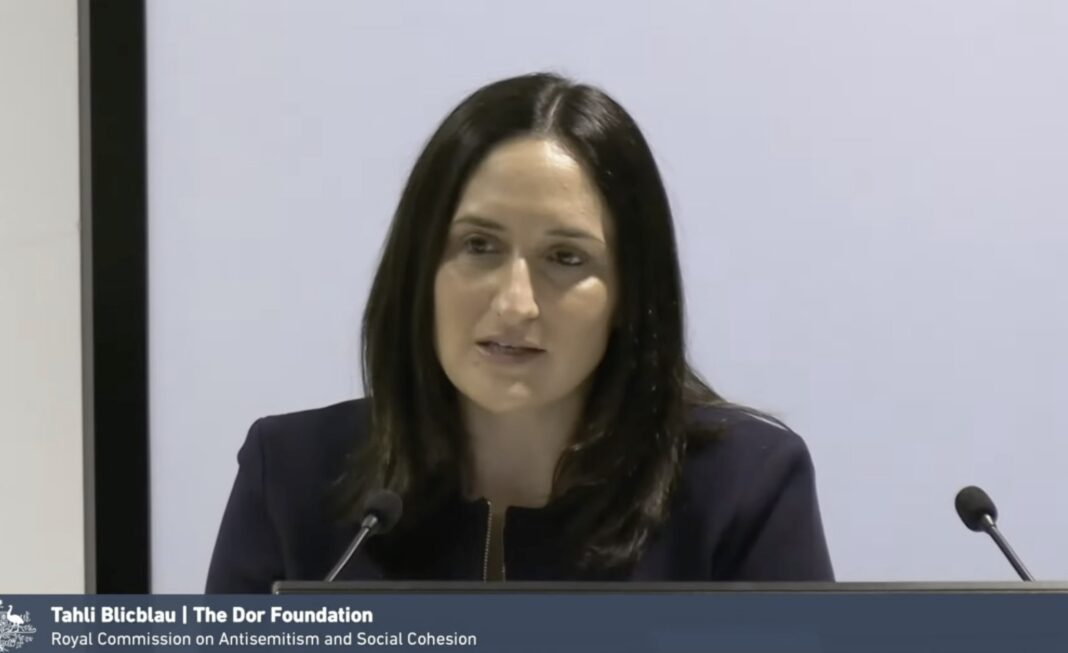
Jewish Australians have told the Royal Commission on Antisemitism and Social Cohesion that their participation in the inquiry has exposed them to online threats involving gas chambers, concentration camps and firebombing.
Dor Foundation chief executive Tahli Blicblau said witnesses had faced violent, sexually degrading and antisemitic abuse, while social media companies repeatedly failed to remove reported content.
She told the commission today that an online comment proposing that disused oil refineries be converted into “makeshift concentration camps” had been reported several times during the previous week but remained online.
Other posts directed threats at individual witnesses and called for Jews to be killed.
“Where do you live so I can firebomb your car? You Jewish whore,” read one comment aimed at a woman who had posted about her royal commission submission in May.
Blicblau said the abuse was not limited to isolated comments, with more than 1000 hateful or violent messages recorded after witnesses appeared during the commission’s first public hearing block.
The posts included death threats, Holocaust denial, sexual abuse and calls for Jews to be placed in concentration camps.
Commissioner Virginia Bell intervened after the threats emerged, warning that attempts to intimidate witnesses could result in prosecution.
The Australian Federal Police began investigating the campaign, and a northern NSW neo-Nazi was later charged over allegedly intimidating emails sent to one witness.
Blicblau said the abuse showed that social media reporting systems were failing to respond adequately even when content explicitly threatened violence.
She warned that action was needed before online hatred escalated into violence.
“By the time someone is drawing a swastika on a school or setting fire to a synagogue, it is too late to reach them and intervene,” she said.
“We need to understand what people are saying before they act and what they are thinking before they speak, and we need to intervene early to prevent harm and reduce fear.”
She joined federal Labor MP Josh Burns in calling for stronger protections and greater accountability for online platforms.
Burns said Jewish Australians were increasingly being treated as collectively responsible for Israel’s actions.
An “us and them” narrative had developed online in which Jewish Australians were assumed to support every action taken by the Israeli government, he said.
He said the attack made him feel that Australia’s standing as a “goldene medina”, or golden land, for Jewish people had ended after generations had regarded the country as a place of safety.
After his electorate office was attacked, he felt despair.
“I felt like we were lost,” he said.
“How was this part of the democracy that we all work for? How was this going to solve anything in the Middle East?
The federal member for Macnamara said Jewish schoolgirls had also been subjected to sexualised and antisemitic abuse online, showing how hatred directed at prominent adults spread to children and other community members.
Violinist Ben Adler, director of the Shir music festival, told the commission that social media boycott campaigns had prompted Australian arts organisations and venues to exclude Jewish and Zionist performers.
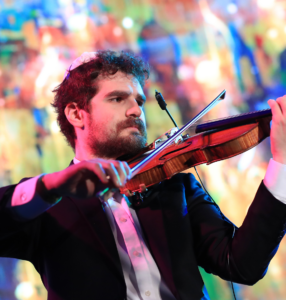
He said a regional Victorian folk festival had invited his band to headline but later sought to withdraw the invitation after the Hamas attacks in Israel on October 7, 2023.
“The path of least resistance for the music festival was just to remove the Jews from the public space to prevent any kind of outrage boiling over on social media,” he said.
Adler said the hostility had also been directed at his band. A social media post featuring the Yiddish Holocaust song Papir Rosen drew comments describing Jews as a “cancer on the world”, while another user referred to using Molotov cocktails at a Melbourne concert.
The original venue later withdrew, forcing the band to find a replacement at short notice. Adler said he had contacted Victoria Police repeatedly since September 2025 but had not received a meaningful response.
He told the commission that resisting attempts to exclude Jewish performers had taken time away from rehearsing and performing. He said the removal of Jewish artists from festivals, venues, awards and media also denied audiences the chance to encounter Jewish culture beyond political debate.
Adler said cultural organisations were often more concerned about avoiding online criticism than protecting artists from discrimination.
The Sydney hearing block, which runs until July 10, is examining the spread of antisemitism and other hate speech online, the effect on Jewish Australians and the effectiveness of social media companies’ reporting and moderation systems.
The commission will also examine cooperation between platforms, regulators and law-enforcement agencies, as well as allegations of antisemitism in traditional media and public broadcasters including the ABC and SBS.
Lifeline 13 11 14
Kids Helpline 1800 55 1800, for people aged five to 25
By Lucinda Garbutt-Young/AAP
As a non Jewish person anybody heard or writes such vile anti semantic comments needs to be heavily fined. These un educated bogans need to read about the holocaust or watch a British programme the World at War and listen to Jewish people’s testimonies about the gas chambers. They might, although I wouldn’t be suprised if there is any remorse on Jewish people’s behalf, as these thugs would have very little knowledge of history.Basically they are oxygen thieves.