
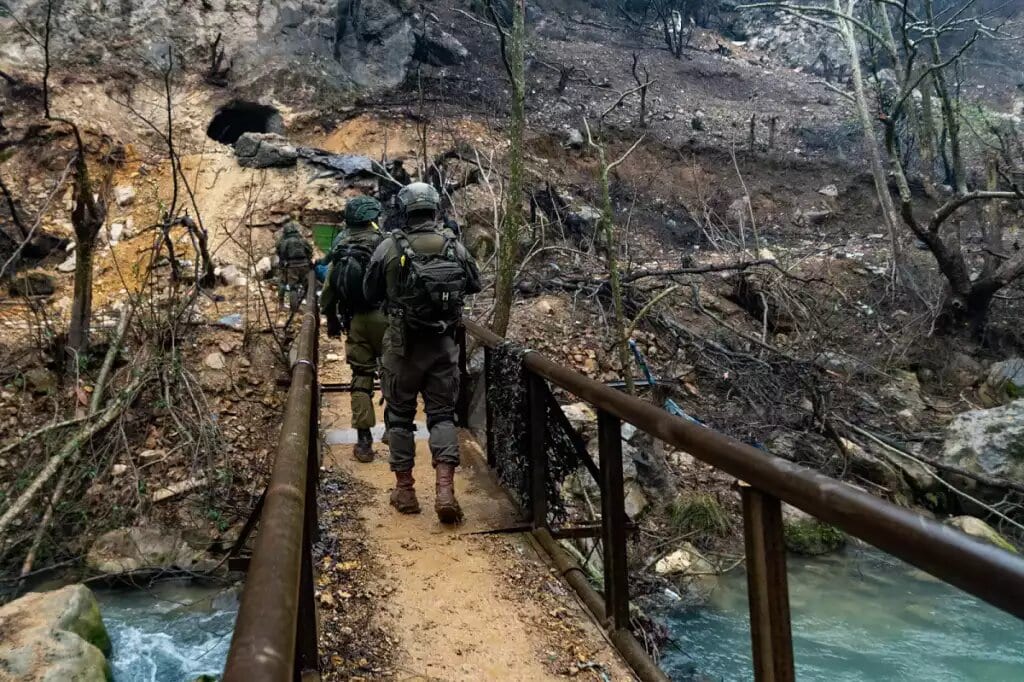
The Israel Defence Forces rapidly detected and eliminated armed Hezbollah terror operatives who violated newly established ceasefire understandings in southern Lebanon on Monday, as a new expanded Israeli security zone took shape.
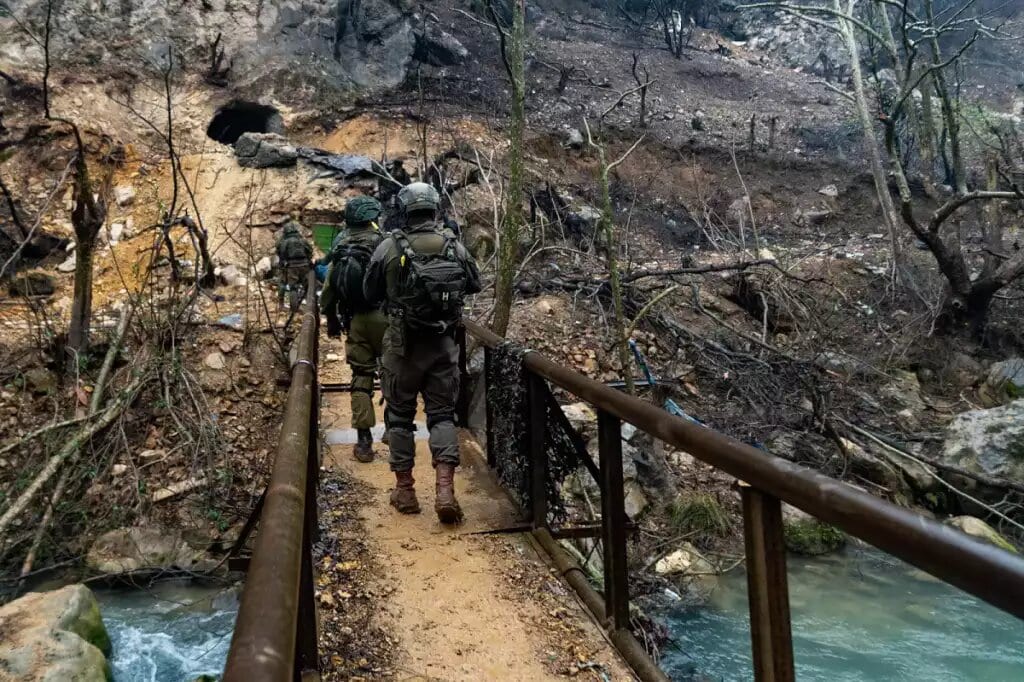
The military is enforcing what it describes as a forward defence line roughly 10 kilometres deep into Lebanon to neutralise immediate threats to northern Israeli communities.
According to the IDF Spokesperson Unit on Monday, Divisions 98 and 36 operating within the security zone identified and neutralised multiple threats that breached the security zone in two incidents, involving Paratroopers in Bint Jbeil and Golani soldiers in the Litani River sector.
“Shortly after the identification and in a rapid circle closure, the Air Force, directed by forces on the ground, struck and eliminated the terrorists to remove the threat,” the military stated, describing one of the incidents.
The IDF will continue to operate to clear the area under its control and remove any threat to the citizens of the State of Israel and its forces,” it added.
A security source on Monday detailed the operational reality on the ground since the ceasefire went into effect on April 16. “With the ceasefire understandings, we continue to remain in a defensive posture in southern Lebanon,” the security source stated. “On the night between Friday and Saturday, we halted our ground operations at midnight.”
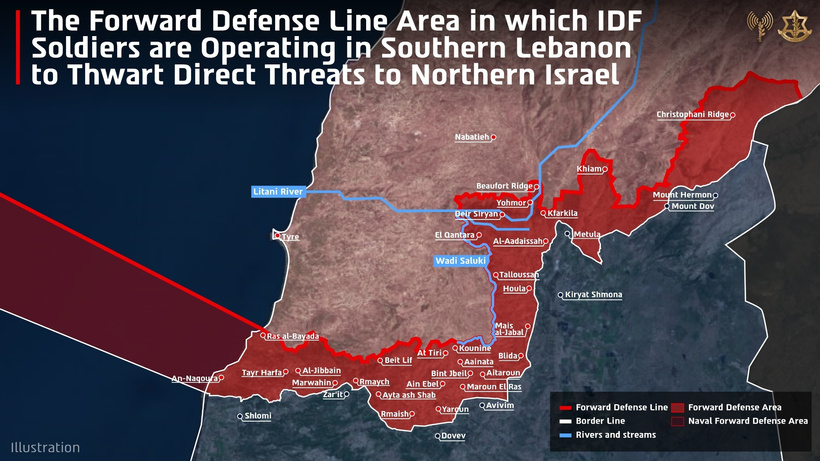
New map
The military publicly delineated its operational boundaries, releasing a map of the new forward defensive line, “to be clear for the people of Lebanon, the media, and anyone interested in our positions,” the source noted.
South of this line, the source said, “our soldiers continue to dismantle Hezbollah’s infrastructure and activity,” he added. “These areas are in close proximity to our communities and work areas, and they pose a threat to our civilians, whether through direct fire or through rapid attempts by terrorists to approach the border.”
Despite the truce, the area remains an active combat zone due to the ongoing presence of Hezbollah operatives and its terror infrastructure, according to the source, including within the security zone.
“According to the ceasefire agreement, the IDF is authorized to take necessary self-defense measures against such threats,” he stated, adding, “Our troops operate in accordance with guidelines, international law, and self-defense principles to counter immediate threats,” the source detailed.
The IDF’s goal at this time is to prevent the reconstitution of terror infiltration threats, anti-tank missile threats on northern communities, and Hezbollah’s rocket capabilities.
Prior to the truce going into effect, Lebanon had become the primary war arena after the U.S. and Iran reached a truce on April 8, which Israel also observed.
The military executed a massive ground maneuver utilising five divisions to systematically dismantle Hezbollah’s military infrastructure in southern Lebanon and establish a long-term four-tier defence buffer zone.
Defence Minister Israel Katz outlined the architecture of this new security reality, which relies on the separation of the Iranian and Lebanese arenas. “The agreement on the separation of the arenas is an important achievement led by the Prime Minister, and allows us to act forcefully against Hezbollah according to an orderly plan based on four lines,” Katz stated.
Last week, Defence Minister Katz detailed the tiers of the defensive perimeter, stating that the first line lies directly on the border and involves significant engineering operations. This includes “the destruction of homes in the Lebanese contact villages,” Katz explained. The second line involves defensive strongpoints within Lebanon, which Katz noted is “the line of defenders inside Lebanon, which was expanded from 5 to 15 points”.
The third layer neutralises direct-fire (anti-tank missile) threats. Katz described this as “the anti-tank line whose capture was completed through the ground maneuver and we are currently working to expand it in additional points”. The final boundary rests at the Litani River. Katz confirmed this is “the Litani line where the IDF will control as part of the control of the Litani space, and will prevent the infiltration of additional terrorists and the return of residents south”.
Within this buffer zone, the IDF is currently surrounding and securing Bint Jbeil, a city that previously served as a central symbol and operational hub for Hezbollah. According to IDF assessments, Hezbollah had planned to conduct a cross-border raid from Bint Jbil into Israel, but this threat, along with anti-tank missile fire, has now been removed.
Inside Bint Jbeil, Hezbollah systematically utilised a Lebanese government hospital as a fortified military base. IDF soldiers identified several terrorists conducting surveillance and firing on troops from the hospital windows in the days before the truce, and neutralised the threat.
Approximately 20 terrorists were eliminated within the hospital compound, and Israeli forces searching the facility subsequently located a cache of weapons stored inside.
Between March 2, when Hezbollah entered the war, and April 16, more than 8,500 projectiles have been fired toward Israel from Lebanon, according to the security source.
“These include UAVs, missiles, and rockets,” the source added. The targeting deliberately sought to inflict mass casualties. “About one-third were fired at Israeli communities, and two-thirds targeted our troops,” he noted.
The origins of these attacks highlight Hezbollah’s deep integration across Lebanese territory. “Approximately 50% of these attacks came from north of the Litani River, and 50% from south of the Litani, including areas such as the Dahiya and the Bekaa Valley,” the security source stated. “Over 4,000 of these projectiles were launched from south of the Litani,” the source confirmed.