
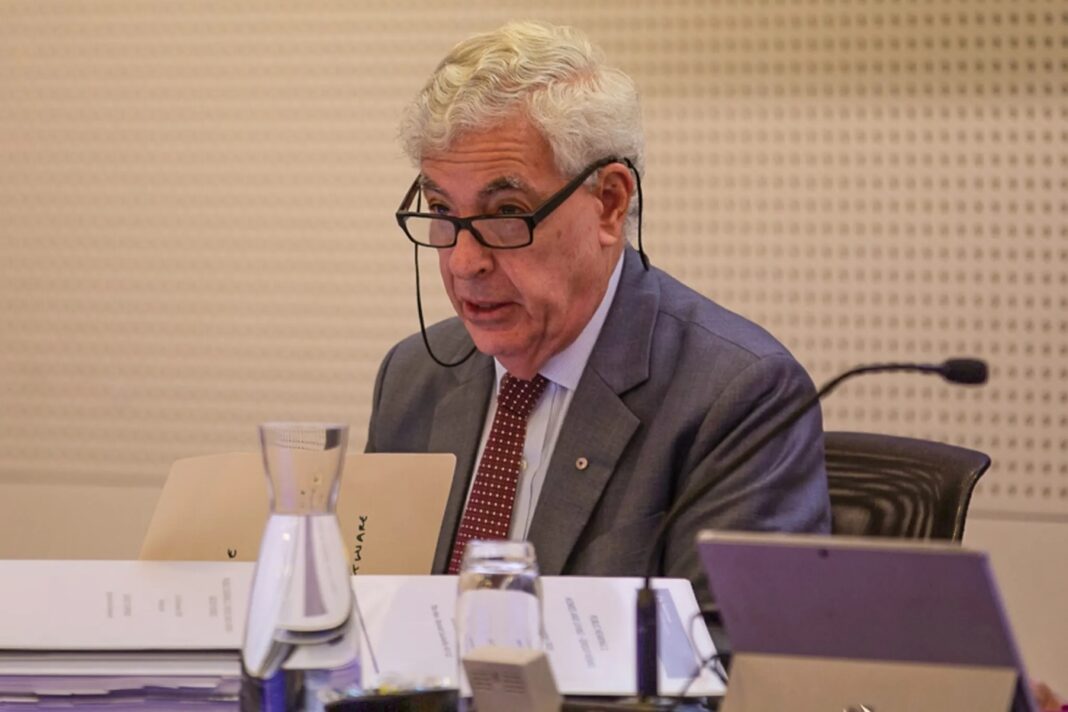
Former Federal Court judge Ronald Sackville has questioned whether the Royal Commission into Antisemitism and Social Cohesion risks leaving a major gap in its work if it avoids identifying perpetrators of antisemitic abuse.
Sackville, who chaired the Royal Commission into Violence, Abuse, Neglect and Exploitation of People with Disability in 2019, said recent hearings on social media had exposed disturbing online vilification of Jewish Australians, but senior counsel assisting the Commission had made clear the evidence would not identify individual perpetrators.
Writing on Substack in a post titled “Who is being held accountable?”, Sackville said the approach deserved scrutiny.
Commissioner Virginia Bell said the purpose of the hearings was to give the public “a better understanding of what life on social media has been like for many Australian Jews”.
She also said the Commission’s role was not “to shame or to sow further division in our society”, but to show the “essentially antisemitic nature” of much online content directed at Australians known to be Jewish.
Sackville took issue with that framing.
“With all due respect, ‘shame’ is an odd word to use in this context,” he wrote.
He said naming people or institutions found to have engaged in serious antisemitic conduct should not be dismissed as shaming.
“The purpose is to hold people or institutions accountable for wrongful actions that have caused significant harm, in this case to Australian Jews,” Sackville wrote.
He said royal commissions routinely made adverse findings about individuals and institutions, citing inquiries into child abuse, disability abuse and financial misconduct.
Such findings, he said, could bring perpetrators “out of the shadows”, expose harmful conduct, vindicate those who gave evidence and warn others against similar behaviour.
Sackville acknowledged that anyone at risk of an adverse finding must be given procedural fairness, including the chance to answer allegations and make submissions.
But he said that obligation had to be balanced against the need to hold perpetrators accountable.
He questioned whether the Commission’s desire to finish by 14 December 2026 had influenced what he described as an apparent decision not to investigate who was responsible for serious antisemitic threats and abuse aired in evidence.
“If this is the case, adherence to a predetermined deadline seems to have come at the cost of avoiding holding accountable the perpetrators of the most serious forms of antisemitism (short of terrorism),” he wrote.
Sackville said the Commission’s work remained significant and had given voice to Jewish Australians while exposing serious failures in official and institutional responses to antisemitism, including in the lead-up to the Bondi massacre.
He said it would probably make important recommendations on law enforcement, intelligence gathering, hate speech laws, social media regulation, education, health services and the safety of the Jewish community.
“But it is likely that something will be missing,” he concluded.