
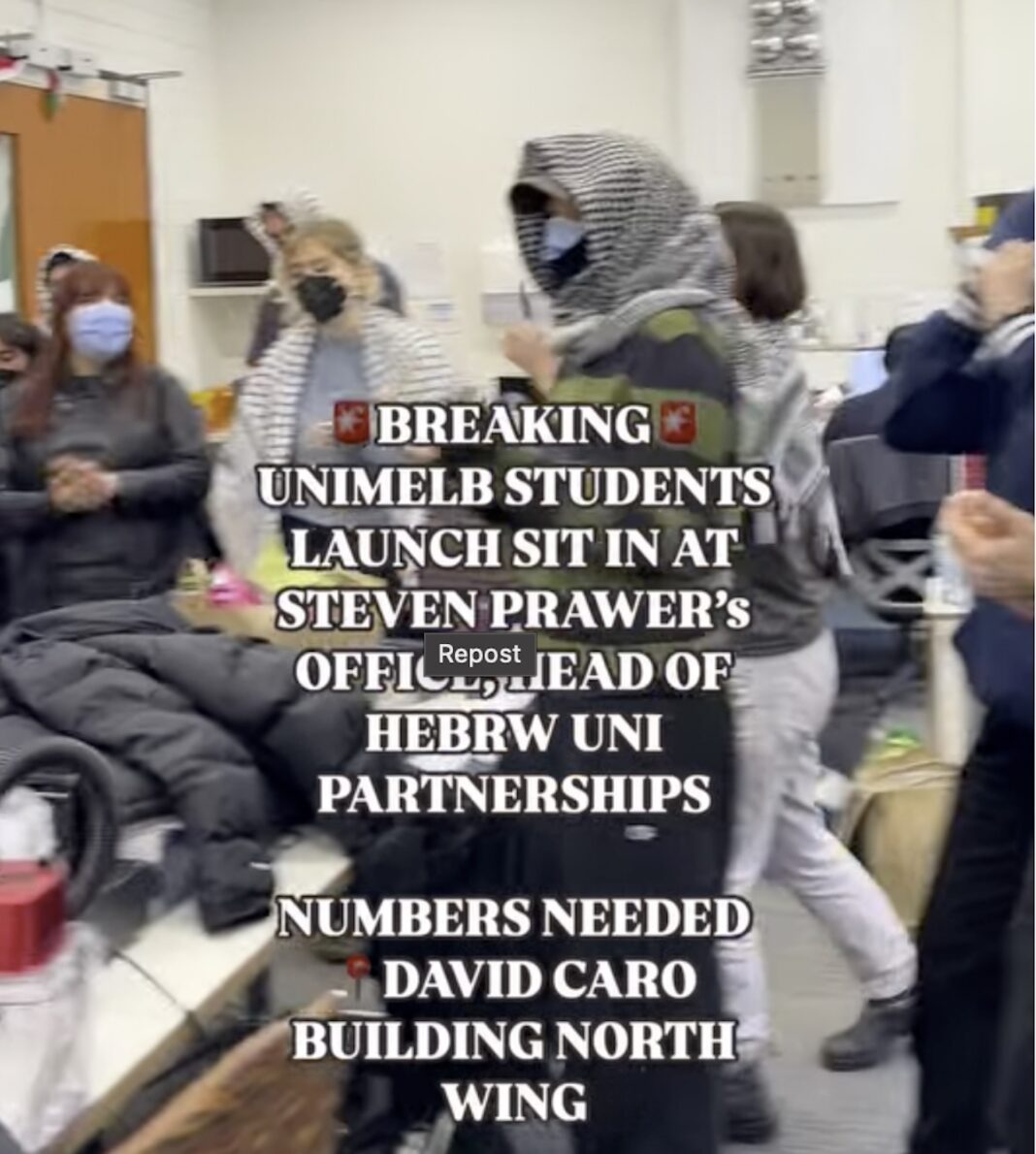
A Jewish University of Melbourne professor has told the Royal Commission on Antisemitism and Social Cohesion that he feared a group of masked protesters occupying his office might be terrorists.
Physics professor Steven Prawer said he arrived at his campus office in October 2024 to find about 20 people inside, many with their faces concealed by keffiyehs and masks.
“They said, ‘We’ve been waiting for you; why don’t you come in and have a chat with us’,” he told the commission on Tuesday.
Professor Prawer said the appearance of the group immediately raised fears about their intentions.
“I don’t know what their intentions were, but when a Jewish person with some experience of what happens in Israel sees a masked person, you can only see their eyes, the rest of them are covered with a keffiyeh, this is a classic terrorist pose,” he said.
“This was only one year after the atrocities in Israel, and so I was very perturbed. I had no idea at that stage if it was a protest or if it was a terrorist attack.”
Professor Prawer told the commission that he tried to leave the office and contact university security as the protesters chanted, “Prawer, Prawer, you can’t hide; you’re guilty of genocide.”
Police were called, and the group was told it was trespassing.
Professor Prawer said he believed he had been targeted because of his role in a joint PhD program with the Hebrew University of Jerusalem and his work with Israeli academics.
The commission heard that a manifesto left behind by the protesters referred to those academic links as a reason for the occupation.
Professor Prawer said joint programs with overseas universities were common and that his involvement with the Hebrew University had been limited.
“One might say that it’s legitimate for people to protest at the seat of power,” he said.
“In my case, they were protesting against someone who I think was a soft target.”
He told the commission that he still did not know the identities of most of those who entered his office.
“To this day, I do not know the identities of the people that were in my office,” he said.
Four students were later identified and disciplined over the incident. Two were recommended for expulsion and two for suspension, but the expulsion decisions were overturned on appeal.
“The community needs to hear loudly and clearly that the university tolerates dissent, but it doesn’t tolerate misbehaviour,” he said.
“Where’s the deterrence?”
He also told the commission that about 150 university staff later signed a petition arguing that the sit-ins were justified and that the students should not be punished.
Professor Prawer said the incident had led to major changes in his daily life.
His office was placed under tighter security; he was offered an escort while on campus and given access to an Uber for Business account so he could avoid travelling to work by public transport.
Security cameras were also installed at his home, while access to his office was restricted to people with swipe passes.
He said the measures had affected the open exchange of ideas that had previously been part of university life.
“The free flow of discussion, information has been severely curtailed,” he said.
Professor Prawer also criticised the university for failing to notify him after graffiti containing a death threat was found near a campus entrance in February 2025.
He told the commission that the message read: “Death to Israel, death to USA, death to Steven Prawer.”
The graffiti was removed, but Professor Prawer said he did not learn about it until police contacted him the following month to conduct a welfare check.
“So, I then went back to the security office and said, ‘what’s going on here’, and they had removed the graffiti and didn’t think that it was appropriate to tell me that this had been posted,” he said.
“I just was flabbergasted that the university could ignore a threat like that and remove it and not tell me about it.”
The university’s vice-chancellor at the time, Duncan Maskell, condemned the office occupation, saying the conduct was unacceptable and contrary to the institution’s values.
A University of Melbourne spokesperson said the institution continued to support Professor Prawer and recognised the effect of the incidents on him and his family.
The royal commission’s Melbourne hearings are examining the experiences of Jewish students and academics, the prevalence and effects of campus antisemitism and the responses of universities.