
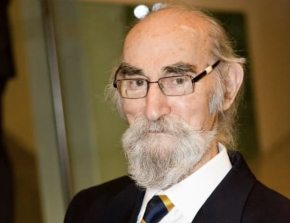
Dr Joseph Brown AO OBE – an art dealer and philanthropist who made a huge and enduring difference to the culture of this country.
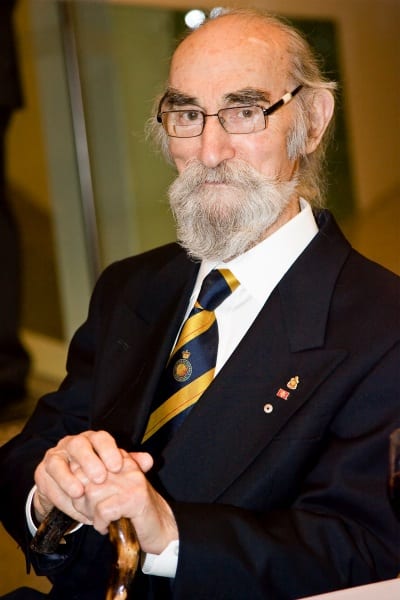
Joseph was born Josef Braun in Łódź, Poland, in 1918, the seventh of eight children in a middle-class Jewish family.
His mother died shortly before the family departed from Poland. In 1933, at the age of fifteen, he emigrated to Australia with his father and five sisters, joining two older brothers who had already settled in Melbourne. The family, who had worked in the hosiery industry in Poland, lived in the Melbourne suburb of Carlton. He attended Princes Hill State School in Carlton, where, struggling with his English, he spent his time drawing at the back of the classroom. His passion was art, and after completing secondary school, he attended evening classes at the Working Men’s College (now RMIT) under the distinguished artist Napier Waller. He won a scholarship to study art at Brunswick Technical College in 1934, where he attended at night while working by day to make a living. However, after six months, the economic pressures of the Great Depression forced him to abandon his studies and work full-time to support his family. He started work at a Bourke Street fashion house and later established his own business, J. Brown Mantles, in 1938 at the age of nineteen. Joseph began painting and sculpting in the 1930s, producing works that reflected an interest in figuration and the Australian landscape tradition. His early works included a 1934 portrait of his father, Jacob Brown.
In 1940, he joined the Royal Australian Air Force as part of the 13th Armoured Regiment and Second Australian Imperial Force, which was formed in 1942 from the 13th Light Horse Regiment. It was part of the armoured forces tasked with the defence of Australia, with records covering its activity until August 1943. He married Estelle in 1945 and returned to the fashion business in 1946. Joseph, did, however, resume his art practice from a small workshop in his North Balwyn home and later, from 1948, in shared premises with sculptor Clement Meadmore in Flinders Lane.
He travelled extensively overseas and began collecting Australian art, especially colonial-era works. His great love, however, was the art world and the art market, and in 1960, he decided to become an art consultant and later dealer. Throughout his life, he continued to make his own sculptures and paintings and was never happier than when in the company of practising artists. From 1963, Joseph operated as an art consultant from a small space at the Flinders Lane showroom of J. Brown Mantles, his fashion business. In 1967, after selling J. Brown Mantles, he opened the Joseph Brown Gallery at 5 Collins Street, Melbourne, with the encouragement of fellow artists Russell Drysdale and William Dobell, who participated in the gallery’s inaugural two-man exhibition. Later that year, he purchased Caroline House, a large nineteenth-century residence in South Yarra, to accommodate both his family and his growing art collection. From here, he became one of Australia’s leading art dealers, collectors, and consultants, whose research and connoisseurship led to the rediscovery of many underappreciated or forgotten Australian artists and to the mentoring of many others.
In the same year, he opened the Joseph Brown Gallery at 5 Collins St, where he held solo shows for artists such as Sidney Nolan, Russell Drysdale, John Brack and Rick Amor, and presented large-scale historical surveys with published catalogues. He conscientiously mentored and fostered the careers of emerging Australian artists. Joseph displayed a notice in his gallery stating it would “not sell Australian paintings of the colonial and impressionist periods to overseas collectors as we regard such works as being part of the country’s artistic heritage”. He built up one of the finest private art collections in Australia, and made such substantial contributions to Australian art history that he was awarded three honorary doctorates. His single gift of works of art to the National Gallery of Victoria was the largest donation ever made to a public gallery in Australia. The collection of more than 150 works included Australian 19th- and 20th-century art, over 100 major paintings and sculptures, and 54 works on paper (watercolours, drawings, and prints). The collection was valued at more than $30 million. In telling The Australian Jewish News about this donation, he said, “I wanted to give the entire collection as a gift to the nation”.
In his speech, when donating his collection, he said, “I am often very surprised when some people say they have not been to the National Gallery of Victoria,” he said. “I always stress to them that this is their property. It’s their Gallery, they should feel it is theirs. It’s not mine, it’s not (NGV Director) Gerard Vaughan’s, it belongs to the people. “I would like all Victorians to feel [they own] this immense Collection. Feel yourself rich for having it, and for enjoying it with your children and your grandchildren.” “My first purchase was literally with my first wage. I was 16. That was the beginning of my collection. I feel very good about presenting this to the Gallery. I’d like people to enjoy it.”
In addition to his major gift to the NGV, he was a remarkably generous donor to many museums and galleries. A major aspiration of his giving was to ensure the representation of younger, emerging artists in public collections. Part of his gifted collection included a painting valued at more than three million dollars, painted in 1857, which he donated to the National Gallery of Australia in Canberra upon its opening by Queen Elizabeth in 1982. He also provided a voluntary, free service to many public institutions by valuing their collections and advising on their management.
The University of Melbourne awarded him an honorary Doctor of Law in 1986. Dr Chris McAuliffe, an art historian, art critic, curator and museum professional, reflects on the nature of Dr Brown’s substantial contribution to the University of Melbourne Art Collection. The story of Dr Brown’s generosity is shaped by his personality; it is challenging, committed and occasionally a little eccentric.
He passed away on 24 August 2009, aged ninety-one, in Melbourne. He was survived by his wife Estelle, his three children, and his grandchildren. Joseph believed that collecting art was a lifelong passion and that anyone, regardless of age or background, could become a collector. He was awarded the Order of the British Empire (OBE) in 1973 and the Order of Australia (AO) in 1990. He held honorary doctorates from Monash, Melbourne, and LaTrobe Universities. The Joseph Brown Collection is located at The Ian Potter Centre: NGV Australia at Federation Square. It has become one of the NGV’s greatest visitor attractions.
Following Joseph’s passing, Dr Gerard Vaughan, Director of the NGV, paid tribute to the contribution of one of its greatest philanthropists, Joseph Brown AO, OBE, and expressed sadness at his passing “Dr Brown was a great Australian, who believed in sharing his outstanding collection with the community”. “All Australians have reason to be grateful to him for his extraordinary gift, which will be enjoyed in perpetuity by visitors to the NGV. Dr Brown was also very much part of NGV life: as Patron of the NGV Foundation, he enjoyed attending functions and was loved by all in the NGV community. His Collection will forever tell the story of the immigrant who became an artist and soldier, a scholar and connoisseur, a successful businessman and an art dealer, a mentor to artists and an art patron; a man who made a huge and enduring difference to the culture of this country.”
He was described as extremely public-spirited, with an educational and patriotic impulse: through Australian art, he believed, people might learn profoundly about Australia.
The AJHS acknowledges the following references in the preparation of this story:
Wikipedia; National Gallery of Victoria; National Portrait Gallery Canberra, Sydney Morning Herald – 7 September 2009; National Library of Australia; Australian Jewish News – 25 August 2009;

The Australian Jewish Historical Society is the keeper of archives from the arrival of the First Fleet in 1788 to the present day. Whether you are searching for an academic resource, an event, a picture or an article, AJHS can help you find that piece of historical material. The AJHS welcomes your contributions to the archives. If you are a descendant of someone of interest with a story to share, or you have memorabilia that may be of significance to our archives, please contact us via www.ajhs.com.au or [email protected].
Edited by Ruth Lilian
Thanks for the entry of Dr Josephs military service.
THe AWM have removed the names of the lighthorsemen making it difficult to bring the them to light in an ANZAC rememberance tree display.