
Book review by Dr Anne Sarzin
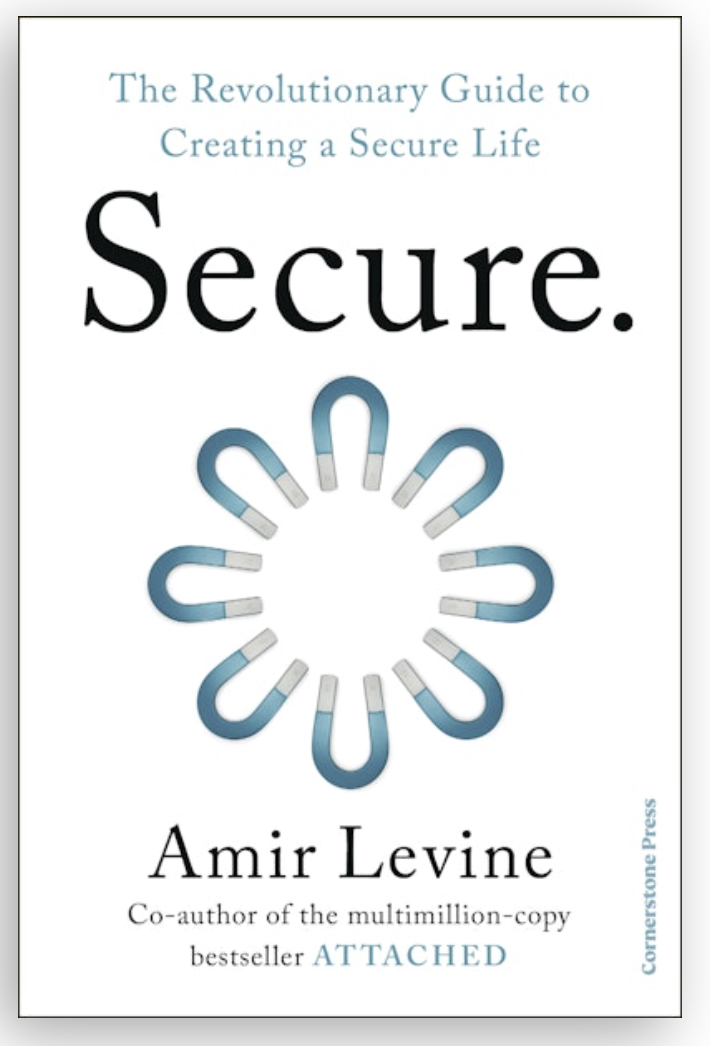
 In an insecure world with shifting sands beneath our feet, stable and significant relationships with others generally promise a safe harbour in stormy weather. American psychiatrist and neuroscientist Dr Amir Levine’s self-help book, Secure: The Revolutionary Guide to Creating a Secure Life, provides a potential lifeboat for readers cast adrift amid life’s storms. He presents, defines and dissects a variety of adult attachment relationship styles. There’s much in this book of particular interest to those striving to understand the ebb and flow of their relationships. Readers will have to decide for themselves what constitutes a genuine lifeline among the many strategies Levine outlines; and what can, in some cases, salvage seemingly shipwrecked lives.
Certainly, there are those who prefer the real-life intimacy and reliability of a professional connection with a real-life therapist trained in attachment theory, who is able to help them analyse and understand relationship problems. Knowledgeable professionals can provide valuable, sound and insightful interventions, skills and coping strategies and, in many cases, ongoing ‘coaching’, enabling their patients to de-stress, confront and resolve troubling issues. But for a variety of reasons, including the scarcity of psychological and counselling services (at least in Australia), not everyone has access to such highly prized and expensive services. Potentially, therefore, many readers will find in Levine’s book a compendium of ideas, suggestions and strategies that, hopefully, will help them navigate life’s treacherous currents.
Attachment theory is an accredited serious science, and its practitioners are equipped with the requisite knowledge and training to guide and assist their patients. Dr Levine writes that when he first encountered the science of adult attachment styles more than a decade ago, ‘it was like seeing our relational world in colour, after only observing shades of grey’. He brings commitment to and enthusiasm for this science into every page of his book. At times, the reader follows detailed case histories and discussions of his scrupulously deidentified subjects, who may also be composites of several patients. With that professional consideration out of way, he launches into descriptions and analysis of different attachment styles characterised as the anxious attachment style, the avoidant attachment style and the fearful avoidant style, all of which constitute major chapters in this book.
Much of the discussion is intriguing and fascinating, prompting self-reflection and self-analysis as the reader encounters these theories and follows his astute commentary. But there are some stylistic impediments that hamper the reader initially, not least his prolific use of acronyms with which Levine peppers his text. Fortunately, it doesn’t take too long to master his SIMIs and CARRPs and other oddities such as the Cyberball Effect, the Wall Tennis with Love tool, and the Appendix Rule. Happily, one can always resort to the index for swift reminders and clarification, which I did. Once these seemingly cryptic references are decoded and committed to memory, however, one’s reading pace accelerates and one’s comprehension of this book definitely improves, aided by his explanatory scenarios and insightful questions.
Levine believes we can change our brains to become more secure and improve our lives; and there is much in this text that prompts and proves thoughts along those lines. In fact, I like to think that the mere act of reading his neuroscience care manual might have changed my brain on a molecular level. He certainly believes that our connectedness with others can dramatically protect our brain on the most fundamental biological level. Studies have found, ‘the more connected people were, the greater their cognitive functioning and brain volume!’. He asserts that sociability also affects the body, affording people protection against heart disease and that, conversely, a lack of social connection increases the risk of obesity and hypertension. He concludes that close supportive relationships have a profound impact on health and longevity. ‘Hyperconnectedness helps you feel that life has meaning, provides you with a sense of control over your life, and boosts your self-esteem,’ Levine states.
Perhaps it is Levine’s chapter on discovering your attachment style in all areas of your life that many readers will find especially intriguing. ‘Your attachment style falls along a spectrum, determined by your position on two independent dimensions: anxiety and avoidance,’ he writes, ‘The anxiety dimension assesses the extent to which individuals worry about being abandoned or unloved… The avoidance dimension, on the other hand, measures the degree to which individuals are uncomfortable with closeness and intimacy.’ As in most of the chapters in this book, he assists readers discover where they fit along the attachment spectrum and offers specific tools for every attachment style.
Levine is drawn to attachment science because ‘it’s not based on the medical model of fixing pathologies but rather on recognizing normal behavioral traits that are common in everyone’. He aims to help people create a secure narrative for themselves so that they can overcome emotional and physical obstacles. It isn’t as simple as it sounds. In learning secure ways of being, at the same time one has to unlearn the deep-rooted insecure ones. He describes the difficulty of mastering this dual process as ‘learning how to write with your other hand’, adding that the interplay of learning and unlearning shapes a neuronal system He ventures into the realm of neuroplasticity, asserting, ‘Each experience we have can either strengthen or weaken the connections between specific synapses, thereby reinforcing or diminishing certain neuronal networks’.
There are passages in the book that mimic homespun wisdom—‘it’s not worth wasting your time pining for an alternate life that might have been’ and ‘every choice comes with its own set of challenges’—but, overall, Levine imparts much astute advice and sound values carefully calibrated for those defined by specific attachment styles and seeking to improve their lives. Levine is a generous guide, giving encouragement and support along the way. ‘As long as you keep practicing, you will grow, you will learn, and you will thrive,’ he states confidently.
Secure: The revolutionary guide to creating a secure life
By Amir Levine
Cornerstone Press, Penguin Random House UK
2026