
Memories of another day are no stranger to Eva de Jong-Duldig a director of a museum which has made a sizable contribution to “Behind Barbed Wire: POW and Interment Camps in Victoria 1939-1945” an exhibition showing the lives and times of internees and prisoners of war in Victoria opened recently at Melbourne’s Shrine of Remembrance.
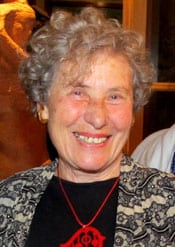
Eva de Jong-Duldig was born in Vienna in 1938 but left with her parents, Karl and Slawa Duldig before the outbreak WWII when she was eight months old.
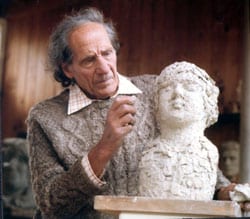
Her father Polish-born Karl Duldig was a world-renowned sculptor and her mother Slawa had invented in 1929 the world’s first collapsible umbrella.
But Duldig was not only artistically-inclined. He was a famous footballer playing in goal for Hakoah Wien, the club that was to inspire the Hakoah Club in Sydney. Eva Duldig told J-Wire: “My father was on the bench when the club played West Ham in London and lost 5-0 but was back in goal for the return match in Vienna which the home side won 1-0. They couldn’t get a ball past my father”.
The Duldigs settled in Singapore in938 but fate was to play a life-saving trick on them. In 1940, when “The Dunera” set sail from Liverpool with its manifest of European Jews and other foreign aliens considered to be a risk to the U.K., the same legislation was applied to aliens living in other parts of the British Empire and the Duldig family found themselves with 250 other European “aliens” on the converted Queen Mary bound for Australia…ahead of the Japanese invasion of the tiny British colony.
The Duldigs were interned in Tatura near Shepparton in rural Victoria. Eva Duldig told J-Wire: “My first memories were of this camp and I can assure it was a far cry from the detention camps in use today. It was not five star luxury but we had a reasonable life there. My father still continued to create art using
eucalyptus logs and an axe to hew out his sculptures and carved figures out of potatoes.”
Duldig also used toilet paper to create drawings.
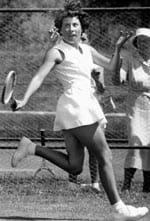
The family moved to Melbourne in 1942 where her father joined the Australian Army. Duldig became one of Australia’s best known sculptors, with works being exhibited at The National Gallery. Eva went on to became a world class tennis player reaching the Wimbledon quarter finals three times.
Today she administers The Duldig Studio, a gallery and museum which houses comprehensive exhibits depicting the lives of the internees at Tatura. The gallery has made a significant contribution to the current exhibition at the Shrine of Remembrance.
Eva Duldig told J-Wire: “The exhibition has not really conjured up memories from the past. I am active in sustaining these memories…but there is a special joy in seeing them exhibited in the public arena.
The exhibition will run until July 28.
The Duldig Studio’s current exhibition (open till 2014) tells the story of our family’s Singapore escapade and links with the current exhibition at The Shrine. Next year The Duldig Studio will mount an exhibition on the internment experiences in Tatura. The Duldig Studio exhibition is by appointment only.

Pencil drawing by Karl Duldig
© The Duldig Gallery
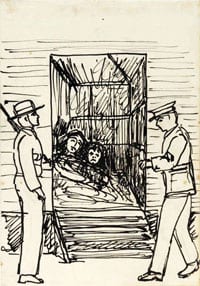
Pencil drawing by Karl Duldig
© The Duldig Gallery
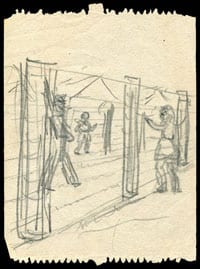
Pencil drawing by Karl Duldig
© The Duldig Gallery