
The unedited text of the address given by Israel’s president, Isaac Herzog.
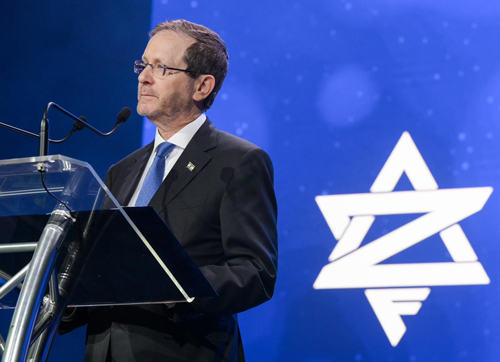
The address is normally delivered at Yad Vashem in Jerusalem, but due to the current situation in Israel, it has been pre-recorded.
“My sisters and brothers, citizens of Israel,
This year, the national days return during a time of war. I wish to open these sacred days with words of strength and encouragement to you – those on the front lines and those on the home front that has become a front line. To each and every one of you, I say: this is a prolonged campaign, but I am confident that we will emerge from it strengthened and empowered.
There are moments within this war in which the story of one family sheds light on and tells the story of an entire nation. A year ago, on Holocaust Martyrs’ and Heroes’ Remembrance Day, Master Sergeant Asaf Cafri, a reservist soldier in the IDF Armoured Corps, fell in battle in the Gaza Strip. He was twenty-six years old when he fell. When Michal and I arrived to console the Cafri family at their home in Beit Hashmonai and met Asaf’s dear parents Yifat and Hagai, his brother, and his partner, I could not help but notice a woman sitting to the side, quiet and withdrawn. Her eyes were sorrowful, as though carrying a pain both old and new. I approached her and asked who she was. “I am Magda, Asaf’s great-grandmother.”
Magda Baratz was only fifteen years old when she was imprisoned with her family in a ghetto in Transylvania. From there, her family was sent to Auschwitz, the factory of death. “We looked at each other and knew: ‘We will never see each other again,’” Magda wrote in her memoirs. Indeed, that was the last time she saw her parents and her younger brother, who were murdered immediately upon their arrival at the camp. Magda and her sister were left alone in the world. Magda, a young girl, endured all the horrors of the Nazi extermination machine. She was subjected to forced labour. She marched on the death march. She suffered starvation and bitter cold. Time and again, she miraculously escaped death.
In the spring of 1945, when she was liberated from the Bergen-Belsen concentration camp, she was sixteen years old and weighed only twenty kilograms. A human skeleton, a muselmann, but with an indomitable spirit. At the detention camp in Cyprus, on her journey to Israel, she met her husband Ze’ev, of blessed memory, also a Holocaust survivor, and together they immigrated to the Land of Israel. Just three years after she exited the gates of hell, three years after she survived the most harrowing and darkest hour in the history of our people, three years after nearly her entire family was murdered in the Holocaust – from the ruins and destruction, Magda brought new life into the world.
Her firstborn daughter, Racheli, who would become Asaf’s grandmother, was born in the midst of the War of Independence. “This is my victory: to survive, to immigrate to the Land of Israel, and to establish a dynasty,” Magda used to say. Indeed, she established a magnificent dynasty – children, grandchildren, and great-grandchildren. Generation after generation of revival, of love of mankind, the Jewish people, and the Land of Israel. Six years ago, ahead of Holocaust Remembrance Day, a photograph of Magda and her great-grandson Asaf was featured on a billboard. Look at this photograph, at the story it tells, how much love, how much pride, how much power and strength it holds.
On the eightieth anniversary of the liberation of the Bergen-Belsen camp, Magda was invited to a ceremony held there as a guest of honour, together with her children, grandchildren, and great-grandchildren. There, on the soil of the concentration camp, she received the devastating news. Asaf, her eldest, beloved great-grandchild, so dear to her soul, a fourth-generation Holocaust survivor, had fallen in battle while defending our home, our homeland, the State of Israel.
Precisely seventy years separated Magda and Asaf, the great-grandmother and her great-grandson – but one spirit bound these generations: a spirit of heroism, of devotion, of determination; a spirit of fighting for our people’s one and only home, the State of Israel. A home that Magda’s generation partook in establishing and her grandchildren’s and great-grandchildren’s generation is fighting to defend, to this very day. A home for which Asaf gave his life.
When we sat with Magda during the shiva for Asaf, she told us about her heroic great-grandson, about Auschwitz and Bergen-Belsen, and about the long journey she had taken – a personal and national journey, the journey of the survivors, the Holocaust survivors, from Holocaust to revival, from destruction to statehood.
I looked at her and her family – four generations in one home – and thought to myself: God in Heaven, is there another people that can bear such a story of pain and heroism? Two weeks later, Magda Baratz passed away. The heart of the woman who had conquered everything, who had survived the concentration and extermination camps, who had withstood starvation, torture, and cold, who knew how to cling to life in the most difficult moments, who returned from destruction to life, and who built a life, could not endure the pain of the loss of Asaf, her eldest great-grandson.
Survivors of the Holocaust, heroes of the revival, my sisters and brothers, citizens of Israel, distinguished guests: approximately six million Jews, a third of the global Jewish population before the Second World War, were murdered in the Holocaust at the hands of the Nazis and their collaborators. One in three Jews, our brothers and sisters. From Poland to the Netherlands, from Germany to Libya, from Greece to France, Jews were persecuted, slaughtered, tortured, and murdered with cruelty. Everywhere, all Jews were victims. The Nazis and their collaborators made no distinction. They did not distinguish between ways of life, worldviews, or different positions within our people. To them, we were one people, and upon all of us, one sentence was decreed: annihilation, destruction, obliteration.
Some nations arise from a land, some peoples are built from a language. For us, the Jewish people, there is both land and language, but at the very beginning of our existence stands family. We carry a bond that cannot be severed and share an affinity that never expires. From the days of our ancestors who walked here in the Land of Israel, through all the communities and congregations in the Diaspora, and to this very day, we are a large and expansive family, bound by history, by deep roots, by a shared destiny, uniqueness, and purpose. A family whose strength, continuity, and eternity you, the dear torchlighters, reflect.
Our people, who endured the Holocaust – the darkest and most abhorrent chapter in human history – chose not merely to survive, but to grow, to create, to rebuild, and to build here, in this place, a national home based on hope, faith, and mutual responsibility. A home that is a miracle, a wonder of wonders. A home built with toil and tears, acquired at an unbearable price, a home that rests even today on that same spirit of family and on the simple understanding held by all who live here, from all ethnic groups, faiths, and worldviews, that we have no other home and that we are here to stay forever.
There are those who seek to destroy this home that we built, even today. For two and a half years, the State of Israel has been at war, since that frightful day, the October 7th massacre. In every place and every site I visit, I see Israeli society and the spirit that animates it. Across the length and breadth of the land, in bomb shelters, at sites destroyed by missile attacks, in hospitals, in command centres, and volunteer hubs, I see the solidarity, the heroism, the devotion, and the mutual responsibility.
This is the spirit that emerges within us when we fight together for our only national home, for our beloved country. It is the spirit of a people that chooses life and rises, roars, and prevails like a lion.
At the same time, throughout the country, in its difficult hour, I also hear a deep demand, repeated again and again: that we remember, that we are all partners in this home, that we belong to one another, that we are family.
History teaches us time and again the heavy price of internal strife and division, and on the other hand, the power of mutual responsibility and brotherhood. It is this memory, this comprehension of everything our people have been through, that must prompt us to say to ourselves: a family may argue, but it must never tear itself apart. We must say to ourselves, especially today, that we did not rise from the ashes of the crematoria only to be consumed by the fire of discord.
Citizens of Israel, we are living through historic days. In recent weeks, the State of Israel has vigorously fought the Iranian regime, in extraordinary cooperation with the United States military and other militaries in the region. And even now, our soldiers are deployed in Lebanon, in Gaza, in Judea and Samaria, and in additional arenas, near and far. Regrettably, this campaign carries heavy costs, including in recent days. Our enemies spare no means to kill us and murder our innocent civilians, including by launching heavy missiles and missiles equipped with cluster munitions at population centres.
In this sacred moment, I wish to address you, all who have lost their loved ones, and all who have been harmed and wounded in body or soul: I see you, I share your pain. I wish to comfort and strengthen you. The entire nation stands by your side, with an embrace, with tears, and with support.
I extend my gratitude from here to all first responders, rescue forces, and support agencies, who are doing extraordinary work in the sacred mission of saving lives. Our eyes look toward the heavens and pray for the safety and success of the soldiers of the Israel Defense Forces and all the security forces wherever they may be, those who stand guard over our land and holy cities. Let us not forget, eighty-one years after the Holocaust, the striped prisoner’s uniform has been replaced by the IDF uniform, worn by the grandchildren, great-grandchildren, and great-great-grandchildren of you – the Holocaust survivors. For them, it is a tremendous privilege to continue your path and, together with their fellow soldiers, to ensure the security of Israel.
Right now, we are witnessing a rising wave of antisemitism that threatens Jews all around the world. As President of the State of Israel, I wish to remind us: Israel and the Diaspora are one family, with one shared destiny. And when a Jew is harmed, anywhere on the face of the earth, our collective heart skips a beat.
I call upon all world leaders: empty words will not cover up inaction. This is the time for courageous action. You must fight antisemitism with all means and in every place, before it is too late.
My sisters and brothers, I meet Holocaust survivors throughout the year. In moving conversations with them and with their families and descendants, I always say to them: you are a source of inspiration for the people of Israel and for the entire world. A symbol of the human spirit in all its glory: of its resilience, its strength, and its ability to overcome even the greatest darkness. Survivors of the Holocaust: you rose from dust and ashes, time and again you chose life, creation, optimism, and love. From you, we draw strength and hope.
There will come a time, as is the way of the world, when not a single living person who survived the Holocaust will remain on the face of the earth. One thing must be clear: we will remember forever, and we will pass on the memory of the Holocaust forever. On behalf of the State of Israel, I vow that we will continue to remember and to remind, to tell your story. We will be faithful to the mandate you have bequeathed to us, the mandate to continue to act for the eternity of Israel.
Last year, shortly before we parted with the Cafri family, Magda Baratz asked to share a final message with us. From the depths of her sorrow, in moments of unbearable grief, Magda, the Holocaust survivor and bereaved great-grandmother, chose a message of hope. “I continue to believe that it will be good here. I may no longer be here, but it will be good here. I believe this with all my heart,” Magda told us. This hope, this faith that Magda left us, is not hers alone. It is the hope that you have bequeathed to us – and this hope, this knowledge, so Jewish, so Israeli – we carry with us.
This past Tu B’Shvat, I had the privilege of planting a tree with another of Magda’s great-grandchildren, Idan, the younger brother of Asaf, of blessed memory. I looked at him and knew: the roots of this home will never be uprooted. I looked at him and knew that Magda’s hope that it will be good here will come to fruition. Yes, yes, it will be good here.
May the memory of our sisters and brothers, the victims of the Holocaust, be preserved and guarded in the heart of the people, from generation to generation, for all eternity.