

Antisemitic comments have flooded the online “public square”, the Royal Commission has been told, affecting the experience of many Jews on social media.
Posts by political leaders, including the Australian Prime Minister, have been flooded with antisemitic comments, Jewish stereotypes and calls for Israel’s destruction.

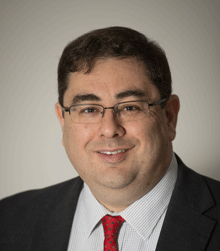
Online Hate Prevention Institute chief executive Dr Andre Oboler gave evidence at the Royal Commission on Antisemitism and Social Cohesion today.
Dr Oboler described a study analysing reactions to 13 social media posts by Australian politicians that were in some way related to the Jewish community or the Middle East.
The Institute recorded 2,572 antisemitic comments believed to be from Australian users and a further 644 from users of uncertain origin.
The majority of the posts either referred to the antisemitic conspiracy theory that Jews control the government and media or blamed all Jews for the actions of Israel, Dr Oboler said.
“This is literally the public square where everyday Australians are engaging in discussion,” he said.
“They’re also posts highly likely to be seen and shared by the Jewish community.”
One of the posts analysed was a greeting to the Jewish community by Prime Minister Anthony Albanese for the Passover holiday.
Antisemitic material made up about 13 per cent of user activity across all of the posts, but in some cases the proportion exceeded 40 per cent.
Dr Oboler told the inquiry antisemitism fell into various categories, including older forms such as Holocaust denial and “new antisemitism”, defined as relating to “Israel, Israelis or Zionists”.
To all Jewish Australians celebrating Passover tonight, Chag Kasher V’Sameach.
As you mark the start of these sacred days, I hope you find comfort, strength and joy together. pic.twitter.com/IvWFumhUox
— Anthony Albanese (@AlboMP) April 1, 2026
“So instead of saying Jews control the banks, it’s saying Zionists control the banks,” he explained.
Dr Oboler noted criticism of Israel and antizionism would not fall within the category of antisemitism unless it included additional sentiments, such as a call to violence.
“If it literally says ‘we should kill all the Israelis’, that’s not criticism,” Dr Oboler said.
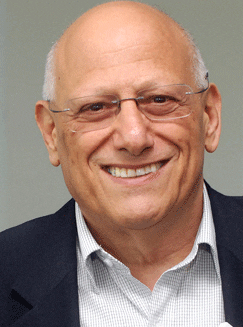
While the Institute covers instances of hate facing a wide range of groups, antisemitism has made up the bulk of its research in recent years, largely funded by Jewish interest groups.
Dr Oboler also formerly co-chaired a global forum to combat antisemitism, which was established by the Israeli government.
The inquiry opened on Tuesday with evidence from Emeritus Professor Andrew Markus that that recent research shows a sharp divide in Australian attitudes
towards Jews and Israel, especially among younger people. His 2025 Crossroads survey found 54 per cent of 18 to 24-year-olds agreed that “Israel treats the Palestinians like the Nazis treated the Jews”, compared with 33 per cent across all age groups.
Markus said the findings pointed to a broader shift in public opinion, not just isolated acts of hate. He also highlighted widespread uncertainty about the October 7 attacks and said Australian views on Israel may be shaped in part by local sensitivities around Indigenous dispossession, which he suggested may carry more weight in Australia than in some other countries.
By Duncan Murray/AAP