
Jewish women in Australia are experiencing antisemitism at alarming rates, with more than 80 per cent saying they or an immediate family member has been targeted since October 7, new research shows.
The national survey by the National Council of Jewish Women Australia, conducted over eight months, found 81 per cent of respondents had experienced Jew-hatred themselves or through an immediate family member, while one in five reported physical violence or verbal abuse.
The findings were tabled at the Royal Commission into Antisemitism and Social Cohesion on Tuesday by NCJWA vice-president Shirley Leader, who led the work on the survey. Participant accounts from the research are also cited in the “Understanding Antisemitism in Australia” handbook published by Australia’s Special Envoy to Combat Antisemitism.
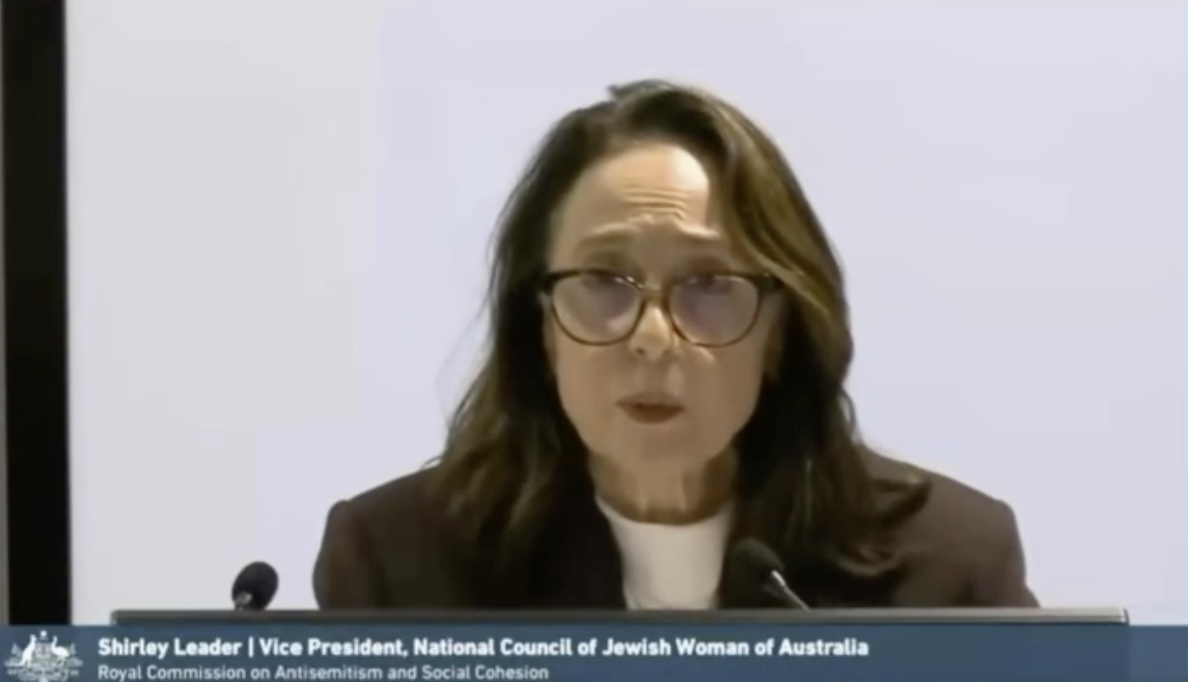
Leader told the commission that the denial of sexual assaults against Jewish women during the October 7 attacks had been particularly damaging, with much of that denial coming from the “women’s sector”. She said “so-called feminists in so-called progressive spaces” in Australia had questioned or mocked reports of sexual abuse by Hamas.
“This has been of great harm to Jewish women,” she said. “Their solidarity with Jewish women has been absolutely trashed by the women’s movement.”
The survey found 54 per cent of Jewish women had made significant lifestyle or behavioural changes because of antisemitism. Sixty-nine per cent said they had been accused of being “genocidal” because they identified as Jewish, Israeli or Zionist, while 66 per cent said they had been blamed for the actions of the State of Israel or the IDF.
Nearly six in ten said they had encountered claims that Israel had no right to exist, while 52 per cent reported hearing claims that the October 7 attack on Israeli civilians was justified or did not occur. Forty-three per cent said they had encountered accusations that Jews are modern-day Nazis.
NCJWA said the research showed antisemitism was being experienced in workplaces, public and social spaces, schools, universities and online. Respondents described direct threats, exclusion, collective blame and classic antisemitic tropes, including allegations of Jewish control of media and financial institutions.
The report also found that many Jewish women and their families were now actively managing their personal safety through vigilance, self-censorship and changes to daily behaviour, particularly after the Bondi terror attack on December 14, 2025.
One respondent said, ‘I question, should I leave Australia?’ I have never before wanted to leave; I was born here.”
Another said: “I was called a f****ing Jew at Bondi Junction.”
Several respondents described children being targeted. One said her 14-year-old son and his schoolmates were attacked while wearing school uniforms on an excursion and accused of “genocide”. Another said: “My children have been screamed at in the street and been egged.”
One parent said: “My child at high school experienced violence, including being spat on, punched in the chest, held down, choked and shouted at.”
Another said the family had turned to homeschooling because of safety fears.
“My children are so affected to the point we now homeschool for fear of safety. Being called “dirty Jews” and “all Jews are monsters” are words no eight-year-old should hear in the school yard,” the respondent said.
The survey also recorded accounts of antisemitism in health care, workplaces and universities.
One respondent said: “A nurse at a Queensland hospital screamed at me and said I didn’t deserve care because I’m Jewish.”
Another said: “A manager at my work made fun of the rapes of Jewish women.”
A university student said, “Campus is not a safe place for me. Just yesterday, I was called a ‘genocide supporter’ and a ‘psychopath’ when two people saw my Star of David necklace. They then followed me to my lecture.”
Another respondent said educators at her university questioned the Holocaust and claimed Yad Vashem, Israel’s Holocaust museum, had “a pro-Jewish bias and so can’t be trusted”.
Others described social exclusion, damage to businesses and the loss of friendships and clients.
“I’ve lost a lot of clients, and several close friends,” one respondent said.
Another said: “Activists targeted my business, and encouraged people I work with not to do business with me.”
One woman said: “A now past friend of 48 years had a long discussion with me on why ‘people like me’ should leave Australia. She said I would have to go to Israel.”
NCJWA president Lynda Ben-Menashe said the findings made for sobering reading.
“The survey launched today shows how antisemitism impacting Jewish Australian women isn’t marginal, it’s widespread,” she said.
“It is incredibly sad to find that so many Jewish Australian women are thinking about leaving this place which once was our haven.”
Ben-Menashe said the survey straddled the Bondi attack, capturing a community whose fears had deepened sharply after December 14.
“Before the Bondi massacre, our previous surveys showed that one in two of our respondents felt unsafe, nearly half felt isolated, and two in five concealed their Jewish identity,” she said.
“After the Chanukah massacre, almost all spoke about constant vigilance, self-censorship, and profound and ongoing changes to their daily behaviour to keep themselves safe.”
She said the targeting of Jewish Australians was a warning sign for the broader country.
“Jews are the canary in the coal mine of any population: throughout history we’ve seen that when Jewish citizens are targeted it’s a sign that social cohesion is fraying and fractured,” Ben-Menashe said.
Caroline O’Hare, chairperson of Victims of Terrorism Australia, said the behaviour described in the survey showed a “toxic lack of empathy”.
“The seeds of terrorism develop from the type of verbal abuse and physical violence that have been directed towards the women of the Jewish community in Australia,” O’Hare said. “This damages social cohesion, and damage to social cohesion is a key prerequisite for extremism and terrorism.”
“If we want to prevent terrorism, we need to call out and prevent this type of behaviour. All of us can help build community cohesion by countering this,” she said.
One respondent captured the pervasive fear running through the survey’s findings.
“I do not live. I exist. I trust no one. I am afraid for myself and my children that people will find out that we are Jewish,” she said.
Another said: “I am the child of a Holocaust survivor, and this is the stuff of my nightmares. I am grateful that my father is no longer alive to see this happening.”
NCJWA, founded in 1923, is the peak representative body for Jewish women in Australia and advocates for human rights, social justice and the advancement of women.