
Moses Isidore Goodman AM – pianist, composer and conductor
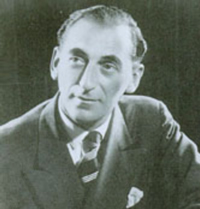
Isador, as he was known and whose name has frequently been misspelt, was born on 27 May 1909 in Cape Town, South Africa, to musical parents who had immigrated from Eastern Europe.
He began studying music and composing when a young child. One of his compositions was performed professionally when he was only six. At age seven, he played Mozart’s Piano Concerto No. 20 in D minor with the Cape Town Symphony Orchestra. When he was twelve, his father died, and his mother took him to London, where there were greater musical opportunities.
Hi studied piano and conducting at the Royal College of Music, and, in 1925, at the age of fifteen, he played Liszt’s Piano Concerto No. 1 in E-flat under Malcolm Sargent, an English conductor, organist, and composer widely regarded as Britain’s leading conductor of choral works. This concerto was to become his “calling card”.
His mother remarried, choosing an uncle of her first husband. They returned to South Africa, leaving Isador in London. In 1929, aged twenty, Isador was invited and accepted to teach at the New South Wales Conservatorium of Music, a position he held for fifty years. Local musicians opposed the director’s decision to offer the position to a man from abroad for such an important position.
In fact, he became a household name in Australia between the 1930s and 1970s. During this time, he introduced many Australians to classical music and made a significant contribution to music-making in his adopted country. Isador, whilst Professor of Piano by day, would often play all night at jazz clubs amongst ‘hardened drinkers and SP bookies.
In 1931, an English critic who knew nothing of this twenty-two-year-old attended two of his recitals and wrote a review that described him as “the best pianist in Australia. I would cheerfully stake my reputation on Mr Goodman’s playing in any capital city of Europe in pieces definitely pianistic or romantic in style. … he is a natural pianist, he plays the piano as most of the rest of us breathe … I did not believe it possible that I could ever again listen to the D flat Waltz of Chopin with virgin and delighted ears. But Mr Goodman rippled the hackneyed piece as though for the first time – Horowitz himself could not have recreated it anew with more enchanting touch and tone and rhythm”.
Isador became well-known in society circles; the Governor of New South Wales, Sir Philip Game and Lady Game, became his patrons and personal friends. One night in May 1932, Isador was attending a dinner at Government House with the Games. After the governor was repeatedly interrupted for consultation, Isador asked if he ought to leave. Game said, “No, that’s not necessary, you see, I am about to dismiss the Premier’’ who at the time was Jack Lang.
Later in 1932, Isador toured Australia and New Zealand for the Tait Organisation as associate artist for the visiting Scottish tenor Joseph Hislop. They did not get on, as Joseph felt that Isador was upstaging him. They even came to blows on one occasion when, on 1 July that year, Isador was the soloist in a concert by the National Broadcasting Symphony Orchestra to mark the official start of the Australian Broadcasting Commission.
Isador married Pattie Evelyn Nathan on 29 January 1933 at the Great Synagogue, Sydney; they were divorced in 1936.
In 1935, Isador wrote the musical score for Harry Southwell’s film The Burgomeister, which included a drinking song, a lullaby, a peasant song and a waltz. Next, Isador became the musical director of cinemas in Sydney and Melbourne, playing classical pieces between films. In 1940, he accompanied the English actor Noel Coward when he appeared in Melbourne.
From 1942 to 1944, Isador served in the Australian Imperial Force, rising to a temporary captain in the Australian Army Education Service. While attached to headquarters, New Guinea Force, in April-May 1944, he gave concerts and wrote, by lamplight, New Guinea Fantasy, which was recorded by the Melbourne Symphony Orchestra. He gave two hundred performances to over 150,000 servicemen. He dedicated his New Guinea Fantasy for piano and orchestra to the Australian servicemen. In September 1944, he was discharged as medically unfit.
Once the War was over, Isador returned to Great Britain; his farewell performance in Australia was his playing Prokofiev’s 7th Sonata. Once back in London, he was invited to perform for King George VI and Queen Elizabeth at a Royal Command Performance at St James’ Palace in October 1948. With England still recovering from the War, Isador found it difficult to re-enter British cultural circles as well as to find steady work in England in the postwar years.
He returned to Australia, this time permanently, and in 1955, he wrote a lush, impressionist score for the Australian director Charles Chauvel’s landmark 1955 film, Jedda, about Aboriginal people. A late 20th-century review of the film’s video described Goodman’s music as being considered now too European to be appropriate for its topic of Aborigines, but it was noted that the European viewpoint was typical of the time. In 1956, Isador played on the opening night of television station TCN9 in Sydney, going on to serve as the channel’s musical director for two years. In the early days of Australian television, he starred in two music series of his own: The Isador Goodman Show, which ran on Melbourne’s station HSV-7 from 1956 to 1957. His second series for Sydney station TCN9 was called Music for You from 1958 to 1960. In 1967, he returned to teaching at the New South Wales Conservatorium of Music.
Unfortunately, he was seriously injured in a car crash in 1969 and was unable to perform for four years. He made a triumphant return to the concert stage with an all-Chopin recital in Sydney in 1973 and later that year played with the Melbourne Symphony Orchestra in the first series of concerts at the Sydney Opera House. In February 1974, he appeared in concerts conducted by the American Arthur Friedler and, in 1975, he played Liszt’s Hungarian Rhapsody No.2 at a concert to raise funds for the city of Darwin, devastated by Cyclone Tracy. On Sunday, 13 July 1980, Isador took on the triple role of conductor-soloist-arranger for the Willoughby Symphony Orchestra’s concert at the Sydney Opera House, which was a spectacular success. He performed in a recital at the new Melbourne Concert Hall, now Hamer Hall, on 31 July 1982, and his last recital was at the Sydney Town Hall on 27 September 1982.
Isador died of cancer on 2 December 1982. As far as his family life was concerned, he was married four times. His fourth wife, Virginia, and his daughter Linda survived him. He was made a Member of the Order of Australia on Australia Day in 1981 in recognition of his service to music. In 1983, Virginia published a biography of him, Isador Goodman – A Life in Music. His recordings are numerous, and particularly, The Yesterday Concerto, John Lanchbery’s arrangement of John Lennon and Paul McCartney’s music for piano and orchestra, with Isador playing with the Sydney Symphony Orchestra under the conductorship of John Lanchbery for the ABC.
Tall and thin with aquiline features, Isador had long fingers. When playing the piano, his hand position was fairly flat, but this unconventional technique did not hinder his command of the keyboard; Margaret Brandman, multi-award-winning composer and accomplished pianist, described his playing as `effortless and with subtle nuances’. Sir Neville Cardus, an English writer, said it was as `natural as spring air’ and wrote of his `light-fingered iridescence’ and the `brilliant and lovely technique’ he placed at the service of the composers.
The AJHS acknowledges the following references in the preparation of this story:
Australia Dictionary of Biography – Anne Carr-Boyd; Wikipedia; Australian Broadcasting Commission; Strathfield Council; The Sydney Morning Herald; Liver Performance Australia; Australian War Memorial

The Australian Jewish Historical Society is the keeper of archives from the arrival of the First Fleet in 1788 to the present day. Whether you are searching for an academic resource, an event, a picture or an article, AJHS can help you find that piece of historical material. The AJHS welcomes your contributions to the archives. If you are a descendant of someone of interest with a story to share, or you have memorabilia that may be of significance to our archives, please contact us via www.ajhs.com.au or [email protected].