
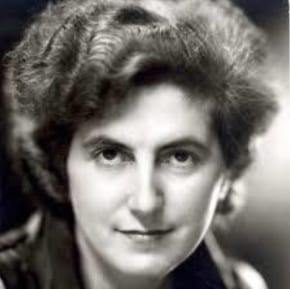
A monthly series by Stevie Whitmont of vignettes of Jewish composers banned in by Nazis. This month features Henriëtte Bosmans.
Henriëtte Bosmans (1895-1952) is one of four women listed among 33 Dutch composers (see The Leo Smit Foundation) known to be persecuted during the WWII Nazi occupation of Holland. She was “Amsterdam through and through”, but her music was internationally recognized and evolved over a number of life periods. It was always heavily influenced by her environment and more importantly, by her personal relationships.
She was born into a very musical family: her father was principal cellist for the Amsterdam Concertgebouw; her mother taught piano at the Amsterdam Conservatory. Henriëtte had established herself as a concert pianist by the age of 17 and also began composing during her teen years. She is said to have been a dominant, headstrong personality who led a libertarian lifestyle from the time she left home (also in her teen years). This included intimate relationships with both men and women, and although once engaged to the violinist Francis Koene, she never married.
Her first compositional period was heavily influenced by German Romanticism and characterised by writing for the cello. Her lover at the time was the famed Dutch cellist Frieda Bellinfante, whom she partnered between 1920 and 1927. She also held a sentimental attachment to her father’s 1st instrument (cello). Later, under the influence of her teacher Willem Pijper her idiom became less Romantic and more compact, incorporating polytonality and polyrthymic elements. Her String Quartet No 1 (1927) was composed during this second period. Later in life, Bosmans formed an intimate alliance with French singer Naomi Perugia, and in this final period she wrote a large number of songs, mostly on French texts.
During WWII Bosmans’ music was banned from performance (in 1942) by the Nazi occupiers of Holland. She immediately stopped composing for the duration of the war. She also refused to join the Kultuurkamer, required of all Dutch musicians. Bosmans is a clear example of the part-Jewish composer who went into so-called “inner exile” / “inner migration”, and who emerged after the war with a quite different musical style. She died of stomach cancer in 1952, aged 57. Bosmans’ biography is available, but only in Dutch (Metzelaar, Helen: Without Music, Life is Unnecessary: Henriëtte Bosmans (1895-1952), a Biography (Zutphen: Walburg Press, 2002). The Henriëtte Bosmans’ Prize for young Dutch composers has been awarded by the Society of Dutch Composers since 1994.