
Book review by Dr Anne Sarzin
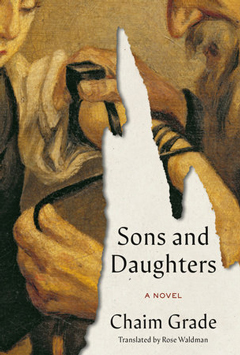 Chaim Grade’s Sons and Daughters transports one brilliantly and completely into the bygone world of the Jewish shtetl, which existed perilously in Poland and Russia between the two world wars. Grade’s vivid descriptive powers evoke this time and place with its Shabbos cholent, tattered prayer books, competitive rabbis, young lovers, patricians and peasants, as well as the ever-present poverty exacerbated by Polish boycotts, the looming threat of pogroms and a bewildering number of political factions, including Russian socialism, Zionism and working-class Bundism. It is an overwhelmingly colourful world, and every page offers the reader an unforgettable immersive experience.
Those who come to this book with nostalgia for the Jewish past will revel in Grade’s origin stories, replete with genealogical roots and the interweaving branches of multiple family trees. This is Grade’s loving depiction of a world that only the readers know—but not his characters—was obliterated so brutally. What a precious legacy the author bequeaths to us, enabling the reader to merge with the communities, to witness their joys and sorrows and the changing circumstances dictated by external forces. All this is rooted in a landscape lovingly described, with willows mournfully trailing their leaves alongside the river, and the stark outline of trees outside the home of Rabbi Sholem Shachne Katzenellenbogen in Morehdalye, one of the many unforgettable characters and shtetls we’re privileged to know. Distinguished, wise and somewhat conservative, he is a respected spiritual leader who, together with his wife Henna’le, clings to the traditional ways of his forefathers, while despairing of his children who choose for themselves different destinies in their changing and challenging world.
It is this momentum of transitioning from one generation to the next that propels this story forward. In Rabbi Katzenellenbogen’s family alone, his children shatter their parents’ fondest hopes and expectations. Every child exemplifies trends diverging from halachic Judaic observance of the time—their youngest, Rafael’ke, whom everyone loves for his kind, gentle nature, trains in an agricultural school in preparation for a secular life on a kibbutz in Israel. His eldest brother, Naftali Hertz, a brilliant yeshivah student, flees to Switzerland, where he writes a doctoral thesis on Baruch Spinoza, marries a Christian woman and raises an uncircumcised son. The Rabbi’s youngest daughter, Bluma Rivtcha, leaves home to study nursing and finds a fiancée of her own choosing, an intellectual but non-observant Jewish poet. The only child who obeys her parents, eldest daughter Tilza, marries a rosh yeshivah her parents have chosen for her, is unhappy in this union and yearns for youthful romantic love.
Their lives are interwoven with those of other families; their characters, strengths and weaknesses, presented in vivid detail, ensuring a multilayered and complex saga that draws the reader into its depths and conveys, quite magically, the textures, sounds, sights and emotions swirling around these people we get to know so intimately.
Grade’s evocation of the shtetl is a superb work of the imagination, grounded in his reverence for the Judaic past and Yiddish culture, and enriched by his rich scholarship and religiosity. He brings this world of Yiddishkeit and the halachic constraints that so many of their youth reject to life. And therein lies the triumph and tragedy, the ambitions and disappointments, the hopes and despair of this world. The desire to perpetuate the beauty and piety of an ancient people conflicts inevitably with new streams of consciousness and belief, such as the secularised observance rooted in the Haskalah, as well as reform practices filtering through from American temples. Also delineated in conversations and arguments are the revolutionary political ideologies and pathways that lure the younger generation away from the precepts and practices of their parents and grandparents. Of course, there are those who accommodate change, while others maintain their vigilance, build a fence around their beloved Torah and their community and refuse steadfastly to compromise—until life effects the changes they resist.
Chaim Grade couldn’t speak English and wrote all his work in Yiddish. As Adam Kirsch points out in his excellent introduction to this newly published edition, Sons and Daughters is probably the last great Yiddish novel. Grade wrote it from the mid-1960s through the mid-1970s and it appeared in serial form in two New York Yiddish newspapers, the Tog-Morge Zhurnal and in Ferverts. As Kirsch notes, the audience for Yiddish fiction was disappearing. In 1978. Grade told an interviewer, ‘It is lonely to have to publish a thousand copies of your own book, and if you sell five hundred of them, you are a best seller’. Although Grade lived in the United States for 34 years, as a non-English speaker he couldn’t really advocate for his work in the way Isaac Bashevis Singer could and did. Hopefully, this translation will introduce Chaim Grade to a new generation of admirers.
Rose Waldman, who grew up in the Satmar community in America and for whom Yiddish is her first language, has translated this edition of Grade’s epic novel with brilliance and great sensitivity. Her English translation and linguistic constructions preserve a musicality and a certain idiomatic flavour, all of which suggest the sounds of a different language and modes of expression. The echo of spoken Yiddish, the beloved mamaloshen, is captured and rendered beautifully giving the text an impressive authenticity. This is a monumental work of translation—all 651 pages—that Waldman has executed with loving and close attention to detail, capturing the myriad descriptive elements that characterise Grade’s writing. Without her dedication and flair, we would be deprived of a marvellous story that compels one’s attention from the first page to the last and also constitutes a magnificent homage to a vanished people and their Middle European culture, erased so tragically in the Holocaust. This rich civilisation, for that is what it was, lives again in Grade’s mesmerising story that pulsates with life.
Aside from the Introduction by Adam Kirsch, there is a helpful ‘Cast of Characters’, and for readers possibly unfamiliar with Yiddish expressions and religious precepts, there is an extensive glossary.
Sons and Daughters
Chaim Grade
Translated from the Yiddish by Rose Waldman
Introduction by Adam Kirsch
Alfred. A. Knopf, New York